Disappearing Superconductivity Reappears -- in 2-D
December 1st, 2008 Disappearing Superconductivity Reappears -- in 2-D

Enlarge

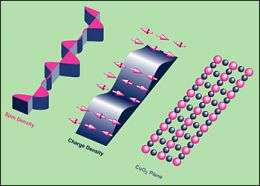
Stripe order in the copper oxide planes involves both a modulation of the charge density (blue), detectable with x-ray diffraction, and a modulation of the arrangement of magnetic dipole moments (spin directions) on copper atoms (magenta arrows), detectable with neutron diffraction.

(PhysOrg.com) -- Scientists studying a material that appeared to lose its ability to carry current with no resistance say new measurements reveal that the material is indeed a superconductor — but only in two dimensions. Equally surprising, this new form of 2-D superconductivity emerges at a higher temperature than ordinary 3-D superconductivity in other compositions of the same material. The research, conducted in part at the U.S. Department of Energy’s (DOE) Brookhaven National Laboratory, will appear in the November 2008 issue of Physical Review B.

“Our basic research goal is to understand why and how these materials act as superconductors,” said Brookhaven physicist John Tranquada, who led the research. “The ultimate practical goal would be to use that understanding to develop improved bulk superconductors — ones that operate at temperatures warm enough to make them useful for real-world applications such as high-efficiency power lines.”

The basic idea behind superconductivity is that electrons, which ordinarily repel one another because they have like charges, pair up to carry electrical current with no resistance. Conventional metallic superconductors do this at temperatures near absolute zero (0 kelvin or -273 degrees Celsius), requiring costly cooling systems. More recently, scientists have discovered materials that transition to superconductivity at higher temperatures, sparking the hope for future room-temperature devices.

Tranquada and his colleagues have been studying a layered material made of lanthanum, barium, copper, and oxygen (LBCO) where the ratio of barium to copper atoms is exactly 1 to 8. At a range of compositions with lower and higher levels of barium, LBCO acts as a “high-temperature” superconductor, with a peak operating temperature of 32 K. But at the mysterious 1:8 ratio, the transition temperature at which superconductivity sets in drops way down toward absolute zero.

This material exhibits another interesting property: an unusual pattern of charge and magnetism known as “stripes,” which many theorists have long assumed was incompatible with superconductivity.

“For a superconductor, you need charges to be paired and moving coherently to carry a current with no resistance. On the other hand, the ‘stripe’ order suggests the charges are localized in relatively fixed positions,” Tranquada explained. So the presence of alternating stripes of magnetism and charge — which are most apparent in the composition with the 1:8 ratio of barium to copper — seems perfectly consistent with the fact that LBCO’s superconductivity “disappears” at exactly that point.

But earlier Brookhaven studies suggest that the stripes do exist in other, superconducting copper oxides, in a way that is more fluid and therefore harder to detect. Now, the latest measurements suggest that a similarly hard-to-detect form of superconductivity occurs in the LBCO 1:8 composition.

One of the key measurements, made by Brookhaven physicist Qiang Li, was of electrical resistance parallel to the planes of the layered material and also perpendicular to them. At a particular temperature, Li detected a big drop in resistance when the current was flowing parallel to the layers, but not when it was flowing perpendicular to them.

At the same time, Brookhaven physicist Markus Hücker, along with Qiang Li, measured the onset of weak “diamagnetism,” an effect in which magnetic fields are pushed out of the sample. “This is one of the key properties of a superconductor — the Meissner effect,” Tranquada said.

Like the drop in resistance, the Meissner effect occurred in only two dimensions, within the planes.

“Combining these results with a variety of other measurements, we now propose that there is a subtle form of superconductivity confined within the two-dimensional planes of copper oxide in LBCO 1:8,” Tranquada said.

“For some reason,” he continued, “the material is unable to coherently couple that superconductivity between the planes. It’s as if you were in a skyscraper where the elevators don’t work and there aren’t any stairs. You can move within the same floor but you can’t get from one floor to the next. That’s the case for the electron pairs in this material; they can’t move from one layer to the next.”

The scientists are particularly intrigued by this new form of 2-D superconductivity because it sets in at an even higher temperature (40 K) than that at which 3-D superconductivity occurs in other forms of LBCO.

“The ultimate practical goal is to find or create superconductors that can operate at room temperature, thus eliminating the need for costly cooling systems. So research aimed at understanding the features that enhance superconductivity is an important step toward designing superconductors that work at higher temperatures,” Tranquada said.

In addition to Tranquada, Hücker, and Li, co-authors on this study include: Genda Gu, Qian Jie, Jinsheng Wen, Guangyong Xu, Zhijun Xu, and Juan Zhou, all of Brookhaven Lab; Hye Jung Kang of the National Institute of Standards and Technology (NIST); Rüdiger Klingeler and Natalia Tristan of the Leibniz Institute for Solid State and Materials Research, Dresden, Germany; and Martin von Zimmermann of HASYLAB, Germany. This study was supported by DOE’s Office of Science (Basic Energy Sciences) and by the U.S. Department of Commerce.

Related stories:
http://www.physorg.com/news65279312.html
http://www.physorg.com/news147.html

Provided by Brookhaven National Laboratory


print this article email this article download pdf blog this article bookmark this article     Digg this Stumble it share on Facebook share on Reddit add to delicious save to Yahoo! bookmarks
4.6/5 after 30 votes

Rank Filter

Move the slider to adjust rank threshold, so that you can hide some of the comments.


Display comments: newest first

  • Assaad33 - Dec 01, 2008
    • Rank: 1 / 5 (2)
    WOW
  • Sean_W - Dec 01, 2008
    • Rank: not rated yet
    Are there any good graphs showing progress in superconductor discoveries (new records set for upper temperature) over time? While I would be surprised to see a consistent curve like the one for computer processing power it would be interesting to see whether the rate of such discoveries have changed markedly or not.
  • thales - Dec 01, 2008
    • Rank: 1 / 5 (1)
    Charting the singularity, eh Sean?
  • Alizee - Dec 01, 2008
    • Rank: 5 / 5 (3)
    You can find such plot for example here:

    http://www.magnet...raph.jpg

    But please don't expect an analogy of Moore's law by now...
  • NeilFarbstein - Dec 01, 2008
    • Rank: 1 / 5 (1)
    what are we supposed to expect eh?
  • Alexa - Dec 02, 2008
    • Rank: 1 / 5 (1)
    what are we supposed to expect eh?
    Well, existence of stripes couldn't be presented as "unusual pattern of charge and magnetism incompatible with superconductivity", because exactly the opposite is known for years. This is example of artificial fabrication of false discoveries.

December 1st, 2008 all stories
Physics / Superconductivity

Comments: 6
Rank: 4.6/5 after 30 votes

  • Stumble this up

  • Digg this

  • Share it:
  • share on Facebook
  • share on MySpace
  • share on Slashdot
  • rss-newsfeed
  • share on Google
  • share on Reddit
  • add to delicious
  • save to Yahoo! bookmarks
  • share on Windows Live
  • Add to Mixx!
Rating: 4.6/5 after 30 votes

  • Related Stories

  • Putting the Pressure on Iron-Based Superconductors
    created Mar 05, 2009 | popularity not rated yet | comments 0
  • Physicists discover surprising variation in superconductors
    created Jan 28, 2009 | popularity not rated yet | comments 0
  • Electron pairs precede high-temperature superconductivity
    created Nov 05, 2008 | popularity not rated yet | comments 0
  • Scientists reveal effects of quantum 'traffic jam' in high-temperature superconductors
    created Aug 27, 2008 | popularity not rated yet | comments 0
  • A 'squeeze' in cuprates may explain superconducting temperatures
    created May 07, 2008 | popularity not rated yet | comments 0


  • Physicists Demonstrate Quantum Memory with Matter Qubits
    Physicists Demonstrate Quantum Memory with Matter Qubits
    Physics / General Physics
    created Jul 03, 2009 | popularity 4.4 / 5 (17) | comments 1
  • 'Holey' Nanosheets for Wastewater Dye Removal
    Nanotechnology / Nanomaterials
    created Jul 01, 2009 | popularity 5 / 5 (5) | comments 1
  • Jellyfish Robot Swims Like its Biological Counterpart
    Jellyfish Robot Swims Like its Biological Counterpart
    Electronics / Robotics
    created Jun 26, 2009 | popularity 4.4 / 5 (8) | comments 1
  • Could Maxwell's Demon Exist in Nanoscale Systems?
    Could Maxwell's Demon Exist in Nanoscale Systems?
    Physics / General Physics
    created Jun 24, 2009 | popularity 4.4 / 5 (18) | comments 29
  • Living Safely with Robots, Beyond Asimov's Laws
    Living Safely with Robots, Beyond Asimov's Laws
    Electronics / Robotics
    created Jun 22, 2009 | popularity 4.6 / 5 (53) | comments 40
  • Other News

    UQ researchers break the law -- of physics

    Physics / General Physics

    created 5 hours ago | popularity 4.7 / 5 (9) | comments 0

    (PhysOrg.com) -- Two UQ Science researchers have proved two famous physical laws that have been widely used for the past 25 years do not always work.


    Scientists create first electronic quantum processor

    Scientists create first electronic quantum processor

    Physics / General Physics

    created Jun 28, 2009 | popularity 4.8 / 5 (54) | comments 42

    A team led by Yale University researchers has created the first rudimentary solid-state quantum processor, taking another step toward the ultimate dream of building a quantum computer.


    Science journals

    How to Spot an Influential Paper Based on its Citations

    Physics / General Physics

    created Jul 04, 2009 | popularity 3.9 / 5 (10) | comments 6

    (PhysOrg.com) -- At first it may seem that the number of citations received by a published scientific paper is directly related to that paper's quality of content. The higher the quality, the more people read ...


    Fermilab's CDF observes Omega-sub-b baryon

    Fermilab's CDF observes Omega-sub-b baryon

    Physics / General Physics

    created Jun 29, 2009 | popularity 4.7 / 5 (18) | comments 7

    (PhysOrg.com) -- At a recent physics seminar at the Department of Energy’s Fermi National Accelerator Laboratory, Fermilab physicist Pat Lukens of the CDF experiment announced the observation of a new particle, ...


    New insights, and a new angle, on high-temperature superconductivity

    New insights, and a new angle, on high-temperature superconductivity

    Physics / Superconductivity

    created Jun 29, 2009 | popularity 4.9 / 5 (14) | comments 7

    (PhysOrg.com) -- A Princeton-led research team has revealed surprising information about how electron behavior influences the conduction of electricity in a class of high-temperature superconductors. An increased ...