Brown chemist finds gray mold's killer gene
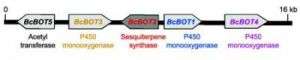
December 1, 2008 Deadly Five-gene Cluster

Enlarge

"The metabolic pathways for creating organic compounds typically involve gene clusters, like a package. One great advantage to our investigation is that if you find one gene for the manufacture of these organic compounds, you look to the left or to the right, and you find the others." Image: David Cane

Gray mold is a gardener's nightmare. The fungus, also known by its scientific name Botrytis cinerea, is a scourge to more than 200 agricultural and ornamental plant species, including staples such as tomatoes, strawberries, snap and lima beans, cabbage, lettuce and endive, peas, peppers, and potatoes. Gray mold envelops its target in a velvety vise, releasing a toxin that poisons the host plants' cells, eventually causing the plant to die.

So far, the only way to eliminate the pathogen is to spray plants with fungicides, which can be costly and can contaminate the surrounding environment.

Now Brown University chemist David Cane, working with researchers in France and Spain, has figured out how the fungus's deadly toxin is made and how it might be disarmed naturally. In a paper published online in ACS Chemical Biology, the scientists have identified the set of genes that manufactures the toxin and in particular the central gene the fungus uses for this synthesis. They also have also shown that shutting off this gene by interrupting the fungus's DNA completely shuts down toxin production, removing the special weapon the mold uses to kill and invade target plant cells.

"It's a big step to being able to disarm this toxin naturally through a combination of DNA sequencing and chemistry," said Cane, the Vernon K. Krieble Professor of Chemistry and professor of biochemistry, one of three primary authors of the paper.

The researchers, led by French scientist and paper co-author Muriel Viaud, started by determining the complete DNA sequence for Botrytis cinerea. Working with Spanish organic chemist and paper co-author Isidro Collado, the scientists focused on the chemical agent — botrydial — that gray mold uses to overwhelm host plants.

From among the roughly 9,000 genes present in gray mold, the researchers identified a cluster of five genes that is responsible for production of botrydial. They then sought to learn how this cluster manufactures the chemical agent and which of the genes was the mastermind in the production.

The culprit is an enzyme called a sesquiterpene cyclase, Cane's laboratory found.

"The metabolic pathways for creating organic compounds typically involve gene clusters, like a package," Cane explained. "One great advantage to our investigation is that if you find one, you look to the left or to the right, and you find the others."

In laboratory tests, Cane and the team introduced a mutant gene that deleted the sesquiterpene cyclase, which completely abolished production of the toxin.

"This means that if you can inhibit the enzyme from this pathway, you can eliminate this toxin," Cane said.

The team now is working on a similar procedure to tackle a strain of Botrytis cinerea that is able to produce both botrydial and a second toxin that it uses to attack its plant targets.

Source: Brown University


print this article email this article download pdf blog this article bookmark this article     Stumble it Digg this share on Facebook retweet share on Reddit add to delicious
Rate this story - 4.5 /5 (2 votes)

Rank Filter

Move the slider to adjust rank threshold, so that you can hide some of the comments.


Display comments: newest first

  • D666 - Dec 02, 2008
    • Rank: not rated yet
    Now if they can just figure out tomato blight, all will be well with the universe...

December 1, 2008 all stories

Comments: 1

4.5 /5 (2 votes)
  • Stumble this up

  • Digg this

  • share this

  • hide
  • Related Stories

  • Advance in the battle against 'gray mold'
    created Dec 15, 2008 | popularity not rated yet | comments 0
  • Trigger of deadly food toxin discovered
    created Oct 21, 2009 | popularity not rated yet | comments 0
  • Gene that governs toxin production in deadly mold found
    created Apr 13, 2007 | popularity not rated yet | comments 0
  • Nanoparticles for gene therapy improve
    created Nov 06, 2009 | popularity not rated yet | comments 0
  • Venomous bite: Harmless digestive enzyme evolved into venom in two species
    created Oct 29, 2009 | popularity not rated yet | comments 0


Other News

Telling an old book by its smell: Aroma hints at ways of preserving treasured documents

Telling an old book by its smell: Aroma hints at ways of preserving treasured documents

Chemistry / Analytical Chemistry

created 8 hours ago | popularity not rated yet | comments 0

Scientists may not be able to tell a good book by its cover, but they now can tell the condition of an old book by its odor. In a report published in the American Chemical Society's Analytical Chemistry they d ...


H1N1 Virus Can Be Killed by Acidic Ozone Water

H1N1 Virus Can Be Killed by Acidic Ozone Water

Chemistry / Biochemistry

created Nov 09, 2009 | popularity 4.8 / 5 (22) | comments 10

(PhysOrg.com) -- Scientists have found that acidic ozone water can deactivate H1N1 viruses very effectively, offering a promising disinfectant for the millions of people trying to avoid the disease. Acidic ...


Toward home-brewed electricity with 'personalized solar energy'

Toward home-brewed electricity with 'personalized solar energy'

Chemistry / Materials Science

created Nov 04, 2009 | popularity 3.4 / 5 (9) | comments 5

New scientific discoveries are moving society toward the era of "personalized solar energy," in which the focus of electricity production shifts from huge central generating stations to individuals in their ...


New imagining technique could lead to better antibiotics and cancer drugs

Chemistry / Biochemistry

created Nov 09, 2009 | popularity 5 / 5 (3) | comments 0

A recently devised method of imaging the chemical communication and warfare between microorganisms could lead to new antibiotics, antifungal, antiviral and anti-cancer drugs, said a Texas AgriLife Research scientist.


Wet ethanol production process yields more ethanol and more co-products

Chemistry / Biochemistry

created Nov 09, 2009 | popularity 1 / 5 (1) | comments 1

Using a wet ethanol production method that begins by soaking corn kernels rather than grinding them, results in more gallons of ethanol and more usable co-products, giving ethanol producers a bigger bang for their buck - ...