Surprise discovery made in cancer research
December 1, 2008
Surprise discovery made in cancer research

Enlarge

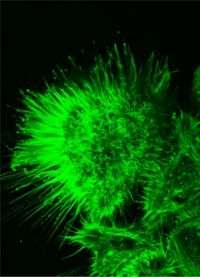
Reducing the expression of some inhibitors of apoptosis (IAPs) led to changes in cell shape and migration. Credit: Krishnaraj Rajalingam

One of the defining characteristics of cancer cells is that they systematically prevent programmed cell death (apoptosis), with which the body guards itself against the proliferation of defective cells. In order to do this, they express so-called apoptosis inhibitors (IAPs) among other proteins.

Many of the cancer drugs currently undergoing clinical trials target IAPs, since if the levels of IAPs are reduced, tumour cells will be destroyed by the body's own self-protecting mechanism or by the chemotherapeutic drugs. However, as a research group from the Goethe University in Frankfurt, working with scientists at the Universities of Würzburg and Philadelphia have recently discovered, IAPs also have another life: they control cell migration.

Where IAP production is suppressed, there is a significant increase in C-RAF kinase, a crucial member of a signal cascade, which, among other functions, controls cell migration. This also means that when IAP levels are reduced, metastasis may be promoted unexpectedly in the absence of cell death. According to the researchers, drugs to target IAPs should therefore only be used with caution in future.

Dr. Krishnaraj Rajalingam, leader of the Emmy-Noether Group at the Institute for Biochemistry at Frankfurt's Goethe University, claims that these findings have been a great surprise. As he puts it: "Up until now, IAPs were well known for their role in apoptosis suppression, but we now realise that they can also influence other processes like cell migration". The classical mitogenic cascade (MAPK) is triggered by RAS proteins, which are activated by mutations in nearly 20 % of all human tumours. In this signalling cascade, the RAS-protein is immediately followed by the C-RAF kinase, which – as the researchers report in the current issue of 'Nature Cell Biology' – binds strongly to an apoptosis inhibitor (XIAP).

"If we reduce the expression of some IAPs by RNA interference technique, C-RAF kinase increases in both the healthy and the cancerous human cells. As a consequence, the cells alter their form and start to move faster." Co-author Prof. Ulf R. Rapp from the University of Würzburg, who discovered C-RAF kinase 25 years ago, claims that these findings will have a significant influence on cancer therapy.

Prof. Werner-Müller Esterl, Director of Frankfurt's Institute for Biochemistry II and the President-elect of the Goethe University, is delighted by the success of his young colleague, who took up his post at the university only a few months ago. "These are very exciting results and with such an early success, our new Emmy Noether Group has proved that the University's programme of supporting young independent scientific investigators has once again paid off."

Source: Goethe University Frankfurt, Germany

4.5 /5 (6 votes)  

Rank 4.5 /5 (6 votes)
Relevant PhysicsForums posts
  • Is Everyday Technology Killing Us?
    createdFeb 08, 2012
  • Exercise and weight loss
    createdFeb 08, 2012
  • Why do we have head aches? Our brains can't feel anything.
    createdFeb 07, 2012
  • "The end of diseases" by David Agus, interview from Daily Show with Jon Stewart
    createdFeb 04, 2012
  • Oncolytic adenovirus
    createdFeb 04, 2012
  • Nutrition label stuffs and diets
    createdFeb 02, 2012
  • More from Physics Forums - Medical Sciences

More news stories

New ability to regrow blood vessels holds promise for treatment of heart disease

(Medical Xpress) -- University of Texas at Austin researchers have demonstrated a new and more effective method for regrowing blood vessels in the heart and limbs — a research advancement that could have ...

Medicine & Health / Research

created 27 minutes ago | popularity 5 / 5 (3) | comments 0 | with audio podcast

New tumor suppressor gene identified

A recent study published in Clinical Cancer Research suggests that the protein hVps37A suppresses tumor growth in ovarian cancer. The work, which was funded by the Austrian Science Fund FWF, shows, for th ...

Medicine & Health / Cancer

created 1 hour ago | popularity 4.7 / 5 (3) | comments 0

Motivation to exercise affects behavior

(Medical Xpress) -- For many people, the motivation to exercise fluctuates from week to week, and these fluctuations predict whether they will be physically active, according to researchers at Penn State. In an effort to ...

Medicine & Health / Health

created 17 minutes ago | popularity not rated yet | comments 0 | with audio podcast

'It's not nutritious until it's eaten'

As part of her "Let's Move! Initiative," First Lady Michelle Obama unveiled a new web resource highlighting new changes in the Chefs Move to Schools, during a CMST gathering in Dallas, TX today. CMTS advocates ...

Medicine & Health / Health

created 4 minutes ago | popularity not rated yet | comments 0

Packard Children's has smallest child yet to get pacemaker

Jaya Maharaj was 15 minutes old when she was sent to surgery at Lucile Packard Children’s Hospital and given a pacemaker that saved her life. The tiny girl — born nine weeks early, weighing 3.5 pounds, ...

Medicine & Health / Cardiology

created 56 minutes ago | popularity not rated yet | comments 0


Fast photon control brings quantum photonic technologies closer

(PhysOrg.com) -- Using photons instead of electrons to transmit information could lead to faster and more secure ways to communicate, among other advantages. Now a team of physicists has taken another step toward realizing ...

Transforming galaxies

(PhysOrg.com) -- Many of the Universe's galaxies are like our own, displaying beautiful spiral arms wrapping around a bright nucleus. Examples in this stunning image, taken with the Wide Field Camera 3 on ...

'Smart' microcapsules in a single step

(PhysOrg.com) -- A new, single-step method of fabricating microcapsules, which have potential commercial applications in industries including medicine, agriculture and diagnostics, has been developed by researchers ...

A continent ablaze in auroral and manmade light

The North American continent is literally set ablaze in a confluence of Auroral and Manmade light captured in spectacular new videos snapped by the astronauts serving aboard the International Space Station ...

Nanostructured electrodes for rechargeable sodium-Ion batteries

Highly efficient 3V cathodes for rechargeable sodium-ion batteries have been developed by users from Argonne National Laboratory's Materials Science, Chemical Sciences & Engineering, and X-ray Sciences Divisions, ...

A lost world? How zooarchaeology can inform biodiversity conservation

A new study of tropical forests will provide a 50,000-year perspective on how animal biodiversity has changed, explored through an archaeological investigation of animal bones.