New movement models tested at the Smithsonian in Panama
Feeling threatened? Hungry? Looking for a mate? Move! Tracking and remote sensing data are making it easier to locate organisms and find out what they are up to. However, general theories of movement are lacking. In a special feature on Movement Ecology in the journal Proceedings of the National Academy of Sciences, researchers present integrative models for movement of organisms as diverse as gut bacteria, tree seeds, ants, marine larvae and cheetahs.
"Our goal is to develop and test a general theoretical framework for movement that will integrate when, where, how and why organisms move, and will reveal the ecological and evolutionary consequences of movement," says Ran Nathan, research associate at the Smithsonian Tropical Research Institute and associate professor of Evolution, Systematics and Ecology at the Hebrew University of Jerusalem.
To ensure that mathematical models accurately predict real events, several have been developed and tested in complex tropical forest at the Smithsonian's Barro Colorado Island research station in Panama.
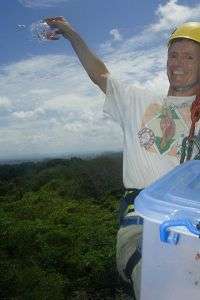
One of these is a new model for seed dispersal by wind, which accurately predicts tree seed movement under a wide range of conditions. Because trees can't simply pull up their roots and move in response to climate change or other threats, accurate modeling of tree seed dispersal has major implications for conservation across fragmented ecosystems and for understanding biological diversity.
"We add two entirely new things to this model: First, we consider dispersal in two dimensions, so that we can tell how close seeds fall to siblings who are potential competitors and sources of pests and disease. Previous investigators only considered the distance seeds moved," said S. Joseph Wright, staff scientist at the Smithsonian in Panama. "In the end, we show that the direction of a seed's fall can compensate for large differences in distance moved: the ability of individual seeds and whole groups of trees to move across a landscape is a result of trade-offs with other traits that affect their survival."
The Movement Ecology special feature also includes links to Movebank, an online data repository developed by researchers who would like to contribute and have access to animal tracking data. Movebank is the brainchild of Roland Kays, curator of mammals at the New York Museum in Albany; Martin Wikelski, director of the Max Planck Institute for Ornithology; Tony Fountain, director of the Knowledge and Information Discovery Lab and Sameer Tilak, member of the Cyberinfrastructure Lab for Environmental Observing Systems at the UC San Diego Supercomputer Center.
Wikelski and Kays are also research associates at the Smithsonian Tropical Research Institute, where they set up a multi-user Automated Radio Telemetry System on the large forest dynamics plot on Barro Colorado Island. The system tracks up to 200 animals, seeds or other moving objects around the clock, and makes data available on the Web.
Sensor systems mounted on satellites and on the ground will deliver increasing quantities of information about the changing location of organisms through time. An integrated Movement Ecology paradigm strengthens the ability of researchers to decide which information matters from a biological point of view and to make predictions essential to understanding phenomena from the spread of infectious diseases to habitat use by migratory birds.
Reference: S. Joseph Wright, Ana Trakhtenbrot, Gil Bohrer, Matteo Detto, Gabriel G. Katul, Nir Horvitz, Helene C. Muller-Landau, Frank A. Jones, Ran Nathan. 2008. Understanding strategies for seed dispersal by wind under contrasting atmospheric conditions. PNAS online, week of Dec. 1-5, 2008.
Source: Smithsonian Tropical Research Institute


