New holographic method could be used for lab-on-a-chip technologies
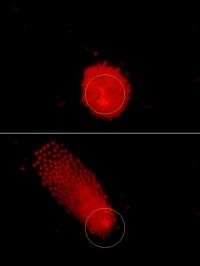
Researchers at Purdue University have developed a technique that uses a laser and holograms to precisely position numerous tiny particles within seconds, representing a potential new tool to analyze biological samples or create devices using nanoassembly.
The technique, called rapid electrokinetic patterning, is a potential alternative to existing technologies because the patterns can be more quickly and easily changed, said mechanical engineering doctoral student Stuart J. Williams.
"It's potentially a very versatile tool," said Williams, who is working with doctoral student Aloke Kumar and Steven T. Wereley, an associate professor of mechanical engineering.
The research is based at the Birck Nanotechnology Center in Purdue's Discovery Park.
The students won a research award for their work in October during the 12th International Conference on Miniaturized Systems for Chemistry and Life Sciences in San Diego. Four young researcher poster awards were selected out of more than 220 posters judged in the contest. Findings also have been recently published in two peer-reviewed journals, Lab on a Chip and Microfluidics and Nanofluidics.
The experimental device consists of two parallel electrodes made of indium tin oxide, a transparent and electrically conductive material. The parallel plates were spaced 50 micrometers, or millionths of a meter, apart, equivalent to two-thousandths of an inch or about the diameter of a human hair. A liquid sample containing fluorescent beads was injected between the two electrodes, a laser in the near infrared range of the spectrum was shined through one of the transparent electrodes and a small electrical voltage was applied between the two electrodes.
"We send holograms of various patterns through this and, because they are holograms, we can create different shapes, such as straight lines or L patterns," Kumar said.
The particles in the liquid sample automatically move to the location of the light and assume the shape of the hologram, meaning the method could be used to not only move particles and molecules to specific locations but also to create tiny electronic or mechanical features.
"It's a very dynamic system, so we can change this pattern quickly," Kumar said.
The light heats up the liquid sample slightly, changing its density and electrical properties. The electric field applied to the plates acts on these altered properties, causing the heated sample to circulate, much like heated air causes convection currents in the atmosphere, producing a donut-shaped "microfluidic vortex" of circulating liquid between the two plates.
This vortex enables the researchers to position the particles in the circulating liquid by moving the laser light.
"You could take one particle, a hundred particles or a thousand particles and move them anywhere you want in any shape that you want," Williams said. "If you have particles of two different types, you can sort one group out and keep the other behind. It's a versatile tool."
Separating particles is important for analyzing medical and environmental samples. The system could allow researchers to design sensor technologies that move particles to specific regions on an electronic chip for detection or analysis.
The technique overcomes limitations inherent in two existing methods for manipulating particles measured on the scale of nanometers, or billionths of a meter. One of those techniques, called optical trapping, uses a highly focused beam of light to capture and precisely position particles. That technique, however, is able to move only a small number of particles at a time.
The other technique, known as dielectrophoresis, uses electric fields generated from metallic circuits to move many particles at a time. Those circuit patterns, however, cannot be changed once they are created.
The new method is able to simultaneously position numerous particles and be changed at a moment's notice simply by changing the shape of the hologram or the position of the light.
"If you want to pattern individual particles on a massive scale using electrokinetic methods as precisely as we are doing it, it could take hours to days, where we are doing it in seconds," Williams said.
The method offers promise for future "lab-on-a-chip" technology, or using electronic chips to analyze biological samples for medical and environmental applications. Researchers are trying to develop such chips that have a "high throughput," or the ability to quickly detect numerous particles or molecules, such as proteins, using the smallest sample possible.
"For example, a single drop of blood contains millions of red blood cells and countless molecules," Williams said. "You always want to have the smallest sample possible so you don't generate waste and you don't have to use as many chemicals for processing the sample. You want to have a very efficient high throughput type of device."
So-called "optical tweezers" use light to position objects such as cells or molecules.
"You can't use mechanical tweezers to move things like molecules because they are too delicate and will be damaged by conventional tweezers," Kumar said. "That is why techniques like optical tweezing and dielectrophoresis are very popular."
The students also have designed an experiment containing one indium tin oxide plate and one gold plate, an important development because gold is often used in biomedical applications.
"It's a technique that you would likely use in sensors, but we also see definite potential ways in which you could use it to manufacture devices with nanoassembly," Wereley said. "But it's really too soon to talk about scaling this up in a manufacturing setting. We're just beginning to develop this technique."
The researchers recorded videos of the circulating particles to document the effect. A video showing the effect was selected as an outstanding entry during a meeting of the American Physical Society in November. The video can be accessed at ecommons.cornell.edu/handle/1813/11399 .
"This technique has not been done before," Williams said. "We can pattern light, we can pattern particles, we can pattern the vortex. No other tool can do all of these."
The researchers demonstrated how the method could be used to cause particles to stick permanently to a surface in a single crystalline layer, a structure that could be used in manufacturing. They used their technique to move fluorescent-dyed beads of polystyrene, latex and glass in sizes ranging from 50 nanometers to 3 micrometers.
Future work may involve using a less expensive light source, such as a common laser pointer, which could not be used to create intricate patterns but might be practical for manufacturing.
Source: Purdue University


