Ship-in-a-bottle kit on a microchip
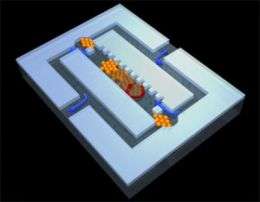
(PhysOrg.com) -- Sometimes physicists resort to tried and trusted model-making tricks. Scientists at the Max Planck Institute for Metals Research, the University of Stuttgart and the Colorado School of Mines have constructed micromachines using the same trick that model makers use to get ships into a bottle where the masts and rigging of the sailing ship are not erected until it is in the bottle. In the same way, the scientists link the valves, pumps and stirrers of a microlaboratory to create a micro device on a chip. To do this, they introduce colloidal particles - tiny magnetizable plastic spheres - as components into the channels on the chip. A rotating magnetic field is used to link the components into larger aggregates and set them into motion as micromachines. (Proceedings of the National Academy of Sciences (PNAS), December 2, 2008)
In the future, biologists and chemists want to avoid using bulky glass flasks, Bunsen burners and magnetic stirrers as far as possible in their experiments. Similarly to microelectronics, where electrons are steered through tiny conducting paths, they intend to perform chemical reactions in microfluidic systems, that is, chambers and channels just a few micrometers in diameter.
These "labs on a chip" will then allow DNA sequences or blood samples to be analyzed much more quickly and more efficiently. As they only require tiny amounts of liquids, this approach costs much less than traditional methods, which require larger quantities of materials. These micro analytical systems would also be transportable, because their core parts take up very little space. Paramedics, for example, could analyze blood samples at the site of an accident.
Researchers working with Clemens Bechinger who is a Professor at the University of Stuttgart and a Fellow at the Max Planck Institute for Metals Research, and David Marr, a professor at the Colorado School of Mines, have now found a new way to equip these miniaturized laboratories with moving parts and how to drive the tiny machines. They introduce colloidal particles, tiny plastic spheres with a diameter of just about five micrometers, into the channels and cavities on the chip.
As the particles contain iron oxide, they group together when they are magnetized by an external magnetic field. The scientists construct the magnetic field with four coils so that the microparticles are literally remote controlled and form diamond shapes or cog wheels. "The shape they assemble into depends crucially on the geometry of the channels," explains Tobias Sawetzki, who a doctoral student is working on the project. The microparticles then remain in this shape as long as the magnetic field is switched on.
The geometry also determines the function of the aggregates. By tipping backwards and forwards, a rhombus creates openings and acts like a valve. On the other hand, if it rotates in a chamber with two inflows, it mixes the incoming liquids. The micro stirrer is also driven by a magnetic field that rotates clockwise or anticlockwise parallel to the chip. In the same way, the researchers in Stuttgart roll a cog wheel through a channel with a serrated wall. The cog wheel, which completely shuts the channel off, agitates liquid back and forth and only in combination with two valves, acts like a pump.
"Compared to other approaches to equipping microlaboratories with moving parts, our ship-in-a-bottle technique has several advantages," says David Marr. Some scientists use pneumatic systems to pump liquids through microchannels, for example. However, this requires each component to be connected with a separate hose to the outside so that it can be supplied with compressed air. This is very complex and limits the integration density on microfluidic devices considerably, i.e. the total number of components on the chip.
With the new method, it is possible to accommodate up to 5,000 pumps on one square centimetre. Moreover, the new approach does not rely on elastic materials as are required for pneumatic pumps. "It is much easier to produce suitable chips for applications if they only consist of a single material, silicon, if at all possible," says Clemens Bechinger. As the electrical control components like the mini-coils can be fabricated based on silicon, it would be ideal to make the microchannels from the same material. This would allow for integration of all the components on one chip, as in microelectronics," says Bechinger.
Currently the researchers are still using large coils, so that all the components are driven by a single magnetic field and they all move in time with each other. However, this need not be a disadvantage as processes in many applications run in parallel; for example when the pharmaceutical industry searches for a new active ingredient amongst many thousands of substances. Furthermore, the researchers can choose the geometry of the channels so skilfully that different aggregates fulfil completely different functions in the same magnetic field. This means that the Stuttgart physicists' method offers the option of driving a complex network of individual, standalone components with only one magnetic field.
Citation: Tobias Sawetzki, Sabri Rahmouni, Clemens Bechinger, David W.M. Marr, In-Situ Assembly of Linked Geometrically-Coupled Microdevices, Proceedings of the National Academy of Sciences (PNAS), December 2, 2008
Video available: Microspheres in a magnetic field (mpg-Video: 3.2 MB) www.mpg.de/video/107819s.mpg
Provided by Max Planck Society


