Replacing corn with perennial grasses improves carbon footprint of biofuels
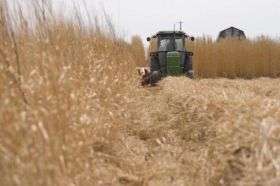
Converting forests or fields to biofuel crops can increase or decrease greenhouse gas emissions, depending on where – and which – biofuel crops are used, University of Illinois researchers report this month.
The researchers analyzed data from dozens of studies to determine how planting new biofuel crops can influence the carbon content of the soil. Their findings appear this month in the journal Global Change Biology Bioenergy.
Plants use the sun's energy to convert carbon dioxide from the atmosphere into the organic carbon that makes up leaves, stems and other plant parts. As plants decay, this carbon goes into the soil. Organic carbon is an important component of soil health and also influences atmospheric carbon dioxide levels. Whenever the soil is disturbed, as occurs when land is plowed or cleared of vegetation, some of this carbon returns to the atmosphere in the form of carbon dioxide.
"From the time that John Deere invented the steel plow, which made it possible to break the prairie sod and begin farming this part of the world, the application of row crop agriculture to the Midwest has caused a reduction of soil carbon of about 50 percent," said Evan DeLucia, a professor of plant biology at Illinois and corresponding author on the new study.
Any debate on the environmental consequences of using plants to produce liquid fuels should also consider how each option affects soil carbon, DeLucia said.
"The biggest terrestrial pool of carbon is in the soil. The top meter of soil holds more than three times the amount of carbon stored in either vegetation or the atmosphere, so if you do little things to change the amount of carbon in the soil it has a huge impact on the atmosphere and thus global warming."
Unlike corn, which must be replanted every year, perennial grasses such as switchgrass and Miscanthus preserve and increase carbon stores in the soil. These and other grasses have been proposed as high-energy alternative feedstocks for biofuel production.
Currently, ethanol is produced by fermenting the starch in corn kernels, but significantly more liquid fuel energy can be harvested from the stems and leaves of plants. The technology for producing this "cellulosic" ethanol is still quite expensive, but many believe that it will displace corn ethanol as the technology advances.
About 20 percent of the corn crop currently goes into ethanol production in the U.S., DeLucia said, "so we began with the hypothesis that it might be good for soil carbon to put a perennial biofuel crop on the landscape instead of corn."
The researchers analyzed published estimates of changes in soil organic carbon in landscapes converted from natural or agricultural land to biofuel crops. They focused on corn, sugar cane, Miscanthus, switchgrass and native prairie grasses. They also evaluated the impact of harvesting and using corn stover (the plant debris left over after corn is harvested) as a cellulosic biofuel source.
Their analysis showed that converting native land (grassland or forest) to sugarcane dramatically reduced soil carbon, creating a carbon deficit that would take decades to repay. While perennial grasses add carbon to the soil each year, DeLucia said, it could take up to a century for the sugar cane to rebuild soil carbon to former levels on native land.
Harvesting the corn residue for cellulosic ethanol production also reduced the carbon in the soil. The more plant residue was removed, the more the soil carbon declined.
Planting perennial grasses on existing agricultural lands had the most beneficial effect on soil carbon, the researchers found. Although there was an initial drop in carbon as fields were converted from corn to Miscanthus, switchgrass or native perennial grasses, the loss was fairly quickly offset by yearly gains in soil carbon as the grasses became established.
"Consistent with our hypothesis, the perennial feedstocks like Miscanthus and switchgrass start building soil carbon very, very early on," DeLucia said. "From a purely carbon perspective, our research indicates that putting perennial biofuel crops on landscapes that are dominated by annual row crops will have a positive effect on soil carbon."
The finding "seems to walk you right into the food for fuel debate," DeLucia said, referring to the controversy over using agricultural land for fuel production. But because the U.S. is already devoting about 20 percent of its corn crop to ethanol production, he said, it would make sense to eventually use that land to produce a much higher yielding biofuel feedstock that has the added benefit of increasing organic carbon in the soil.
Source: University of Illinois at Urbana-Champaign


