These shells don't clam up: Innovative technique to record human impact on coastal waters
December 2, 2008 Mercenaria mercenaria Have Tales to Tell

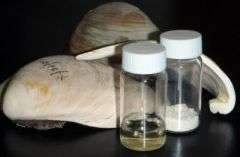
Stable isotope techniques used on Mercenaria mercenaria have yielded valuable information on wastewater inputs in coastal waters. Credit: Dr. Ruth Carmichael, Dauphin Island Sea Lab

With their sedentary lifestyles and filter-feeding habits, clams have been silent witnesses to the changes that humans have inflicted upon their waters. These clams are silent no more, as Dr. Ruth H. Carmichael of the Dauphin Island Sea Lab and her colleagues have reported in their recent paper in Aquatic Biology.

Using stable isotope techniques, Carmichael demonstrated it is possible to identify and trace wastewater inputs to estuaries and coastal food webs by studying the organic matrix in the shell of the hard clam Mercenaria mercenaria.

This work presents a novel application of established biochemical techniques that can be applied to refine diet analyses for shellfish, trace nitrogen entry to coastal waters relative to changes in urbanization or climate, and help discern natural from human-driven influences on coastal ecosystems.

Using this new technique will allow coastal researchers and managers to document increases in waste loadings to coastal waters over longer periods of environmental change.

"This technique is exciting because it gives scientists and coastal managers a way to look into the past and trace human influences, in this case wastewater pollution, into local waters and ultimately into the organisms living there," said Dr. Carmichael. "Tools that help us define and trace specific sources of human-influence on our coastal waters are essential to inform management and future research efforts."

Source: Dauphin Island Sea Lab


print this article email this article download pdf blog this article bookmark this article     Stumble it Digg this share on Facebook retweet share on Reddit add to delicious
Rate this story - 4.3 /5 (3 votes)


December 2, 2008 all stories

Comments: 0

4.3 /5 (3 votes)
  • Stumble this up

  • Digg this

  • share this

  • hide
  • Related Stories


Other News

Beyond sunlight: Explorers census 17,650 ocean species between edge of darkness and black abyss

Beyond sunlight: Explorers census 17,650 ocean species between edge of darkness and black abyss (w/ Video)

Biology / Plants & Animals

created 7 hours ago | popularity 5 / 5 (4) | comments 0

Census of Marine Life scientists have inventoried an astonishing abundance, diversity and distribution of deep sea species that have never known sunlight - creatures that somehow manage a living in a frigid ...


Rare Charles Darwin book found on toilet bookshelf (AP)

Rare Charles Darwin book found on toilet bookshelf

Biology / Other

created 6 hours ago | popularity 5 / 5 (1) | comments 0

(AP) -- An auction house says it is selling a rare first edition of Charles Darwin's "On the Origin of Species" found in a family's guest lavatory in southern England.


Bigger not necessarily better, when it comes to brains

Bigger not necessarily better, when it comes to brains

Biology / Plants & Animals

created Nov 17, 2009 | popularity 4.5 / 5 (19) | comments 11

(PhysOrg.com) -- Tiny insects could be as intelligent as much bigger animals, despite only having a brain the size of a pinhead, say scientists at Queen Mary, University of London.


Extinct goat Myotragus balearicus

Extinct goat was cold-blooded

Biology / Plants & Animals

created Nov 18, 2009 | popularity 4.9 / 5 (34) | comments 10

(PhysOrg.com) -- An extinct goat that lived on a barren Mediterranean island survived for millions of years by reducing in size and by becoming cold-blooded, which has never before been discovered in mammals.


Right-handed chimpanzees provide clues to the origin of human language

Biology / Plants & Animals

created Nov 16, 2009 | popularity 3 / 5 (1) | comments 7

Most of the linguistic functions in humans are controlled by the left cerebral hemisphere. A study of captive chimpanzees at the Yerkes National Primate Research Center (Atlanta, Georgia), reported in the January 2010 issue ...