Innovative MRI-based technique
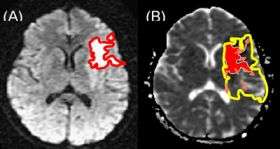
(PhysOrg.com) -- A new approach to the early prediction of the evolution of cerebral infarcts caused by stroke has just been evaluated on nearly 100 patients. The NEURiNFARCT technique yields an estimate of the final extent of brain tissues at risk of infarction for acute stroke patients.
This new technique is derived from unprecedented analysis of Magnetic Resonance Imaging (MRI) data. The approach results from the collaboration of the Cognitive Neuroscience & Brain Imaging Laboratory of the French National Center for Scientific Research (CNRS), the Neuroradiology Department and the Acute Stroke Centre of the Pitié-Salpêtrière General Hospital in Paris France.
The results of the study from Charlotte Rosso and her coauthors – which are published online on the Radiology journal web site – demonstrate how this new technique may help predict within minutes the severity of stroke infarcts using a conventional clinical MR scanner.
NEURiNFARCT is a new technique for the identification of the “ischemic penumbra”, a region which is rapidly developing within the next few hours after stroke onset and may conduct to severe irreversible brain lesions. Contrarily to the zone of initial infarct, the penumbra region may be saved during the early acute phase of stroke – and therefore the risk of subsequent deficits for the patients may be reduced - using thrombolytic medication, though this treatment has its share of possible secondary hemorrhagic complications.
Early evaluation of the severity of stroke could therefore help assist the necessary fast therapeutic decision-making process. This challenge has fostered the research project from which NEURiNFARCT has originated. Existing MRI-based approaches necessitated the injection of a contrast agent, something NEURiNFARCT could make become obsolete as the new technique only necessitates basic routine diffusion MR image sequences.
The diffusion data measure the mobility of water molecules in tissues, which is significantly reduced in the core of the infarct lesion and to a much lesser extent, in the ischemic penumbra region. Eye identification of these alterations of the MRI data in the region at risk of infarction is impossible. The new approach therefore proposes an image analysis approach based on a model of the ongoing infarct growth in brain tissues.
The results from the study published in Radiology demonstrate that NEURiNFARCT performs at least as well as alternative approaches using perfusion techniques in MRI or CT scanners, though these latter are conditioned to the delicate intravenous injection of a contrast agent. NEURiNFARCT has the secondary advantages in the context of acute emergency care that it is an automatic and standard procedure.
This approach is likely to significantly contribute to rapid therapeutic decision-making and to faster throughput in the evaluation of new drug molecules by the pharmaceutical industry.
A NEURiNFARCT software prototype is currently contributing to ongoing research studies on treatments against evolving brain infarcts. This is of critical importance in the context of stroke which concerns as many patients as Alzheimer and Parkinson's diseases. The NEURiNFARCT technique has been internationally patented.
Provided by CNRS, France


