Bringing lab-on-a-chip to a surgery near you
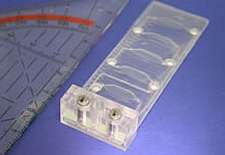
(PhysOrg.com) -- If doctors were able to conduct efficient genetic analysis at the point of care, using inexpensive, portable equipment, it would revolutionise disease detection and treatment. European researchers are close to enabling this revolution.
Today, anybody getting tests done in a GP’s surgery or hospital outpatients will usually have to wait several days before getting any results.
Using current technology, it is not possible to carry out a complete DNA analysis on a single device, and several steps are required with expensive and cumbersome equipment.
Because of the different steps involved, and the need to move blood and tissue samples from one location to another, the potential for human error can reduce the reliability of the test procedures.
Now an ambitious EU-funded project, SMART-BIOMEMS, is in the process of fabricating a novel microsystem – a lab on a microfluidic chip – which can be used in a portable diagnostic device, to simultaneously and automatically analyse various DNA samples with high precision.
Explains project coordinator Gianluca Vezzani: “What we are developing here is a comparatively inexpensive, easy-to-use and portable point-of-care system which will have very real clinical benefits.”
He says that, while the SMART-BIOMEMS system could be customised for any field where DNA testing is used, the prototype has been specifically designed for cancer testing and diagnosis.
“Because there are biochemical reactions occurring on the device, it has to be set up with specific reagents and biological protocols appropriate to the task at hand, and we chose cancer for the initial testing because it is such an important field.”
Signs of a working prototype
Since the project kicked off in December 2005, a lot of initial research and testing of different components of the system have been carried out. In order that a prototype device could be properly assembled and validated, the duration of the project has been extended by four months until the end of March 2009. By that time, Vezzani is confident a working and fully tested prototype will be ready for demonstration.
For the final validation of the system, a clinically relevant human gene, TP53, will be tested. It is well known that mutations in this gene can potentially be the cause of cancerous tumours.
“We will use a known sample – where we know the mutations – and test the capability of the system to identify these mutations. We will then compare the results of our tests with results from a conventional testing procedure to check on the accuracy of the results and the time our microsystem takes to complete the analysis,” he says.
In the testing, a DNA sample will be inserted into the device, the power switched on to move the fluid sample within the microfluidic chip by the pressure control unit, and from there the whole process is automatic, thus eliminating the possibility of human error or contamination of the sample.
The device will be connected to a standard PC equipped with a camera to acquire images of fluorescence transmitted by the device. Software, which has been specially developed by the project, analyses the images and displays the results of the testing on the computer monitor.
“The idea is to detect cancer at a very early stage, before it has a chance to spread, because we know that specific mutations in specific genes are likely to be the cause of potential tumours. The doctor can take samples on the spot, feed them into the device, and get a diagnosis in a short time span,” Vezzani says.
Once the devices are commercialised, doctors can routinely and affordably carry out on-the-spot checks of patients who are considered to be cancer risks, and catch the disease at an early enough stage to treat it – saving thousands of lives.
From cancer to other applications
Diagnosing cancer is just the start for the SMART-BIOMEMS system, however, with other potential applications ranging from any sort of medical testing of DNA samples, to animal health and livestock breeding programmes, etc.
The only restriction is that samples must be liquid, so if, say, firm plant tissue needs to be tested it must be liquidised first.
“Otherwise it is simply a question of storing different reagents in different chambers on the system depending on what it is that you want to test,” says Vezzani. “SMART-BIOMEMS is what we call a fully integrated microfluidic device which moves a liquid plug of a specific volume through a network of micro-channels and chambers where the reactions take place.”
Vezzani says there are companies involved in the project that are looking at patenting some parts of the core technology which has been developed with a view to commercialisation.
“Should the prototype work, which we are sure it will do, we think it would take two to three years after the end of the project to see a commercial device, and these could be available by 2012. Right from the start, we have tried to design a cost-effective system.”
So in a few years’ time, doctors throughout the EU may have a SMART-BIOMEMS diagnostic system sitting on their desks next to their PCs.
Provided by ICT Results


