Plastic as a conductor
December 2, 2008 Plastic as a conductor

Enlarge

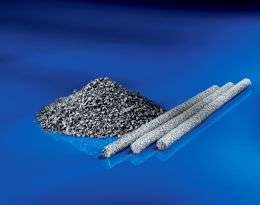
A plastic-metal hybrid as a granulate or a strand. In the next step the conductive material can be plasticized (softened) again and applied as a printed circuit board. © Fraunhofer IFAM

(PhysOrg.com) -- Plastic that conducts electricity and metal that weighs no more than a feather? It sounds like an upside-down world. Yet researchers have succeeded in making plastics conductive and cutting production costs at the same time.

You could hardly find greater contrasts in one and the same team. Plastic is light and inexpensive, but insulates electric current. Metal is resilient and conducts electricity, but it is also expensive and heavy. Up to now, it has not been possible to combine the properties of these two materials.

The IFAM in Bremen (Germany) has devised a solution that combines the best of both worlds without requiring new machinery to process the components. The greatest challenge for the researchers was getting the plastic to conduct electricity, for plastic-metal hybrids are to be used in the very places where plastic components are equipped with printed circuit boards, for instance in cars or aircraft. Until now, this was only possible via the roundabout route of punching and bending metal sheets in an elaborate process in order to integrate them in a component.

The new solution is simpler: a composite material. The different materials are not merely slotted together or bonded, but mixed in a special process to form a single material. This process produces a homogeneous and fine-meshed electrically conductive network. The composite possesses the desired chemical stability and low weight, coupled with the electrical and thermal conductivity of metals. As it will no longer be necessary in future to integrate metal circuit boards and the components will soon be able to be produced in a single work step, the production costs and the weight of the material are drastically reduced.

Automobile and aircraft manufacturers, in particular, will benefit from this development. The headlamp housings on a car, for example, are made of plastic. Until now, punched metal sheets have been installed in order to illuminate the headlamps. If the housings were fitted with circuit boards made of the conductive plastic-metal hybrids, they could be produced more efficiently and at lower cost than ever before. Many components of an aircraft, such as the fuselage, are partly made of carbon fiber composites (CFC). However, they lack the ability to conduct electricity. A stroke of lightning would have fatal consequences. A plastic-metal hybrid would be a good alternative for discharge structures on components.

Provided by Fraunhofer-Gesellschaft


print this article email this article download pdf blog this article bookmark this article     Stumble it Digg this share on Facebook retweet share on Reddit add to delicious
Rate this story - 4.2 /5 (11 votes)


December 2, 2008 all stories

Comments: 0

4.2 /5 (11 votes)
  • Stumble this up

  • Digg this

  • share this

  • hide
  • Related Stories

  • Lasers put a shine on metals
    created Nov 03, 2009 | popularity not rated yet | comments 0
  • Researchers bring noise to virtual worlds
    created Oct 27, 2009 | popularity not rated yet | comments 0
  • New laryngoscope could make difficult intubations easier
    created Oct 15, 2009 | popularity not rated yet | comments 0
  • Review: Wireless charging lets you cut the cords
    created Oct 07, 2009 | popularity not rated yet | comments 0
  • Upgrading RAM is a simple process
    created Sep 11, 2009 | popularity not rated yet | comments 0


  • hide
  • Relevant PhysicsForums posts

  • Ducted fan intake
    created 1hour ago
  • why are you an engineer?
    created 10 hours ago
  • Variable Pitch Propeller mechanism?
    created 14 hours ago
  • Bread Board
    created Nov 14, 2009
  • More from Physics Forums - General Engineering

Other News

All eyes on Murdoch as newspapers ponder digital future

Technology / Internet

created 16 hours ago | popularity not rated yet | comments 1

Is Rupert Murdoch bluffing? Making a bold high-stakes gamble that will save the troubled newspaper industry? Or pursuing a pipe dream that can only end in failure?


Road trains may be coming soon to Europe

Road trains may be coming soon to Europe (w/ Video)

Technology / Engineering

created Nov 13, 2009 | popularity 4.8 / 5 (12) | comments 22

(PhysOrg.com) -- Road trains linking vehicles together in a traveling convoy are planned for Europe. With only the lead vehicle being actively driven, the road trains would allow commuters to sleep, read a ...


A system of space solar power system (SSPS)

Japan eyes solar station in space as new energy source

Technology / Energy

created Nov 08, 2009 | popularity 4.8 / 5 (22) | comments 31

It may sound like a sci-fi vision, but Japan's space agency is dead serious: by 2030 it wants to collect solar power in space and zap it down to Earth, using laser beams or microwaves.


Cars sit in traffic on a highway

Netherlands to levy 'green' road tax by the kilometre

Technology / Hi Tech

created Nov 13, 2009 | popularity 3 / 5 (4) | comments 8

The Dutch government said Friday it wants to introduce a "green" road tax by the kilometre from 2012 aimed at cutting carbon dioxide emissions by 10 percent and halving congestion.


Hydrogen milestone moves energy independence one step forward

Hydrogen milestone moves energy independence one step forward

Technology / Energy

created Nov 10, 2009 | popularity 3.9 / 5 (12) | comments 7

(PhysOrg.com) -- Big things often come in small packages. That's certainly the case with the potential created by recent successes in hydrogen research at Idaho National Laboratory.