NASA Finishes Listening for Phoenix Mars Lander
December 2, 2008 NASA Finishes Listening for Phoenix Mars Lander

Enlarge

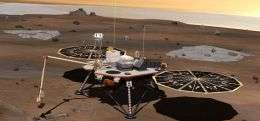
NASA's Phoenix Mars Lander monitors the atmosphere overhead and reaches out to the soil below in this artist's depiction of the spacecraft fully deployed on the surface of Mars.

(PhysOrg.com) -- After nearly a month of daily checks to determine whether Martian NASA's Phoenix Mars Lander would be able to communicate again, the agency has stopped using its Mars orbiters to hail the lander and listen for its beep.

As expected, reduced daily sunshine eventually left the solar-powered Phoenix craft without enough energy to keep its batteries charged.

The final communication from Phoenix remains a brief signal received via NASA's Mars Odyssey orbiter on Nov. 2. The Phoenix lander operated for two overtime months after achieving its science goals during its original three-month mission. It landed on a Martian arctic plain on May 25.

"The variability of the Martian weather was a contributing factor to our loss of communications, and we were hoping that another variation in weather might give us an opportunity to contact the lander again," said Phoenix Mission Manager Chris Lewicki of NASA's Jet Propulsion Laboratory, Pasadena, Calif.

The end of efforts to listen for Phoenix with Odyssey and NASA's Mars Reconnaissance Orbiter had been planned for the start of solar conjunction, when communications between Earth and Mars-orbiting spacecraft are minimized for a few weeks. That period, when the sun is close to the line between Earth and Mars, has begun and will last until mid-December.

The last attempt to listen for a signal from Phoenix was when Odyssey passed overhead at 3:49 p.m. PST Saturday, Nov. 29 (4:26 p.m. local Mars solar time on the 182nd Martian day, or sol, since Phoenix landed). Nov. 29 was selected weeks ago as the final date for relay monitoring of Phoenix because it provided several weeks to the chance to confirm the fate of the lander, and it coincided with the beginning of solar conjunction operations for the orbiters. When they come out of the conjunction period, weather on far-northern Mars will be far colder, and the declining sunshine will have ruled out any chance of hearing from Phoenix.

Provided by NASA


print this article email this article download pdf blog this article bookmark this article     Stumble it Digg this share on Facebook retweet share on Reddit add to delicious
Rate this story - 3.9 /5 (11 votes)

Rank Filter

Move the slider to adjust rank threshold, so that you can hide some of the comments.


Display comments: newest first

  • Modernmystic - Dec 02, 2008
    • Rank: 1 / 5 (4)
    YAY! Now can we PLEASE have no more articles on this abject failure of a mission!!??
  • morpheus2012 - Dec 03, 2008
    • Rank: 1.6 / 5 (7)
    for the newbies

    nasa is the bigest gas giant in the solar system

    all they they do is bunch of lies omissions,
    airburshing, and generally uselles reasearch

    ther secret space program has bases on moon mars

    nasa knows about them soo they coutinulslly lie and cover them up

    i mean if u belive what nasa tells u

    ur on the par beliving what bush tells u
  • gmurphy - Dec 03, 2008
    • Rank: 3 / 5 (2)
    RIP
  • DGBEACH - Dec 03, 2008
    • Rank: 2 / 5 (2)
    indeed. RIP
  • Ethelred - Dec 03, 2008
    • Rank: 5 / 5 (2)
    for the newbies

    nasa

    ther secret space program has bases on moon mars

    nasa knows about them soo they coutinulslly lie and cover them up

    i mean if u belive what nasa tells u

    ur on the par beliving what bush tells u


    Gosh I never knew that. Bases on the Moon. So then UFO by Gerry and Sylvia Anderson wasn't fiction it was a documentary.

    I wonder if Mopious actually believes that.
  • deatopmg - Dec 03, 2008
    • Rank: not rated yet
    RIP


    ...then why is it called Phoenix? NASA names these missions for a reason.
  • RTT - Dec 03, 2008
    • Rank: 3 / 5 (2)
    So if it is the winter season where the lander is at - will it's batteries recharge as the season progresses to summer?
  • Ethelred - Dec 04, 2008
    • Rank: 5 / 5 (1)
    Maybe. If the probe isn't destroyed by the weather. A previous article said there might be an attempt to communicate with it after winter. Odds are very bad.

    Oh and Mopious, If you hate science so much that you feel the need to give every reasonable post a rating of one what the heck are you doing on this site?

    Tit for tat Mopious.
  • NOM - Dec 04, 2008
    • Rank: not rated yet
    Oh and Mopious, If you hate science so much that you feel the need to give every reasonable post a rating of one what the heck are you doing on this site?
    Morpharse was booted off the physorg sister site physforum, so he knows he isn't wanted here.
  • denijane - Dec 08, 2008
    • Rank: not rated yet
    What failure, NASA Phoenix wasn't a failure. It did its job and its death was well expected. They just hoped they might get it moving for little longer but it didn't happen.
    I don't understand where's the failure in this.

December 2, 2008 all stories

Comments: 10

3.9 /5 (11 votes)
  • Stumble this up

  • Digg this

  • share this

  • hide
  • Related Stories

  • Frost-Covered Phoenix Lander Seen in Winter Images
    created Nov 05, 2009 | popularity not rated yet | comments 0
  • Scientists see water ice in fresh meteorite craters on Mars
    created Sep 24, 2009 | popularity not rated yet | comments 0
  • Biosphere 2 Opens Phoenix Mars Lander Exhibit
    created Sep 18, 2009 | popularity not rated yet | comments 0
  • Reconstruct Mars automatically in minutes
    created Sep 18, 2009 | popularity not rated yet | comments 0
  • Telltale tells story of winds at Phoenix landing site
    created Sep 16, 2009 | popularity not rated yet | comments 0


  • hide
  • Relevant PhysicsForums posts

  • The shape of our solar system's orbits.
    created Nov 07, 2009
  • Above or Below the Line of Nodes
    created Nov 07, 2009
  • Supernova vs. Nova?
    created Nov 07, 2009
  • Supernova's Gamma Rays and Comets
    created Nov 06, 2009
  • More from Physics Forums - General Astronomy

Other News

Deep creep means milder, more frequent earthquakes along Southern California's San Jacinto fault

Deep creep means milder, more frequent earthquakes along Southern California's San Jacinto fault

Space & Earth / Earth Sciences

created 17 hours ago | popularity 4.5 / 5 (4) | comments 0

With an average of four mini-earthquakes per day, Southern California's San Jacinto fault constantly adjusts to make it a less likely candidate for a major earthquake than its quiet neighbor to the east, the ...


Success in 'space elevator' competition (AP)

Success in 'space elevator' competition (Update 3)

Space & Earth / Space Exploration

created Nov 05, 2009 | popularity 4.3 / 5 (33) | comments 50

(AP) -- A robot powered by a ground-based laser beam climbed a long cable dangling from a helicopter on Wednesday to qualify for prize money in a $2 million competition to test the potential reality of the ...


In a Galaxy Far, Far Away...

In a Galaxy Far, Far Away...

Space & Earth / Astronomy

created Nov 06, 2009 | popularity 4.8 / 5 (5) | comments 17

(PhysOrg.com) -- Astronomers have published the discovery of the farthest known object in the cosmos: a star that exploded when the universe was only 630 million years old -- only 4.6% of its current age. ...


'Dropouts' pinpoint earliest galaxies

'Dropouts' pinpoint earliest galaxies

Space & Earth / Astronomy

created Nov 06, 2009 | popularity 4.2 / 5 (10) | comments 13

Astronomers, conducting the broadest survey to date of galaxies from about 800 million years after the Big Bang, have found 22 early galaxies and confirmed the age of one by its characteristic hydrogen signature ...


Space hotel taking bookings for 2012 opening

Space hotel taking bookings for 2012 opening

Space & Earth / Space Exploration

created Nov 05, 2009 | popularity 4.4 / 5 (21) | comments 11

(PhysOrg.com) -- The first orbiting space hotel is on track to open for its first customers in 2012, but hurry, as bookings are filling fast.