Magnetic nanotags allow sensitive detection of cancer biomarkers
December 2, 2008
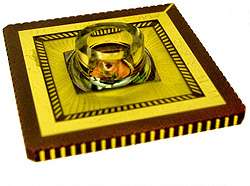
The magnetic nanotag-based protein assay chip has a 200 microliter reaction well and is supported by an 84-pin ceramic base. Embedded in the bottom of the reaction well are 64 sensors in an 8-by-8 array. Credit: Osterfeld et al., PNAS.
(PhysOrg.com) -- The detection of cancer-associated proteins, or biomarkers, in blood samples is a potentially powerful tool for early diagnosis of cancer and monitoring of cancer treatment. A team led by researchers at Stanford University and the University of California, Santa Cruz, has developed a compact prototype detector that uses magnetic nanotechnology to spot cancer-associated proteins in a human blood serum sample with much higher sensitivity than current detectors.
The researchers describe their results in a paper published by Proceedings of the National Academy of Sciences (PNAS) the week of December 1, 2008.
In addition to its high sensitivity, the new detector can monitor multiple biomarkers simultaneously. This "multiplex" capability is important because the use of multiple biomarkers is likely to provide greater accuracy and reliability than single biomarkers for cancer diagnosis and other potential applications, said Nader Pourmand, professor of biomolecular engineering at UCSC.
"With current detectors, you can only detect one protein at a time," Pourmand said. "Instead of the standard fluorescent tags, we used nanosized magnetic beads as tags and were able to detect target molecules with tens to hundreds of times greater sensitivity than standard techniques."
"This is essentially a proof-of-concept study showing that now we have a chip and a reader that can find multiple biomarkers in a sample at a concentration much lower than the standard that is commercially available," said Shan Wang, a Stanford professor of materials science and engineering and electrical engineering.
Wang and Pourmand are senior authors of the paper, along with Stanford biochemistry and genetics Professor Ronald W. Davis.
To tag the cancer proteins with magnetic nanoparticles, the detector subjects blood serum samples to an incubation process that takes place in roughly half an hour. At the heart of the detector is a silicon chip designed by the paper's first author, Sebastian Osterfeld, a Stanford materials science and engineering doctoral student. The chips have 64 embedded sensors whose electrical resistance changes in the presence of a nearby magnetic field. Attached to these sensors are capture antibodies that have the unique ability to latch on to specific cancer-related proteins as they float by.
During the incubation process, these antibodies first capture their specific cancer proteins. Next, a second wave of antibodies attach to the specific cancer proteins on one end and magnetic nanoparticles on the other end, tethering the captured cancer biomarkers to magnetic "nanotags." The tags emit a magnetic field that causes a change in the resistance of the underlying sensor, giving the detector a clear signal.
In the PNAS paper, the researchers described detection of very low concentrations of various cancer biomarkers, such as tumor necrosis factor alpha and cancer embryonic antigen. In a multiplex assay involving seven potential cancer biomarkers, concentrations ranging from 5 quadrillionths to 0.1 trillionths of a mole (a standard unit of measurement for molecules) were unambiguously detected simultaneously.
The researchers also estimated that they could detect levels of the protein human chorionic gonadotropin about 400 times lower than the concentration detectable by current commercial kits known by the acronym ELISA, in which captured proteins are conjugated to color-altering or fluorescent labels.
To properly prepare a patient's blood sample for use with the detector, a technician must use a centrifuge to separate out the serum, which contains the biomarkers. For this reason, the device would need to be located in a hospital or a private diagnostic lab, Wang said. Even before that, the device faces clinical utility testing and then must undergo clinical trials to win regulatory approval. To see the device through those steps, Pourmand and Wang have cofounded a startup company, MagArray, in the Panorama Institute for Molecular Medicine, a nonprofit incubator in Sunnyvale, Calif.
Wang said he is optimistic that the technology could someday save lives by detecting cancer early or by helping doctors to select more effective therapy.
"The earlier you can detect a cancer, the better chance you have to kill it," Wang said. "This could be especially helpful for lung cancer, ovarian cancer, and pancreatic cancer, because those cancers are hidden in the body."
The nascent startup has also begun to apply the technology to diagnosis and assessing risk of heart attack in emergency rooms. Heart cell death is also associated with the release of specific biomarker proteins.
Provided by UC Santa Cruz
-
Diagnostic brain tumor test could revolutionize care of patients
Jan 27, 2012 |
5 / 5 (1) |
0
-
MRI may be noninvasive method to measure breast cancer prognosis
Dec 08, 2011 |
not rated yet |
0
-
Hand-held NMR instrument yields rapid analysis of human tumors
Mar 28, 2011 |
5 / 5 (2) |
0
-
Detecting whether a heart attack has occurred
Feb 14, 2011 |
5 / 5 (3) |
0
-
A crucial test for Alzheimer's
Sep 20, 2010 |
not rated yet |
0
-
Engineers build first sub-10-nm carbon nanotube transistor
Feb 01, 2012 |
4.9 / 5 (30) |
30
-
Something old, something new: Evolution and the structural divergence of duplicate genes
Jan 31, 2012 |
4.6 / 5 (7) |
1
-
The hidden nanoworld of ice crystals: Revealing the dynamic behavior of quasi-liquid layers
Jan 30, 2012 |
5 / 5 (3) |
1
-
Stock market network reveals investor clustering
Jan 27, 2012 |
3.9 / 5 (23) |
8
-
Of microchemistry and molecules: Electronic microfluidic device synthesizes biocompatible probes
Jan 26, 2012 |
5 / 5 (1) |
0
-
Cancer drugs and Alzheimer's, Oh my!
1 hour ago
-
Squishing cells
1 hour ago
-
Any books/articles for evolutionary stable strategy models in humans?
13 hours ago
-
Science behind the bore feeling?
19 hours ago
-
Homo Sapien vs. Chimpanzee - Divergence Timeline
23 hours ago
-
a single mRNA strand is attached to sevaral ribosomes?
Feb 08, 2012
- More from Physics Forums - Biology
More news stories
'Dark plasmons' transmit energy
Microscopic channels of gold nanoparticles have the ability to transmit electromagnetic energy that starts as light and propagates via "dark plasmons," according to researchers at Rice University.
7 hours ago |
5 / 5 (4) |
0
|
Nanotube therapy takes aim at breast cancer stem cells
Wake Forest Baptist Medical Center researchers have again proven that injecting multiwalled carbon nanotubes (MWCNTs) into tumors and heating them with a quick, 30-second laser treatment can kill them.
Nanotechnology / Bio & Medicine
12 hours ago |
5 / 5 (1) |
0
|
Inspired by steel, nanomanufacturing gets wear-resistant carbide tip
(PhysOrg.com) -- Scientists at the University of Pennsylvania, the University of Wisconsin-Madison and IBM Research - Zurich have fabricated an ultrasharp silicon carbide tip possessing such high strength ...
17 hours ago |
5 / 5 (3) |
1
|
New technology platform for molecule-based electronics
Researchers at the Nano-Science Center at the University of Copenhagen have developed a new nano-technology platform for the development of molecule-based electronic components using the wonder material graphene. At the same ...
Nanotechnology / Nanomaterials
14 hours ago |
5 / 5 (2) |
0
Australians risking skin cancer to avoid nanoparticles
More than three in five Australians are concerned enough about the health implications of nanoparticles in sunscreens to want to know more about their impact. And while the initial scientific information released suggests ...
Nanotechnology / Bio & Medicine
16 hours ago |
5 / 5 (1) |
0
FDA-approved drug rapidly clears amyloid from the brain, reverses Alzheimer's symptoms in mice
Neuroscientists at Case Western Reserve University School of Medicine have made a dramatic breakthrough in their efforts to find a cure for Alzheimer's disease. The researchers' findings, published in the journal Science, show t ...
Hydrogen from acidic water: Researchers develop potential low cost alternative to platinum for splitting water
A technique for creating a new molecule that structurally and chemically replicates the active part of the widely used industrial catalyst molybdenite has been developed by researchers with the Lawrence Berkeley ...
Ultraviolet protection molecule in plants yields its secrets
Lying around in the sun all day is hazardous not just for humans but also for plants, which have no means of escape. Ultraviolet (UV) radiation from the sun can damage proteins and DNA inside cells, leading ...
Anyone can learn to be more inventive, cognitive researcher says
There will always be a wild and unpredictable quality to creativity and invention, says Anthony McCaffrey, a cognitive psychology researcher at the University of Massachusetts Amherst, because an "Aha moment" is rare and ...
Soraa LED light may dim 50-watt halogen rivals
(PhysOrg.com) -- Soraa, a Fremont, California company founded in 2008, this week launched its first product, a light that uses LEDS (light emitting diodes). The "Soraa LED MR16 lamp" is the "perfect" replacement ...
New method makes culture of complex tissue possible in any lab
Scientists at the University of California, San Diego have developed a new method for making scaffolds for culturing tissue in three-dimensional arrangements that mimic those in the body. This advance, published online in ...