'Intelligent' materials to revolutionize surgical implants
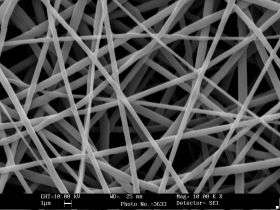
(PhysOrg.com) -- A brand new process that could revolutionise the reliability and durability of surgical implants, such as hip and knee replacements, has today, 2 December 08, received recognition for its medical and commercial potential by achieving one of the world's most sought after accolades.
A team of researchers, led by the Science and Technology Facilities Council (STFC), has received a Medical Futures Innovation Award for its high technology process designed to coat surgical implants with fibres that, for the first time, will encourage the implant to 'bond' with living bone and to last the lifetime of the patient.
This unique surface engineering process is being developed at the Micro-Nano Technology Centre (MNTC) at STFC. In collaboration with the Electrospinning Company Ltd (TECL) and Anglia Ruskin University, the concept will be taken forward under the guidance of a Medical Futures team, and eventually exclusively licensed to TECL, a spin out company of STFC.
This advanced nanotechnology technique builds on an existing technique known as electrospinning, and will utilise a vastly superior electrospinning source to create bespoke fibrous materials. Electrospinning is a process that uses an electrical charge to turn polymers into extremely thin fibres that are 'spun' to form a mat of fine fibres. It is seen as a platform technology for the medical sector with a wide range of applications including tissue regeneration and drug delivery. The MNTC has developed systems to increase the production rate of nanofibres which has been previously prevented this technology from being adopted by industry.
In this case, nanosized hair- like structures, a thousand times thinner than the width of a human hair, are electrospun at MNTC and added to the surface of an orthopaedic implant to create a 'living interface' between the artificial implants and living bone. Not only does this improve the performance of the implants it also significantly increases their durability to last the lifetime of the patient. Any stress on the implant is relieved, making it more reliable and durable. Additionally, it is also possible to add a unique biological coating that can facilitate growth and improve the bonding of healthy tissue to the implant, primarily benefitting patients with osteoarthritis in the aging population and sports injuries in the younger population.
This process will be transferred to UK industry and TECL will provide access to state-of-the-art electrospinning systems. TECL has spun out from STFC to provide open access to electrospinning equipments and expertise to organisations that would like to explore the technique's potential. The main benefit is that this can be done without commercial companies committing to capital investment or developing in-house expertise until the potential value of electrospinning to the organisation is fully understood. TECL is based both at the Daresbury Science and Innovation Campus in Cheshire and at STFC's Rutherford Appleton Laboratory in Oxfordshire, and was founded by CLIK, the wholly-owned technology exploitation company of STFC. TECL's specialised facilities are designed to extend current electrospinning capabilities so that nanofibres can be reproduced in volume.
Dr Robert Stevens, Head of the MNTC at STFC said: "This award provides a major step forward for the future of patients requiring surgical implants and I am thrilled that this concept was selected as an award winner over several hundred entries. Our award is given for translational research innovation to meet the current and future orthopaedic needs of patients."
Mansel Williams, Chief Executive of The Electrospinning Company said: "Ten percent of patients receiving surgical implants go on to develop infection and loosening of their implants, costing the UK at least £14 million every year, £224 million globally. We want to eliminate this by creating the ideal implant surface matched to the individual patient, benefitting both the patient and the economy. This award will now allow us to scale up the testing and commercialisation of these implants"
Source: Science and Technology Facilities Council


