How to destroy an asteroid
December 3rd, 2008 Tara

Enlarge

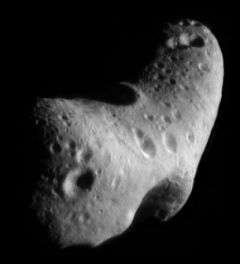
"Tara," an asteroid being tracked by Tel Aviv University researchers. Credit: AFTAU

In the hit 1998 movie Armageddon, Bruce Willis and Ben Affleck blew up an asteroid to save the world. While the film was science fiction, the chances of an asteroid hitting the Earth one day are very real ― and blowing up an asteroid in real life, says a Tel Aviv University researcher, will be more complicated than in the movies.

Astrophysicists agree that the best method for avoiding a catastrophic collision would be to change the path of the asteroid heading toward our planet. "For that to work, we need to be able to predict what would happen if we attempt an explosion," says Tel Aviv University doctoral student David Polishook, who is studying asteroids with his supervisor Dr. Noah Brosch at the Department of Geophysics and Planetary Sciences.

Polishook and Brosch are among the few scientists in the world researching the structure and composition of asteroids –– a critical first step in learning how to destroy them before they reach the Earth's atmosphere. Their research could prevent catastrophe: blowing up an asteroid may create many equally dangerous smaller asteroids of about 100 meters each in diameter ― twice the size of the asteroid that created the famous Arizona crater.

Looking on the Bright Sides

"The information we are investigating can have a tremendous impact on future plans to alter the course of asteroids on a collision course with Earth," says Polishook. "Science needs to know whether asteroids are solid pieces of rock or piles of gravel, what forces are holding them together, and how they will break apart if bombed."

By observing the waxing and waning brightness of far-away asteroids, Polishook is able to examine the shape, spin period and surface composition of these flying rocks. "This is a good way of evaluating what asteroids are made of," says Polishook, who takes measurements on an almost daily basis at Tel Aviv University's Wise Observatory.

As part of their observations, the researchers used the fact that small asteroids change their rotation rate, accelerating or slowing down during short periods, as often as every 100,000 years. Compared to the age of the solar system – 4.5 billion years – that is an extremely fast change, says Polishook.

The most recent results of their research were presented at the 2008 meeting of Asteroids, Comets and Meteors, sponsored by the Johns Hopkins University Applied Physics Laboratory in Baltimore.

Size Matters

An asteroid's rotation and acceleration are influenced by sunlight –– the "YORP Effect." If the YORP effect causes an asteroid to rotate faster than one revolution in 2.2 hours, it will break apart.

To understand how the YORP Effect works on asteroids, Tel Aviv University researchers examined several variables relating to these asteroids, including size and location. They concluded that size is the most important factor in determining how an asteroid's rotation rate accelerates according to the YORP Effect.

"We think this adds an important clue to how asteroids will behave should a space agency need to knock one off-course to prevent a collision with earth," Polishook notes.

Source: American Friends of Tel Aviv University


print this article email this article download pdf blog this article bookmark this article     Digg this Stumble it share on Facebook share on Reddit add to delicious save to Yahoo! bookmarks
4.2/5 after 20 votes

Rank Filter

Move the slider to adjust rank threshold, so that you can hide some of the comments.


Display comments: newest first

  • Doug_Loss - Dec 03, 2008
    • Rank: not rated yet
    I notice they mention the "flying gravel pile" conception of asteroid composition. If that's true, how could you possibly divert one? Pushing on it with rockets wouldn't work, and exploding anything near it would just give you a mildly wider gravel pile. You'd have to bag it and drag it somehow...
  • NeilFarbstein - Dec 03, 2008
    • Rank: 1 / 5 (1)
    Establish an asteroid buster force and build nuclear powered rockets that can get to an asteroid much quicker than chemical rockets. The VASIMIR ionic engine is closest to being operational. In tests it developed a hundredth the thrust of a regular rocket engine, beating other ionic engines by a longshot. NASA recently sold the patent license on VASIMIR to a private space company. This would cause a quantum leap in interplanetary space travel with rockets that can get to the asteroid belt in 6 weeks and to the asteroid belt in double that time. Besides protecting earth from an asteroid hit, asteroid mining might be economical decades ahead of schedule.
  • Doug_Huffman - Dec 03, 2008
    • Rank: not rated yet
    I don't know. Sure a gravel mountain bolide would be disastrous but that is a limit on a 2D continuum that should allow smearing the gravel mountain in space and time. Would a gravel drizzle be as catastrophic or a gravel downpour? What if the individual pieces were a bit larger?
  • TJ_alberta - Dec 04, 2008
    • Rank: 5 / 5 (1)
    I think what they may be hinting at is that one possibility of dealing with a loosely agglomerated asteroid would be to increase the spin to the point were centrifugal force would disperse it into components too small to survive atmospheric entry. Gravity will not be much, even for a large asteroid. If the "gravel" is held together with some kind of ice (not necessarily water ice) then perhaps decreasing the albedo will warm it >m.p. Solid asteroids would require a different approach.

    In any event, understanding the structure of tracked asteroids seems a worthwhile endeavor.
  • TJ_alberta - Dec 04, 2008
    • Rank: not rated yet
    just thought of something else. If you could warm up one corner of an asteroid, would any gas released achieve escape velocity and accelerate spin by reaction?
  • tkjtkj - Dec 04, 2008
    • Rank: not rated yet
    They concluded that size is the most important factor in determining how an asteroid's rotation rate accelerates according to the YORP Effect.
    "We think this adds an important clue to how asteroids will behave..."


    and do you care actually to share
    that 'behaviour' with us????

    This seems to be a 'non-article',
    so far as i can see.
  • DeadCorpse - Dec 04, 2008
    • Rank: not rated yet
    Interesting. Using the same principle that the radiometer works on to induce a spin in a agglomerated accretion body to create an inertial instability.

    Elegant. But who's gonna go up there and spray paint part of it black? Further, it'd take a few years for such a minuscule effect to induce sufficient spin in a mass the size of an Earth threatening asteroid. We're talking fractions of a Newton applied over large time scales to get them to spin as observed.

    A large area effect explosion would do two things: 1) Impart a rather violent force to the body. 2) If sufficient surface heat is generated, it could "blacken" the surface. If we are talking kilometers worth of asteroid, then we're talking nukes.

    Not sure the UN is gonna like that idea. Save the species or weaponize space.
  • FainAvis - Dec 04, 2008
    • Rank: not rated yet
    Spin it up by whatever means but keep a large mass tethered by a cable. When the spin is high enough cut the cable and the two masses fly off in different directions.
  • Thecis - Dec 08, 2008
    • Rank: not rated yet
    To create spin, a new concept could also be used, namely a mirror...
    Set up a giant mirror on earth, catch sunlight, reflect it and make sure the focus is right on the asteroid itself. This induces melting as the change of water of vapor makes it is acting as a small rocket, "pushing" the asteroid out of its trajectory.
    A few notes.
    1. How to make sure the focus is correct? You'll see
    2. Will this be enough for larger asteroids? I haven't got a clue. Some astronomers will know, because this is an idea that has been announced before.
    3. What to do if it comes from outside the solar system, from the dark side of the earth... Well, other options are welcome as well ;-)

December 3rd, 2008 all stories
Space & Earth / Space Exploration

Comments: 9
Rank: 4.2/5 after 20 votes

  • Stumble this up

  • Digg this

  • Share it:
  • share on Facebook
  • share on MySpace
  • share on Slashdot
  • rss-newsfeed
  • share on Google
  • share on Reddit
  • add to delicious
  • save to Yahoo! bookmarks
  • share on Windows Live
  • Add to Mixx!
Rating: 4.2/5 after 20 votes

  • Related Stories

  • We owe it all to comets
    created Apr 28, 2009 | popularity not rated yet | comments 0
  • Asteroid Attack 4 Billion Years Ago May Have Accelerated Life on Earth
    created May 20, 2009 | popularity not rated yet | comments 0
  • Geoscientist offers new evidence that meteorite did not wipe out dinosaurs
    created May 04, 2009 | popularity not rated yet | comments 0
  • Contrary to recent hypothesis, 'chevrons' are not evidence of megatsunamis
    created Apr 29, 2009 | popularity not rated yet | comments 0
  • Solar wind tans young asteroids
    created Apr 22, 2009 | popularity not rated yet | comments 0

Tags

asteroids

  • Physicists Demonstrate Quantum Memory with Matter Qubits
    Physicists Demonstrate Quantum Memory with Matter Qubits
    Physics / General Physics
    created Jul 03, 2009 | popularity 4.4 / 5 (17) | comments 1
  • 'Holey' Nanosheets for Wastewater Dye Removal
    Nanotechnology / Nanomaterials
    created Jul 01, 2009 | popularity 5 / 5 (5) | comments 1
  • Jellyfish Robot Swims Like its Biological Counterpart
    Jellyfish Robot Swims Like its Biological Counterpart
    Electronics / Robotics
    created Jun 26, 2009 | popularity 4.4 / 5 (8) | comments 1
  • Could Maxwell's Demon Exist in Nanoscale Systems?
    Could Maxwell's Demon Exist in Nanoscale Systems?
    Physics / General Physics
    created Jun 24, 2009 | popularity 4.4 / 5 (18) | comments 29
  • Living Safely with Robots, Beyond Asimov's Laws
    Living Safely with Robots, Beyond Asimov's Laws
    Electronics / Robotics
    created Jun 22, 2009 | popularity 4.6 / 5 (54) | comments 40
  • Other News

    Hurricane Katrina: Phone home

    Space & Earth / Earth Sciences

    created 1hour ago | popularity not rated yet | comments 0

    Though New Orleans residents were told to evacuate days before the arrival of Hurricane Katrina, no one could have predicted the real extent of the devastation.


    Space Station Marathon

    Space Station Marathon

    Space & Earth / Space Exploration

    created 3 hours ago | popularity not rated yet | comments 0

    The International Space Station (ISS) is about to make a remarkable series of flybys over the United States. Beginning this 4th of July weekend, the station will appear once, twice, and sometimes three times ...


    Researchers test new 'space Internet' system on International Space Station

    Researchers test new 'space Internet' system on International Space Station

    Space & Earth / Space Exploration

    created 3 hours ago | popularity 5 / 5 (1) | comments 0

    The University of Colorado at Boulder is working with NASA to develop a new communications technology now being tested on the International Space Station, which will extend Earth's Internet into outer space ...


    World's Largest Ocean Observatory Nears Completion

    Space & Earth / Earth Sciences

    created 1hour ago | popularity not rated yet | comments 0

    Canada is about to take the world on a 25-year non-stop research expedition—into the deep ocean.


    California to require sun-blocking car windows

    Space & Earth / Environment

    created 8 hours ago | popularity 2 / 5 (4) | comments 10

    New cars sold in California must include windshields that block or absorb the sun's rays beginning in 2012, the state's Air Resources Board recently ruled.