Venus comes to life at wavelengths invisible to human eyes
December 3, 2008 Venus comes to life at wavelengths invisible to human eyes

Enlarge

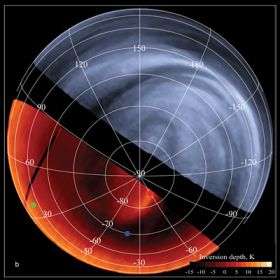
Using Venus Express, it is possible to compare what the planet looks like at different wavelengths, giving scientists a powerful tool with which to study this planet’s turbulent atmosphere. The lower left shows a differential temperature map (not absolute values) of the venusian cloud tops, derived from the Visible and Infrared Thermal Imaging Spectrometer, VIRTIS, on the planet’s night-side. The darker the region, the colder the cloud tops. To the upper right is an ultraviolet image of the venusian day side, captured by the Venus Monitoring Camera, VMC, simultaneously with the night-side infrared image. The ultraviolet reveals the structure of the clouds and the dynamical conditions in the atmosphere, whereas the infrared provides information on the temperature and altitude of the cloud tops. Credits: VMC ultraviolet image: ESA/MPS/DLR/IDA VIRTIS infrared image: ESA/VIRTIS/INAF-IASF/Obs. de Paris-LESIA

(PhysOrg.com) -- A pale yellow-green dot to the human eye, Earth's twin planet comes to life in the ultraviolet and the infrared. New images taken by instruments on board ESA's Venus Express provide insight into the turbulent atmosphere of our neighbouring planet.

Using Venus Express, it is possible to compare what the planet looks like in different wavelengths, giving scientists a powerful tool to study the physical conditions and dynamics of the planet's atmosphere.

Observed in the ultraviolet, Venus shows numerous high-contrast features. The cause is the inhomogeneous distribution of a mysterious chemical in the atmosphere that absorbs ultraviolet light, creating the bright and dark zones.

The ultraviolet reveals the structure of the clouds and the dynamical conditions in the atmosphere, whereas the infrared provides information on the temperature and altitude of the cloud tops.

With data from Venus Express, scientists have learnt that the equatorial areas on Venus that appear dark in ultraviolet light are regions of relatively high temperature, where intense convection brings up dark material from below. In contrast, the bright regions at mid-latitudes are areas where the temperature in the atmosphere decreases with depth. The temperature reaches a minimum at the cloud tops suppressing vertical mixing. This annulus of cold air, nicknamed the 'cold collar', appears as a bright band in the ultraviolet images.

Observations in the infrared have been used to map the altitude of the cloud tops. Surprisingly, the clouds in both the dark tropics and the bright mid-latitudes are located at about the same height of about 72 km.

At 60° south, the cloud tops start to sink, reaching a minimum of about 64 km, and form a huge hurricane at the pole.

Infrared image overlaid on ultraviolet images bring the giant hurricane's eye at the planet's south pole to life. Its centre is displaced from the pole and the whole structure measures about 2000 km across, rotating around the pole in about 2.5 days.

This study, carried out by D. Titov and colleagues, has revealed that variable temperature and dynamical conditions at the Venus cloud tops are the cause of the global ultraviolet pattern.

But the exact chemical species that creates the high-contrast zones still remains elusive, and the search is on.

Provided by European Space Agency


print this article email this article download pdf blog this article bookmark this article     Stumble it Digg this share on Facebook retweet share on Reddit add to delicious
Rate this story - 4.1 /5 (22 votes)


December 3, 2008 all stories

Comments: 0

4.1 /5 (22 votes)
  • Stumble this up

  • Digg this

  • share this

  • hide
  • Related Stories

  • Venus Express adds evidence for atmospheric water loss on Earth's Twin
    created Sep 16, 2009 | popularity not rated yet | comments 0
  • Watching Venus glow in the dark
    created Feb 24, 2009 | popularity not rated yet | comments 0
  • New details on venusian clouds revealed
    created May 30, 2008 | popularity not rated yet | comments 0
  • The light and dark of Venus
    created Feb 21, 2008 | popularity not rated yet | comments 0
  • CU-Boulder scientists ready for MESSENGER Mission flyby of Mercury
    created Jan 10, 2008 | popularity not rated yet | comments 0


  • hide
  • Relevant PhysicsForums posts

  • The shape of our solar system's orbits.
    created 15 hours ago
  • Above or Below the Line of Nodes
    created 19 hours ago
  • Supernova vs. Nova?
    created Nov 07, 2009
  • Supernova's Gamma Rays and Comets
    created Nov 06, 2009
  • More from Physics Forums - General Astronomy

Other News

Deep creep means milder, more frequent earthquakes along Southern California's San Jacinto fault

Deep creep means milder, more frequent earthquakes along Southern California's San Jacinto fault

Space & Earth / Earth Sciences

created 54 minutes ago | popularity 4 / 5 (1) | comments 0

With an average of four mini-earthquakes per day, Southern California's San Jacinto fault constantly adjusts to make it a less likely candidate for a major earthquake than its quiet neighbor to the east, the ...


Success in 'space elevator' competition (AP)

Success in 'space elevator' competition (Update 3)

Space & Earth / Space Exploration

created Nov 05, 2009 | popularity 4.3 / 5 (33) | comments 50

(AP) -- A robot powered by a ground-based laser beam climbed a long cable dangling from a helicopter on Wednesday to qualify for prize money in a $2 million competition to test the potential reality of the ...


'Dropouts' pinpoint earliest galaxies

'Dropouts' pinpoint earliest galaxies

Space & Earth / Astronomy

created Nov 06, 2009 | popularity 4.1 / 5 (9) | comments 12

Astronomers, conducting the broadest survey to date of galaxies from about 800 million years after the Big Bang, have found 22 early galaxies and confirmed the age of one by its characteristic hydrogen signature ...


Space hotel taking bookings for 2012 opening

Space hotel taking bookings for 2012 opening

Space & Earth / Space Exploration

created Nov 05, 2009 | popularity 4.4 / 5 (20) | comments 11

(PhysOrg.com) -- The first orbiting space hotel is on track to open for its first customers in 2012, but hurry, as bookings are filling fast.


In a Galaxy Far, Far Away...

In a Galaxy Far, Far Away...

Space & Earth / Astronomy

created Nov 06, 2009 | popularity 4.8 / 5 (4) | comments 11

(PhysOrg.com) -- Astronomers have published the discovery of the farthest known object in the cosmos: a star that exploded when the universe was only 630 million years old -- only 4.6% of its current age. ...