Students discover unique planet
December 4, 2008 A Planet Around a Hot Star

Enlarge

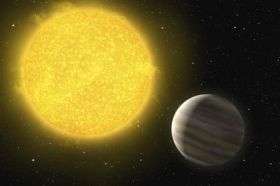
Artist's impression of the planet OGLE-TR-L9b. Circling its host star in about 2.5 days, it lies at only three percent of the Earth-Sun distance from its star, making the planet very hot with a bloated roiling atmosphere. The star itself is the hottest star with a planet ever discovered. Credit: ESO/H. Zodet

The students were testing a method of investigating the light fluctuations of thousands of stars in the OGLE database in an automated way. The brightness of one of the stars was found to decrease for two hours every 2.5 days by about one percent. Follow-up observations, taken with ESO's Very Large Telescope in Chile, confirmed that this phenomenon is caused by a planet passing in front of the star, blocking part of the starlight at regular intervals.

According to Ignas Snellen, supervisor of the research project, the discovery was a complete surprise. "The project was actually meant to teach the students how to develop search algorithms. But they did so well that there was time to test their algorithm on a so far unexplored database. At some point they came into my office and showed me this light curve. I was completely taken aback!"

The students, Meta de Hoon, Remco van der Burg, and Francis Vuijsje, are very enthusiastic. "It is exciting not just to find a planet, but to find one as unusual as this one; it turns out to be the first planet discovered around a fast rotating star, and it's also the hottest star found with a planet," says Meta. "The computer needed more than a thousand hours to do all the calculations," continues Remco.

The planet is given the prosaic name OGLE2-TR-L9b. "But amongst ourselves we call it ReMeFra-1, after Remco, Meta, and myself," says Francis.

The planet was discovered by looking at the brightness variations of about 15 700 stars, which had been observed by the OGLE survey once or twice per night for about four years between 1997 and 2000. Because the data had been made public, they were a good test case for the students' algorithm, who showed that for one of stars observed, OGLE-TR-L9, the variations could be due to a transit — the passage of a planet in front of its star. The team then used the GROND instrument on the 2.2 m telescope at ESO's La Silla Observatory to follow up the observations and find out more about the star and the planet.

"But to make sure it was a planet and not a brown dwarf or a small star that was causing the brightness variations, we needed to resort to spectroscopy, and for this, we were glad we could use ESO's Very Large Telescope," says Snellen.

The planet, which is about five times as massive as Jupiter, circles its host star in about 2.5 days. It lies at only three percent of the Earth-Sun distance from its star, making it very hot and much larger than normal planets.

The spectroscopy also showed that the star is pretty hot — almost 7000 degrees, or 1200 degrees hotter than the Sun. It is the hottest star with a planet ever discovered, and it is rotating very fast. The radial velocity method — that was used to discover most extrasolar planets known — is less efficient on stars with these characteristics. "This makes this discovery even more interesting," concludes Snellen.

Source: ESO


print this article email this article download pdf blog this article bookmark this article     Stumble it Digg this share on Facebook retweet share on Reddit add to delicious
Rate this story - 4.6 /5 (35 votes)

Rank Filter

Move the slider to adjust rank threshold, so that you can hide some of the comments.


Display comments: newest first


December 4, 2008 all stories

Comments: 1

4.6 /5 (35 votes)
  • Stumble this up

  • Digg this

  • share this

  • hide
  • Related Stories

  • 3 Questions: Sara Seager on searching for Earth-like planets
    created 15 hours ago | popularity not rated yet | comments 0
  • Planet 51 Star Brings NASA's Message of Exploration Down to Earth
    created Nov 20, 2009 | popularity not rated yet | comments 0
  • Hunting for Planets in the Dark
    created Nov 19, 2009 | popularity not rated yet | comments 0
  • Discovery of a Retrograde or Highly Tilted Extrasolar Planet
    created Nov 18, 2009 | popularity not rated yet | comments 0
  • NASA's Wise Gets Ready to Survey the Whole Sky (w/ Video)
    created Nov 17, 2009 | popularity not rated yet | comments 0


  • hide
  • Relevant PhysicsForums posts

  • life on Mars
    created 2 hours ago
  • Semi-major axis from cartesian co-ordinates
    created 14 hours ago
  • Primary Mirror grinding
    created 17 hours ago
  • dark energy can escape black holes.
    created Nov 23, 2009
  • More from Physics Forums - General Astronomy

Other News

Humanity would need five Earths to create the resources needed if everyone lived as like Americans, a report has stated

Mankind using Earth's resources at alarming rate

Space & Earth / Environment

created 1hour ago | popularity not rated yet | comments 5

Humanity would need five Earths to produce the resources needed if everyone lived as profligately as Americans, according to a report issued Tuesday.


From Greenhouse to Icehouse

From Greenhouse to Icehouse

Space & Earth / Earth Sciences

created 1hour ago | popularity not rated yet | comments 0

A new study that reconstructed ocean temperatures from millions of years ago could provide new insight into how the Earth responds to climate change.


'Cosmic fruit machine' matches collisions

'Cosmic fruit machine' matches collisions

Space & Earth / Astronomy

created 3 hours ago | popularity not rated yet | comments 0

(PhysOrg.com) -- A new website will give everyone the chance to contribute to science by playing a 'cosmic fruit machine' and compare images of colliding galaxies with millions of simulated images of galactic ...


Astronauts rest up after 3 spacewalks

Space & Earth / Space Exploration

created 1hour ago | popularity not rated yet | comments 0

(AP) -- The astronauts aboard the orbiting shuttle-station complex are resting after their three successful spacewalks.


Supervolcano eruption -- in Sumatra -- deforested India 73,000 years ago

Supervolcano eruption -- in Sumatra -- deforested India 73,000 years ago

Space & Earth / Earth Sciences

created 18 hours ago | popularity 4.4 / 5 (11) | comments 2

A new study provides "incontrovertible evidence" that the volcanic super-eruption of Toba on the island of Sumatra about 73,000 years ago deforested much of central India, some 3,000 miles from the epicenter, ...