Next NASA Mars Mission Rescheduled for 2011
December 4th, 2008 Mars Science Laboratory

Enlarge

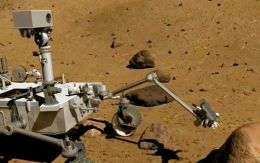
Mars Science Laboratory. Image: NASA

NASA's Mars Science Laboratory will launch two years later than previously planned, in the fall of 2011. The mission will send a next-generation rover with unprecedented research tools to study the early environmental history of Mars.

A launch date of October 2009 no longer is feasible because of testing and hardware challenges that must be addressed to ensure mission success. The window for a 2009 launch ends in late October. The relative positions of Earth and Mars are favorable for flights to Mars only a few weeks every two years. The next launch opportunity after 2009 is in 2011.

"We will not lessen our standards for testing the mission's complex flight systems, so we are choosing the more responsible option of changing the launch date," said Doug McCuistion, director of the Mars Exploration Program at NASA Headquarters in Washington. "Up to this point, efforts have focused on launching next year, both to begin the exciting science and because the delay will increase taxpayers' investment in the mission. However, we've reached the point where we can not condense the schedule further without compromising vital testing."

The Mars Science Laboratory team recently completed an assessment of the progress it has made in the past three months. As a result of the team's findings, the launch date was changed.

"Despite exhaustive work in multiple shifts by a dedicated team, the progress in recent weeks has not come fast enough on solving technical challenges and pulling hardware together," said Charles Elachi, director of NASA's Jet Propulsion Laboratory in Pasadena, Calif. "The right and smart course now for a successful mission is to launch in 2011."

The advanced rover is one of the most technologically challenging interplanetary missions ever designed. It will use new technologies to adjust its flight while descending through the Martian atmosphere, and to set the rover on the surface by lowering it on a tether from a hovering descent stage. Advanced research instruments make up a science payload 10 times the mass of instruments on NASA's Spirit and Opportunity Mars rovers. The Mars Science Laboratory is engineered to drive longer distances over rougher terrain than previous rovers. It will employ a new surface propulsion system.

Rigorous testing of components and systems is essential to develop such a complex mission and prepare it for launch. Tests during the middle phases of development resulted in decisions to re-engineer key parts of the spacecraft.

"Costs and schedules are taken very seriously on any science mission," said Ed Weiler, associate administrator for NASA's Science Mission Directorate at NASA Headquarters. "However, when it's all said and done, the passing grade is mission success."

The mission will explore a Mars site where images taken by NASA's orbiting spacecraft indicate there were wet conditions in the past. Four candidate landing sites are under consideration. The rover will check for evidence of whether ancient Mars environments had conditions favorable for supporting microbial life and preserving evidence of that life if it existed there.

Provided by NASA


print this article email this article download pdf blog this article bookmark this article     Digg this Stumble it share on Facebook share on Reddit add to delicious save to Yahoo! bookmarks
4/5 after 6 votes


December 4th, 2008 all stories
Space & Earth / Space Exploration

Comments: 0
Rank: 4/5 after 6 votes

  • Stumble this up

  • Digg this

  • Share it:
  • share on Facebook
  • share on MySpace
  • share on Slashdot
  • rss-newsfeed
  • share on Google
  • share on Reddit
  • add to delicious
  • save to Yahoo! bookmarks
  • share on Windows Live
  • Add to Mixx!
Rating: 4/5 after 6 votes

  • Related Stories

  • Forty years ago man first walked on the moon
    created 23 hours ago | popularity not rated yet | comments 0
  • Mars data published in Science this week
    created Jul 02, 2009 | popularity not rated yet | comments 0
  • Geological landforms indicate 'recent' warm weather on Mars
    created Jun 29, 2009 | popularity not rated yet | comments 0
  • Mars Odyssey Alters Orbit to Study Warmer Ground
    created Jun 22, 2009 | popularity not rated yet | comments 0
  • Apollo astronaut Aldrin urges US to land on Mars
    created Jun 19, 2009 | popularity not rated yet | comments 0


  • Physicists Demonstrate Quantum Memory with Matter Qubits
    Physicists Demonstrate Quantum Memory with Matter Qubits
    Physics / General Physics
    created Jul 03, 2009 | popularity 4.4 / 5 (17) | comments 1
  • 'Holey' Nanosheets for Wastewater Dye Removal
    Nanotechnology / Nanomaterials
    created Jul 01, 2009 | popularity 5 / 5 (5) | comments 1
  • Jellyfish Robot Swims Like its Biological Counterpart
    Jellyfish Robot Swims Like its Biological Counterpart
    Electronics / Robotics
    created Jun 26, 2009 | popularity 4.4 / 5 (8) | comments 1
  • Could Maxwell's Demon Exist in Nanoscale Systems?
    Could Maxwell's Demon Exist in Nanoscale Systems?
    Physics / General Physics
    created Jun 24, 2009 | popularity 4.4 / 5 (18) | comments 29
  • Living Safely with Robots, Beyond Asimov's Laws
    Living Safely with Robots, Beyond Asimov's Laws
    Electronics / Robotics
    created Jun 22, 2009 | popularity 4.6 / 5 (52) | comments 40
  • Other News

    Steam billows from the cooling towers at a nuclear power generating station in Byron

    Tropical zone expanding due to climate change: study

    Space & Earth / Earth Sciences

    created 1hour ago | popularity 5 / 5 (2) | comments 0

    Climate change is rapidly expanding the size of the world's tropical zone, threatening to bring disease and drought to heavily populated areas, an Australian study has found.


    US ambitions to send astronauts back to the moon as a prelude to missions to Mars have been put in doubt

    Forty years ago man first walked on the moon

    Space & Earth / Space Exploration

    created 23 hours ago | popularity 4.3 / 5 (4) | comments 2

    Forty years ago on July 20, 1969, American astronaut Neil Armstrong realized the oldest dream of human civilizations when he became the first man to walk on the moon.


    The least sea ice in 800 years

    The least sea ice in 800 years

    Space & Earth / Earth Sciences

    created Jul 01, 2009 | popularity 4.1 / 5 (65) | comments 60

    New research, which reconstructs the extent of ice in the sea between Greenland and Svalbard from the 13th century to the present indicates that there has never been so little sea ice as there is now. The ...


    Gas around young galaxy

    Intense heat killed the Universe's would-be galaxies, researchers say

    Space & Earth / Astronomy

    created Jul 01, 2009 | popularity 3.4 / 5 (21) | comments 27

    (PhysOrg.com) -- Our Milky Way galaxy only survived because it was already immersed in a large clump of dark matter which trapped gases inside it, scientists led by Durham University's Institute for Computational ...


    Scientists' Drill Hits Magma: Only Third Time on Record

    Scientists' Drill Hits Magma: Only Third Time on Record

    Space & Earth / Earth Sciences

    created Jun 29, 2009 | popularity 4.7 / 5 (22) | comments 21

    (PhysOrg.com) -- Scientists drilling a borehole deep into Iceland’s rocky crust to explore new methods of using geothermal energy hit a major roadblock on Thursday: Their drill ran into molten rock at a depth ...