Engineers work to make historic buildings safer during strong earthquakes
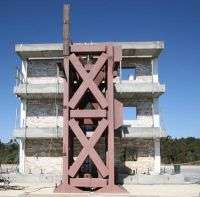
Recent simulated earthquake tests conducted by UC San Diego engineers are expected to lead to retrofit schemes that make historic buildings safer. The structural engineers tested a structure similar to those that were built in California in the 1920s that have masonry-infilled walls and reinforced concrete frames.
Based on data collected from tests performed on the world's only outdoor shake table, the engineers will come up with new seismic assessment tools and critical retrofit designs for these kinds of structures, which were not designed according to current standards. As part of the project, the engineers subjected a 3-story structure with non-ductile reinforced concrete frames with unreinforced masonry infill walls to shaking representative of a series of different seismic events.
Infill walls can generally improve the seismic safety of a building up to a certain level of earthquake intensity depending on the number of walls present and their locations. Once the strength of the walls is exceeded by the earthquake force, the failure of such structures could be sudden and catastrophic as demonstrated in the recent UC San Diego tests. Due to the frame-panel interaction, the earthquake load resisting mechanism of these structures is complicated and it is difficult for engineers to assess their seismic resistance. The objectives of this project are to investigate the resistance of this type of structure under realistic seismic load conditions with large-scale tests and develop and calibrate reliable analytical models to assess their seismic performance.
"We will also look into retrofit methods to push the performance envelop of these structures. In reality, some of these structures may not have sufficient walls to resist earthquake loads or some walls may be missing in critical locations of a building. Hence, we need reliable means to assess and improve their performance," said Benson Shing, a structural engineering professor at the UC San Diego Jacobs School of Engineering, and the lead researcher on the project.
The recent seismic tests were conducted at the UC San Diego Englekirk Structural Engineering Center, which is about 8 miles from the main university campus in La Jolla, and has the largest shake table in the country and the only outdoor shake table in the world. The concrete masonry structure is the largest of this type ever tested on a shake table.
After several strong jolts – measuring all the way up to a shaking that could be generated by a 7.5 magnitude earthquake – clusters of bricks fell off the structure as it suffered severe damaged on the first floor, which is a typical behavior of this type of building. The series of dramatic tests brought the structure close to collapsing.
"From these series of tests, one can see that unreinforced masonry infill walls can significantly improve the seismic resistance of a non-ductile reinforced concrete frame constructed according to the 1920's practice in California," Shing said. "The infilled structure tested here could resist a maximum considered earthquake according to the current building code. However, once the strength limit of the structure has been exceeded by the earthquake forces, the structure exhibited a sudden and catastrophic failure with the damage essentially localized in the bottom story. This kind of behavior is highly unsafe and presents a major problem for this class of existing structures, which may or may not have sufficient infill walls to resist strong earthquake forces, and in particular for those with large openings in infill walls."
Currently, there is a lack of reliable analysis methods to evaluate the seismic performance of these older structures and validated retrofit methods to improve their seismic behavior. In California, construction of unreinforced masonry buildings including those with brick infill walls came to a halt after the 1933 Long Beach earthquake – which was a 6.4 magnitude – but many of them still exist today. Although only moderate in terms of magnitude, this earthquake caused serious damage to unreinforced masonry structures on land fill from Los Angeles south to Laguna Beach. Property damage was estimated at $40 million, and 115 people were killed.
To succeed in their goals, the UC San Diego researchers are collaborating with a Professional Advisory Panel, a group of practicing engineers from different parts of the country, with significant experience in the seismic retrofit of older buildings. The project also involves researchers from Stanford University and the University of Colorado at Boulder.
"This is a masonry infilled-building with clay bricks and mortar joints as partition walls," explained Andreas Stavridis, a UC San Diego structural engineering Ph.D. student working on the project. "Due to their historical significance or economic reasons, we cannot bring them down and build new ones according to the current design practices."
The impact of this $1.24 million project, funded by the National Science Foundation, is vast since a large number of such structures can be found in the Pacific Northwest, and in the midwestern and eastern United States, where big earthquakes could occur even though the recurrence frequency is lower. This type of structural system is also very common in areas of high seismicity around the world, including China and the Mediterranean region.
"The brick walls in these kinds of buildings were not intended as structural elements," Shing said. "They were intended as partition walls and also provided fire protection. When they were built, the engineers did not consider these brick walls as part of the structural system. But in reality, in a big earthquake, these walls will interact with the frame and can sometimes cause very undesirable damage."
The researchers will now use data collected from the recent shake tests to validate the analytical models and analyze the failure patterns and behavior of the structure so that they can develop a scheme to retrofit a second specimen with the same design that will be built and tested in the spring 2009.
Recent simulated earthquake tests conducted by UC San Diego engineers are expected to lead to retrofit schemes that make historic buildings safer. The structural engineers tested a structure similar to those that were built in California in the 1920s that have masonry-infilled walls and reinforced concrete frames. Based on data collected from tests performed on the world's only outdoor shake table, the engineers will come up with new seismic assessment tools and critical retrofit designs for these kinds of structures, which were not designed according to current standards. As part of the project, the engineers subjected a 3-story structure with non-ductile reinforced concrete frames with unreinforced masonry infill walls to shaking representative of a series of different seismic events.
Infill walls can generally improve the seismic safety of a building up to a certain level of earthquake intensity depending on the number of walls present and their locations. Once the strength of the walls is exceeded by the earthquake force, the failure of such structures could be sudden and catastrophic as demonstrated in the recent UC San Diego tests. Due to the frame-panel interaction, the earthquake load resisting mechanism of these structures is complicated and it is difficult for engineers to assess their seismic resistance. The objectives of this project are to investigate the resistance of this type of structure under realistic seismic load conditions with large-scale tests and develop and calibrate reliable analytical models to assess their seismic performance.
"We will also look into retrofit methods to push the performance envelop of these structures. In reality, some of these structures may not have sufficient walls to resist earthquake loads or some walls may be missing in critical locations of a building. Hence, we need reliable means to assess and improve their performance," said Benson Shing, a structural engineering professor at the UC San Diego Jacobs School of Engineering, and the lead researcher on the project.
The recent seismic tests were conducted at the UC San Diego Englekirk Structural Engineering Center, which is about 8 miles from the main university campus in La Jolla, and has the largest shake table in the country and the only outdoor shake table in the world. The concrete masonry structure is the largest of this type ever tested on a shake table.
After several strong jolts – measuring all the way up to a shaking that could be generated by a 7.5 magnitude earthquake – clusters of bricks fell off the structure as it suffered severe damaged on the first floor, which is a typical behavior of this type of building. The series of dramatic tests brought the structure close to collapsing.
"From these series of tests, one can see that unreinforced masonry infill walls can significantly improve the seismic resistance of a non-ductile reinforced concrete frame constructed according to the 1920's practice in California," Shing said. "The infilled structure tested here could resist a maximum considered earthquake according to the current building code. However, once the strength limit of the structure has been exceeded by the earthquake forces, the structure exhibited a sudden and catastrophic failure with the damage essentially localized in the bottom story. This kind of behavior is highly unsafe and presents a major problem for this class of existing structures, which may or may not have sufficient infill walls to resist strong earthquake forces, and in particular for those with large openings in infill walls."
Currently, there is a lack of reliable analysis methods to evaluate the seismic performance of these older structures and validated retrofit methods to improve their seismic behavior. In California, construction of unreinforced masonry buildings including those with brick infill walls came to a halt after the 1933 Long Beach earthquake – which was a 6.4 magnitude – but many of them still exist today. Although only moderate in terms of magnitude, this earthquake caused serious damage to unreinforced masonry structures on land fill from Los Angeles south to Laguna Beach. Property damage was estimated at $40 million, and 115 people were killed.
To succeed in their goals, the UC San Diego researchers are collaborating with a Professional Advisory Panel, a group of practicing engineers from different parts of the country, with significant experience in the seismic retrofit of older buildings. The project also involves researchers from Stanford University and the University of Colorado at Boulder.
"This is a masonry infilled-building with clay bricks and mortar joints as partition walls," explained Andreas Stavridis, a UC San Diego structural engineering Ph.D. student working on the project. "Due to their historical significance or economic reasons, we cannot bring them down and build new ones according to the current design practices."
The impact of this $1.24 million project, funded by the National Science Foundation, is vast since a large number of such structures can be found in the Pacific Northwest, and in the midwestern and eastern United States, where big earthquakes could occur even though the recurrence frequency is lower. This type of structural system is also very common in areas of high seismicity around the world, including China and the Mediterranean region.
"The brick walls in these kinds of buildings were not intended as structural elements," Shing said. "They were intended as partition walls and also provided fire protection. When they were built, the engineers did not consider these brick walls as part of the structural system. But in reality, in a big earthquake, these walls will interact with the frame and can sometimes cause very undesirable damage."
The researchers will now use data collected from the recent shake tests to validate the analytical models and analyze the failure patterns and behavior of the structure so that they can develop a scheme to retrofit a second specimen with the same design that will be built and tested in the spring 2009.
Source: University of California - San Diego


