Researchers gain new insight on wonder of cell division
December 4th, 2008 Cell Division

Enlarge

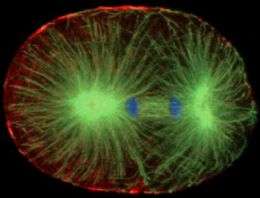
A photomicrograph made using fluorescent light microscopy shows a one-cell stage Caenorhabditis elegans (roundworm) embryo undergoing cell division. Microtubules (green) are rigid protein polymers that organize, capture and move chromosomes (blue) made up of DNA. Chromosomes are in two groups, which are being pulled by microtubules towards opposite poles of the bipolar spindle. The microfilament cytoskeleton (red) is at the cell cortex just underneath the cell membrane. These longer, more flexible protein polymers must be organized into a "cleavage furrow" that pulls a circumferential ring of the cell surface into the center of the cell, ultimately dividing the single parent cell into two daughter cells at the end of cell division -- each with one complete set of chromosomes and genes. The organization and constriction of the cleavage furrow happens slightly later. Credit: Courtesy of Bruce Bowerman

Biologists have discovered a mechanism that is critical to cytokinesis -- nature's completion of mitosis, where a cell divides into two identical daughter cells.

The researchers have opened a new window on the assembly and activity of a ring of actin and myosin filaments that contract to pinch a cell at just the right time. They focused on key proteins whose roles drive signaling mechanisms that promote the production of both linear and branching microfilaments along the inside surface membrane of a dividing cell. By down-regulating the production of branched microfilaments at the right time, the membrane may be more malleable and better able to pinch inward and complete cytokinesis.

The findings-- detailed in the Dec. 5 issue of the journal Science -- come from basic research using Caenorhabditis elegans (roundworm) embryos. The discovery provides more basic insight than immediate biomedical application, but the implications could lead to a fine-tuning of anti-cancer drug therapies or to isolating new targets for drugs to stop cancerous cell division, said Bruce Bowerman, professor of biology in the University of Oregon's Institute for Molecular Biology.

Bowerman and Karen Oegema of the Ludwig Institute for Cancer Research at the University of California, San Diego, were principal investigators of a seven-member team funded by the National Institutes of Health.

Scientists have theorized that the modulation of microfilament structure plays a role in healthy cell division. However, finding that such shape-shifting down-regulation specifically targets branched microfilaments assembly came as a surprise, Bowerman said.

C. elegans is used in many genetics research laboratories to discover basic requirements for the 20,000 genes that compose its genome; most of the genes are conserved in humans and carry out similar processes. Using these nematodes, Bowerman said, is allowing researchers to "find players inside that previously weren't known to be involved in cytokinesis."

The new research focused on enzymes targeted by the GAP domain of the protein CYK-4 that is part of a multi-protein complex called centralspindlin. This GAP domain functions as a GTPase activator, targeting protein switches called GTPases, which bind and hydrolyze guanosine triphosphate (GTP) to guanosine diphosphate (GDP). When GTPase is bound to GTP it acts as an on switch; when GTP is hydrolyzed to GDP, the switch is turned off.

The researchers found that deleting a GTPase called Rac could bypass the requirement for the GAP domain in CYK-4, Bowerman said. Because Rac GTPases promote branched microfilament assembly, this suggests that normally the CYK-4 GAP acts to down-regulate the production of branched microfilaments.

Previously CYK-4 had been thought to only down-regulate a different GTPase called RhoA, which promotes linear microfilament assembly. Thus these new results implicate the down-regulation of branched microfilaments at the cell cortex as a critical step in cell division.

"We have found a completely new way of thinking about how cells remodel their internal skeletons such that they undergo the shape changes needed to divide and produce daughter cells," Bowerman said. "Some of these proteins already are targets of some cancer drugs. Now we have the opportunity to study and understand how certain proteins stabilize microfilaments within cells and inhibit cell division, and how other proteins act to modulate the stiffness of a cell's membrane to allow them to undergo shape changes needed for cell division and proliferation."

Source: University of Oregon


print this article email this article download pdf blog this article bookmark this article     Digg this Stumble it share on Facebook share on Reddit add to delicious save to Yahoo! bookmarks
4.5/5 after 11 votes


December 4th, 2008 all stories
Biology /

Comments: 0
Rank: 4.5/5 after 11 votes

  • Stumble this up

  • Digg this

  • Share it:
  • share on Facebook
  • share on MySpace
  • share on Slashdot
  • rss-newsfeed
  • share on Google
  • share on Reddit
  • add to delicious
  • save to Yahoo! bookmarks
  • share on Windows Live
  • Add to Mixx!
Rating: 4.5/5 after 11 votes


  • Physicists Demonstrate Quantum Memory with Matter Qubits
    Physicists Demonstrate Quantum Memory with Matter Qubits
    Physics / General Physics
    created Jul 03, 2009 | popularity 4.4 / 5 (17) | comments 1
  • 'Holey' Nanosheets for Wastewater Dye Removal
    Nanotechnology / Nanomaterials
    created Jul 01, 2009 | popularity 5 / 5 (5) | comments 1
  • Jellyfish Robot Swims Like its Biological Counterpart
    Jellyfish Robot Swims Like its Biological Counterpart
    Electronics / Robotics
    created Jun 26, 2009 | popularity 4.4 / 5 (8) | comments 1
  • Could Maxwell's Demon Exist in Nanoscale Systems?
    Could Maxwell's Demon Exist in Nanoscale Systems?
    Physics / General Physics
    created Jun 24, 2009 | popularity 4.4 / 5 (18) | comments 29
  • Living Safely with Robots, Beyond Asimov's Laws
    Living Safely with Robots, Beyond Asimov's Laws
    Electronics / Robotics
    created Jun 22, 2009 | popularity 4.6 / 5 (52) | comments 40
  • Other News

    California water plan aims to save Puget Sound orcas

    Biology / Ecology

    created 14 hours ago | popularity not rated yet | comments 0

    A plan to restore salmon runs on California's Sacramento River also could help revive killer whale populations 700 miles to the north in Puget Sound, as federal scientists struggle to protect endangered species in a complex ...


    Scientists 'rebuild' giant moa using ancient DNA

    Biology / Plants & Animals

    created Jul 01, 2009 | popularity 5 / 5 (10) | comments 12

    (PhysOrg.com) -- Scientists have performed the first DNA-based reconstruction of the giant extinct moa bird, using prehistoric feathers recovered from caves and rock shelters in New Zealand.


    Pacific Giant Salamander (Dicamptodon tenebrosus)

    Salamanders, regenerative wonders, heal like mammals, people

    Biology / Microbiology

    created Jul 01, 2009 | popularity 5 / 5 (20) | comments 11

    The salamander is a superhero of regeneration, able to replace lost limbs, damaged lungs, sliced spinal cord -- even bits of lopped-off brain. But it turns out that remarkable ability isn't so mysterious after ...


    Genetically modified trees

    Anti-biotech groups obstruct forest biotechnology

    Biology / Biotechnology

    created Jun 30, 2009 | popularity 3.7 / 5 (7) | comments 5

    The potential of forest biotechnology to help address significant social and environmental issues is being "strangled at birth" by the rigid opposition of some groups and regulations that effectively preclude ...


    Super-sleepers could help super-sizers!

    Super-sleepers could help super-sizers!

    Biology / Plants & Animals

    created Jun 29, 2009 | popularity 5 / 5 (2) | comments 4

    Burrowing frogs can survive buried for several years without food or water. Scientists have discovered that the metabolism of their cells changes radically during the dormancy period allowing the frogs to ...