Why is the Earth's mantle conductive?
December 4, 2008 Why is the Earth's mantle conductive?

Enlarge

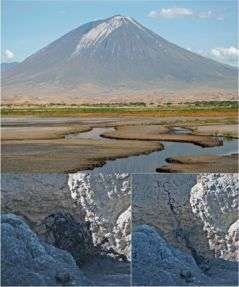
Above: Image of the Masai volcano, Oldoinyo Lengia (mountain of the gods) with, in white, a recent flow of liquid carbonate. Below: Two images of the lava lake, illustrating the very fluid character of this lava with extraordinary electrical properties. © Hannes Mattsson, ETH Zurich,

(PhysOrg.com) -- Researchers from INSU-CNRS (France), working with chemists at a CNRS research unit, have explained that the high conductivity of the Earth's upper mantle is due to molten carbonates. They demonstrated the very high conductivity of this form of carbon.

Appearing in the 28 November issue of Science, their work has revealed the high carbon content of the interior of the upper mantle. This composition can be directly linked to the quantity of carbon dioxide produced by 80% of volcanoes. This result is important for quantifying the carbon cycle, which contributes significantly to the greenhouse effect.

Geologists have long claimed that significant amounts of carbon have been present in the Earth's mantle for thousands of years. Up until now, there was very little direct proof of this hypothesis, and samples from the surface of the mantle contained only very small quantities of carbon. Also, for the last thirty years, scientists have been unable to explain the conductivity of the mantle, which is crossed by natural electrical currents at depths of 70 to 350 kms, even though olivine, one of the main mineral components of the upper mantle, is completely isolating.

To explain these phenomena, researchers from the Institut des Sciences de la Terre d'Orléans (ISTO, CNRS / Université de Tours / Université d'Orléans) looked into liquid carbonates, one of the most stable forms of carbon within the mantle, along with graphite and diamond. The Masai volcano is Tanzania is the only place in the world where these carbonates can be observed. Elsewhere, the carbonates are dissolved in basalts and emitted into the atmosphere in gaseous form, as CO2.

Based on lab measurements at CNRS's CEMHTI, the researchers established the high conductivity of molten carbonates. Their conductivity is 1000 times higher than that of basalt, which was previously thought to be the only potential conductor in the mantle. Fabrice Gaillard and his team have shown that the conductivity of the Earth's mantle is a result of the presence of small amounts of molten carbonates between chunks of solid rock.

This work shows that the electrical characteristics of the asthenosphere, the conductive part of the upper mantle, are directly connected to the amount of carbonate in the layer. The work also points to varying carbon distribution according to the regions and depth of the mantle. The researchers calculated that the amount of carbon present as liquid carbonate directly within the asthenosphere is between 0.003 and 0.025%, which seems low but makes it possible to explain the amounts of CO2 emitted into the atmosphere by 80% of volcanoes(5). This nonetheless represents a reservoir of carbon integrated into the mantle which is higher than that present on the surface of the earth. These results are unmatched in helping to quantify the carbon cycle, which plays a major role in the greenhouse effect. Indeed, the CO2 emitted by volcanic activity had never before been evaluated at the source (at the level of the mantle).

The presence of molten carbonates in the asthenosphere certainly has major implications on the viscosity of this region of the mantle, which participates in the sliding of tectonic plates, a phenomenon we know little about. The behavior of liquid carbonates in solids and potential effects on viscosity remain to be studied. Everything seems to indicate that the asthenosphere contains only oxidated forms of carbon (carbonates), and not carbon in its reduced solid form (diamond). Diamond formation remains mysterious, but researchers are guessing that diamonds form from liquid carbonates at the base of the lithosphere, below the asthenosphere. Enfin, the electrical measurements of the team on liquid carbonates are of interest to the field of clean energy production, as they can be used as electrolytes in high temperature batteries (eg. lithium carbonate).

This work was funded through a Young Researcher ANR project led by Fabrice Gaillard. He hopes to continue the work on liquid electrolytes through another ANR project and to therefore clarify these new hypotheses.

Reference:
Carbonatite Melts and Electrical Conductivity of the Asthenosphere. F. Gaillard, M. Malki, G. Iacono-Marziano, M. Pichavant, B. Scaillet. Science. 28 November 2008.

Provided by CNRS


print this article email this article download pdf blog this article bookmark this article     Stumble it Digg this share on Facebook retweet share on Reddit add to delicious
Rate this story - 4.6 /5 (24 votes)

Rank Filter

Move the slider to adjust rank threshold, so that you can hide some of the comments.


Display comments: newest first

  • CWFlink - Dec 04, 2008
    • Rank: 3.3 / 5 (3)
    Hum... Can we get wires down that far? Spinning conductor in a magnetic field.... non polluting source of electricity?
  • GrayMouser - Dec 04, 2008
    • Rank: 3 / 5 (4)
    Why did they have to tie this to GW?
  • Bob_Kob - Dec 05, 2008
    • Rank: 1 / 5 (4)
    Why did they have to tie this to GW?


    EVERYTHING is global warming.
  • KBK - Dec 05, 2008
    • Rank: 2.3 / 5 (3)
    Cow Farts!
  • axemaster - Dec 05, 2008
    • Rank: 5 / 5 (1)
    An interesting piece of work. However, I would hesitate to make the statement:

    "Indeed, the CO2 emitted by volcanic activity had never before been evaluated at the source (at the level of the mantle)."

    In fact, they still have not been evaluated "at the source", since that would imply that we actually measured it directly in the mantle. Nonetheless, very compelling evidence. I would imagine this has a significant effect on the Earth's magnetic field strength.
  • theophys - Dec 05, 2008
    • Rank: not rated yet
    I wonder if this might (in another century or two) lead to some modicum of control over the strength of Earth's magnetic field. That would be an interesting for of energy, climate control, and possibly global sun block.
    Or it could just end up as an interesting footnote in the dustbin of scietific leaps that never were.

December 4, 2008 all stories

Comments: 6

4.6 /5 (24 votes)
  • Stumble this up

  • Digg this

  • share this

  • hide
  • Related Stories

  • Carbon dioxide forms polymeric materials under high pressure
    created Mar 25, 2009 | popularity not rated yet | comments 0
  • Rocks could be harnessed to sponge vast amounts of CO2 from air, says study
    created Nov 05, 2008 | popularity not rated yet | comments 0
  • Mountain Ranges Rise Dramatically Faster Than Expected
    created Jan 26, 2006 | popularity not rated yet | comments 0
  • New coastland map could help strengthen sea defenses
    created Oct 06, 2009 | popularity not rated yet | comments 0
  • Water in Earth's mantle may be associated with subduction
    created Aug 19, 2009 | popularity not rated yet | comments 0


  • hide
  • Relevant PhysicsForums posts

  • cycles
    created 14 hours ago
  • The Origin of the term 'fossil' fuels
    created Nov 05, 2009
  • co2
    created Nov 03, 2009
  • Early Earths Sulfidic Ocean Conditions
    created Oct 30, 2009
  • vegetation
    created Oct 29, 2009
  • climate change
    created Oct 29, 2009
  • More from Physics Forums - Earth

Other News

Deep creep means milder, more frequent earthquakes along Southern California's San Jacinto fault

Deep creep means milder, more frequent earthquakes along Southern California's San Jacinto fault

Space & Earth / Earth Sciences

created 13 hours ago | popularity 4.7 / 5 (3) | comments 0

With an average of four mini-earthquakes per day, Southern California's San Jacinto fault constantly adjusts to make it a less likely candidate for a major earthquake than its quiet neighbor to the east, the ...


Success in 'space elevator' competition (AP)

Success in 'space elevator' competition (Update 3)

Space & Earth / Space Exploration

created Nov 05, 2009 | popularity 4.3 / 5 (33) | comments 50

(AP) -- A robot powered by a ground-based laser beam climbed a long cable dangling from a helicopter on Wednesday to qualify for prize money in a $2 million competition to test the potential reality of the ...


In a Galaxy Far, Far Away...

In a Galaxy Far, Far Away...

Space & Earth / Astronomy

created Nov 06, 2009 | popularity 4.8 / 5 (5) | comments 17

(PhysOrg.com) -- Astronomers have published the discovery of the farthest known object in the cosmos: a star that exploded when the universe was only 630 million years old -- only 4.6% of its current age. ...


'Dropouts' pinpoint earliest galaxies

'Dropouts' pinpoint earliest galaxies

Space & Earth / Astronomy

created Nov 06, 2009 | popularity 4.2 / 5 (10) | comments 13

Astronomers, conducting the broadest survey to date of galaxies from about 800 million years after the Big Bang, have found 22 early galaxies and confirmed the age of one by its characteristic hydrogen signature ...


Space hotel taking bookings for 2012 opening

Space hotel taking bookings for 2012 opening

Space & Earth / Space Exploration

created Nov 05, 2009 | popularity 4.4 / 5 (21) | comments 11

(PhysOrg.com) -- The first orbiting space hotel is on track to open for its first customers in 2012, but hurry, as bookings are filling fast.