Measuring sound with a nanoscopic air bubble
December 4th, 2008 Measuring sound with a nanoscopic air bubble

Enlarge

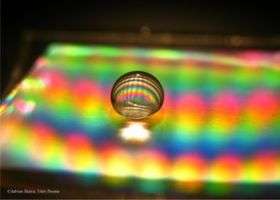
In the ultrasound sensor, the interface between water and air acts as a membrane. The vibrations of this membrane are measured using light.

(PhysOrg.com) -- It will soon be possible to measure ultrasonic sound using water, air, light and nanotechnology – over a hundred times more accurately than with existing sensors.

This innovative method is based on a new principle for an ultrasound sensor developed by Helmut Rathgen of the University of Twente, Netherlands. The new sound sensor enables accurate ultrasound scans with a small mobile device and can be used to improve the sonar equipment used on boats. Mr Rathgen was awarded his doctorate on 3 December at the faculty of Science and Technology.

The sensor designed by Helmut Rathgen consists of a glass fibre in which a hole measuring a few hundred nanometres has been bored; a hole many times smaller than a hair. The fibre is placed in a water droplet, so that a miniscule air bubble is created in the cavity. The interface between this air bubble and the water acts as a membrane which begins to vibrate under the influence of ultrasonic sound. The intensity of the sound can be determined by measuring the extent to which the interface vibrates.

The extent of this vibration is measured using a beam of light that is led through the glass fibre. Some of the light reflects against the interface. If the interface begins to vibrate, the intensity of the ultrasonic sound can be determined on the basis of the change in the reflection of the light.

Mobile ultrasound scans

The new sensor is over a hundred times more accurate than existing ultrasonic sound sensors and can be used for many applications. For instance, the sensor can be used in ships which, just like bats, make use of ultrasonic sound to map their environment. The sensor can also be used to improve medical sound scanning. Scans are used for various purposes including following the growth of unborn babies in the uterus. Since the sensor measures very accurately, the body only has to send out a very weak signal to be picked up. This means that it will be possible to make ultrasound scans with a small, battery-powered mobile device in the future.

The PhD student was presented with the NanoNed Innovation Award for his invention on 19 November. The objective of this prize is to encourage young researchers to translate their scientific work into a business idea that meets a demonstrable market need.

The University of Twente has applied for a patent on the invention and will be developing the principle into a ready-to-use product in cooperation with a company in the region.

Provided by University of Twente


print this article email this article download pdf blog this article bookmark this article     Digg this Stumble it share on Facebook share on Reddit add to delicious save to Yahoo! bookmarks
4.5/5 after 10 votes


December 4th, 2008 all stories
Nanotechnology / Nanophysics

Comments: 0
Rank: 4.5/5 after 10 votes

  • Stumble this up

  • Digg this

  • Share it:
  • share on Facebook
  • share on MySpace
  • share on Slashdot
  • rss-newsfeed
  • share on Google
  • share on Reddit
  • add to delicious
  • save to Yahoo! bookmarks
  • share on Windows Live
  • Add to Mixx!
Rating: 4.5/5 after 10 votes

  • Related Stories

  • I'm forever imploding bubbles
    created Apr 07, 2009 | popularity not rated yet | comments 0
  • Researchers develop portable 'Vein Finder' for faster, more accurate injections
    created Jan 17, 2006 | popularity not rated yet | comments 0
  • Sound imaging: clever acoustics help blind people see the world (w/ Video)
    created Jul 02, 2009 | popularity not rated yet | comments 0
  • Students create portable device to detect suicide bombers (w/ Video)
    created Jun 24, 2009 | popularity not rated yet | comments 0
  • Revolutionizing the diagnosis of serious disease
    created Jun 02, 2009 | popularity not rated yet | comments 0


  • Physicists Demonstrate Quantum Memory with Matter Qubits
    Physicists Demonstrate Quantum Memory with Matter Qubits
    Physics / General Physics
    created Jul 03, 2009 | popularity 4.4 / 5 (17) | comments 1
  • 'Holey' Nanosheets for Wastewater Dye Removal
    Nanotechnology / Nanomaterials
    created Jul 01, 2009 | popularity 5 / 5 (5) | comments 1
  • Jellyfish Robot Swims Like its Biological Counterpart
    Jellyfish Robot Swims Like its Biological Counterpart
    Electronics / Robotics
    created Jun 26, 2009 | popularity 4.4 / 5 (8) | comments 1
  • Could Maxwell's Demon Exist in Nanoscale Systems?
    Could Maxwell's Demon Exist in Nanoscale Systems?
    Physics / General Physics
    created Jun 24, 2009 | popularity 4.4 / 5 (18) | comments 29
  • Living Safely with Robots, Beyond Asimov's Laws
    Living Safely with Robots, Beyond Asimov's Laws
    Electronics / Robotics
    created Jun 22, 2009 | popularity 4.6 / 5 (52) | comments 40
  • Other News

    A 'quantum of sol' -- how nanotechnology could hold the key to a solar-powered future

    A 'quantum of sol' -- how nanotechnology could hold the key to a solar-powered future

    Nanotechnology / Nanomaterials

    created Jun 30, 2009 | popularity 3.9 / 5 (14) | comments 16

    (PhysOrg.com) -- A new generation of 'nano-structured' millimetre-sized solar cells that could convert the sun's energy to electricity more than twice as efficiently as current technology, is the subject of ...


    Australian researchers are set to begin human trials of a tiny nano-cell that acts as a "Trojan horse" against cancer

    Hi-tech 'Trojan horse' can kill cancer cells: researchers

    Nanotechnology / Bio & Medicine

    created Jun 29, 2009 | popularity 4.6 / 5 (11) | comments 7

    Australian researchers are set to begin human trials of a tiny nano-cell that acts as a "Trojan horse" against cancer cells, a breakthrough they say may curb the need for debilitating chemotherapy.


    'Holey' Nanosheets for Wastewater Dye Removal

    Nanotechnology / Nanomaterials

    created Jul 01, 2009 | popularity 5 / 5 (5) | comments 1

    (PhysOrg.com) -- Researchers have discovered that extremely thin sheets of nickel oxide with hexagonally shaped holes can absorb hazardous dyes from wastewater nearly as well as the best traditional methods, but are recyclable. ...


    Harnessing Nanoparticles To Track Cancer Cell Changes

    Nanotechnology / Bio & Medicine

    created Jul 03, 2009 | popularity not rated yet | comments 1

    The more dots there are, the more accurate a picture you get when you connect them. Cancer researchers adopting that philosophy have developed a new imaging technology that could give scientists the ability to simultaneously ...


    Computer-Guided Nanoparticle Therapy Destroys Tumors

    Nanotechnology / Bio & Medicine

    created Jun 29, 2009 | popularity 5 / 5 (11) | comments 0

    Gold nanoshells are among the most promising new nanoscale therapeutics being developed to kill tumors, acting as antennas that turn light energy into heat that cooks cancer to death. Now, a multi-institutional research team ...