Return of the Leonids
December 5, 2008 Return of the Leonids

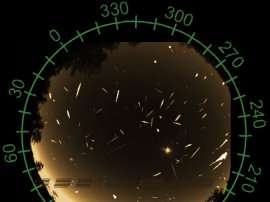
A composite, all-sky image of the 2008 Leonid outburst over Colorado. Credit: Chris Peterson, Cloudbait Observatory.

Astronomers from Caltech and NASA say a strong shower of Leonid meteors is coming in 2009. Their prediction follows an outburst on Nov. 17, 2008, that broke several years of "Leonid quiet" and heralds even more intense activity next November.

"On Nov. 17, 2009, we expect the Leonids to produce upwards of 500 meteors per hour," says Bill Cooke of the NASA Marshall Space Flight Center. "That's a very strong display."

Forecasters define a meteor storm as 1000 or more meteors per hour. That would make the 2009 Leonids "a half-storm," says Jeremie Vaubaillon of Caltech, who successfully predicted a related outburst just a few weeks ago.

On Nov. 17, 2008, Earth passed through a stream of debris from comet 55P/Tempel-Tuttle. The gritty, dusty debris stream was laid down by the Leonids' parent comet more than five hundred years ago in 1466. Almost no one expected the old stream to produce a very strong shower, but it did. Observers in Asia and Europe counted as many as 100 meteors per hour.

Vaubaillon predicted the crossing with one-hour precision. "I have a computer program that calculates the orbits of Leonid debris streams," he explains. "It does a good job anticipating encounters even with very old streams like this one."

The Nov. 17, 2008 outburst proved that the 1466 stream is rich in meteor-producing debris, setting the stage for an even better display in 2009.

On Nov. 17, 2009, Earth will pass through the 1466 stream again, but this time closer to the center. Based on the number of meteors observed in 2008, Vaubaillon can estimate the strength of the coming display: five hundred or more Leonids per hour during a few-hour peak centered on 21:43 UT.

"Our own independent model of the debris stream agrees," says Cooke. "We predict a sub-storm level outburst on Nov. 17, 2009, peaking sometime between 21:34 and 21:44 UT."

The timing favors observers in Asia, although Cooke won't rule out a nice show over North America when darkness falls hours after the peak. "I hope so," he says. "It's a long way to Mongolia."

Many readers will remember the great Leonid showers of 1998-2002. The best years (1999 and 2001) produced storms of up to 3000 Leonids per hour. The 2009 display won’t be so intense. Instead, if predictions are correct, next year's shower could resemble the 1998 Leonids, a "half-storm"-level event caused by a stream dating from 1333. That old stream turned out to be rich in nugget-sized debris that produced an abundance of fireballs. Many observers consider the 1998 Leonids to be the best they've ever seen.

Could 2009 be the same? Vaubaillon expects a similar number of meteors but fewer fireballs. If the models are correct, the 1466 stream in Earth’s path contains plenty of dust but not so many nuggets, thus reducing the fireball count. On the bright side, the Moon will be new next Nov. 17th so nothing will stand in the way of the shower reaching its full potential.

Provided by Dr. Tony Phillips, Science@NASA


print this article email this article download pdf blog this article bookmark this article     Stumble it Digg this share on Facebook retweet share on Reddit add to delicious
Rate this story - 4.7 /5 (7 votes)


December 5, 2008 all stories

Comments: 0

4.7 /5 (7 votes)
  • Stumble this up

  • Digg this

  • share this

  • hide
  • Related Stories

  • The 2009 Leonid Meteor Shower
    created Nov 10, 2009 | popularity not rated yet | comments 0
  • Engineers Closing the Gap Between High-Speed Data Transmission and Processing
    created Jan 27, 2009 | popularity not rated yet | comments 0
  • Spotify launches application for Nokia phones
    created 1hour ago | popularity not rated yet | comments 0
  • Xbox 360, PlayStation 3 friend Facebook
    created Nov 18, 2009 | popularity not rated yet | comments 0
  • Google's SPDY will speed up downloads
    created Nov 16, 2009 | popularity not rated yet | comments 0


  • hide
  • Relevant PhysicsForums posts

  • dark energy can escape black holes.
    created 2 hours ago
  • Are there green, purple and pink stars?
    created 14 hours ago
  • Sideral question
    created Nov 21, 2009
  • Doppler shifted blackbody spectrum
    created Nov 21, 2009
  • More from Physics Forums - General Astronomy

Other News

Is global warming unstoppable?

Space & Earth / Environment

created 3 hours ago | popularity 3.3 / 5 (7) | comments 7

In a provocative new study, a University of Utah scientist argues that rising carbon dioxide emissions - the major cause of global warming - cannot be stabilized unless the world's economy collapses or society builds the ...


The shore of Deception Island in Antarctica, in 2008

Antarctic ice loss vaster, faster than thought: study

Space & Earth / Earth Sciences

created 19 hours ago | popularity 2.9 / 5 (17) | comments 24

The East Antarctic icesheet, once seen as largely unaffected by global warming, has lost billions of tonnes of ice since 2006 and could boost sea levels in the future, according to a new study.


Astronaut suit problem delays spacewalk No. 3 (AP)

Astronaut suit problem delays spacewalk No. 3

Space & Earth / Space Exploration

created 5 hours ago | popularity not rated yet | comments 0

(AP) -- The third and final spacewalk of space shuttle Atlantis' mission is being held up by a suit problem.


How green is your house? Recycling favorite activity among Brits says new survey

Space & Earth / Environment

created 2 hours ago | popularity not rated yet | comments 3

Seventy percent of households always separate their rubbish for recycling, but only 2 percent buy their energy on a green tariff, according to the early findings of a major new annual household survey, called "Understanding ...


Denmark: 65 world leaders for UN climate summit (AP)

Denmark: 65 world leaders for UN climate summit

Space & Earth / Environment

created 19 hours ago | popularity 2.3 / 5 (3) | comments 2

(AP) -- Sixty-five world leaders have said they will attend the Copenhagen climate summit in December, and several more have responded positively to invitations, Danish officials said Sunday.