Pedal pusher: Engineering professor, students plan citywide bike paths
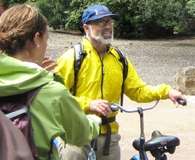
December 5, 2008 By Susan Salk
(PhysOrg.com) -- An earthy mobile of cyclists hangs above Peter Furth’s office computer. A gift from his children, the dangling artifact originates from an African country where bikes are a primary mode of transportation, and is a manifestation of the civil and environmental engineering professor’s passion: bicycles as transport.
“I love public transportation and bicycling because I love active living,” Furth says. “So many people enjoy the convenience of slipping into a car and commuting that way, but I think these people are losing their lives — they’re never outdoors.”
By contrast, there is nothing better than arriving to work red-faced from the wind, lungs and heart pumping, and blood flowing with vitality, he says. Furth and like-minded civil engineering students recently returned from a faculty led study abroad trip to the Netherlands, where they learned about a culture and infrastructure built for bicycle riders. “They have a system that is built to promote walking and cycling,” Furth said.
He noted that 75 percent of school children in the Netherlands ride bikes or walk to school. By contrast, the number of U.S. school children who walk or bike to school are in the single percentages, he said.
Praising the city of Davis, Calif., for its adaptation of bike paths into the infrastructure, Furth hopes Boston will pick up on the idea. He and a team of Northeastern civil engineering students who studied in the Netherlands are working on 11 citywide projects aimed at building better bike paths for those wishing to commute.
Students have been studying the former bridle paths of the Emerald Necklace, a seven-mile stretch winding from the Public Gardens in Boston through Jamaica Plain and winding up in Franklin Park, to look for ways to link the old pathways together. In many portions, roadways overlap the paths and would require reconfiguration or redesign, signals, or even bridges, for safe passage.
“Our goal is to find ways to allow people to be able to bike around, either to and from work, or on errands,” Furth said. “We have a network problem. You can’t have people ride more bikes unless they can get from point to point in a safe, pleasant way.”
Students are seeing the green light in at least one interchange. The rotary that connects Park Drive, the Riverway and Brookline Avenue, is destined to become more passable for cyclists as part of a new redesign.
Furth’s students are in part responsible. The Army Corps of Engineers recently heard student testimony at a public hearing on the Muddy River Project supporting the addition of bike paths to the interchange. Furth said their testimony and research helped support a design change that will allow for bike paths once the new interchange is built in two years.
“The Army Corps completely changed their design to make it safer for bikes after they heard the testimony of our students,” Furth said. “We’ve got 11 projects in the city, and I hope, in time, they will result in safer bike routes throughout Boston.”
Provided by Northeastern University
-
Engineers build first sub-10-nm carbon nanotube transistor
Feb 01, 2012 |
4.9 / 5 (33) |
30
-
Something old, something new: Evolution and the structural divergence of duplicate genes
Jan 31, 2012 |
4.6 / 5 (7) |
1
-
The hidden nanoworld of ice crystals: Revealing the dynamic behavior of quasi-liquid layers
Jan 30, 2012 |
5 / 5 (4) |
1
-
Stock market network reveals investor clustering
Jan 27, 2012 |
3.9 / 5 (23) |
8
-
Of microchemistry and molecules: Electronic microfluidic device synthesizes biocompatible probes
Jan 26, 2012 |
5 / 5 (2) |
0
-
Bohr-Einstein debate: why did Bohr not simply say...
Feb 06, 2012
-
Best/Worst U.S. Presidents
Jan 31, 2012
- More from Physics Forums - History & Humanities
More news stories
A frank discussion of the power law and linking correlation to causation
(PhysOrg.com) -- Michael Stumpf a mathematics professor at Imperial College in London, and Mason Porter a lecturer at Oxford have teamed together to write and publish a perspective piece in Science regarding the in ...
US workers are 'giving away the store,' costing firms billions
Nearly 70 percent of the nation's service employees give away free goods and services from hamburgers to cable TV costing companies billions of dollars a year, according to a groundbreaking study.
Other Sciences / Economics & Business
Feb 09, 2012 |
3 / 5 (5) |
11
Employers feel no love for unscrupulous practice of 'service sweethearting'
A new study led by two Florida State University marketing professors finds that some frontline service employees who are rewarded for hikes in customer loyalty and satisfaction also may engage in "service ...
Other Sciences / Economics & Business
Feb 10, 2012 |
3.3 / 5 (3) |
10
New insights into how to correct false knowledge
The abundance of false information available on the Internet, in movies and on TV has created a big challenge for educators.
Other Sciences / Social Sciences
Feb 07, 2012 |
4.9 / 5 (7) |
9
|
Neanderthal demise due to many influences, including cultural changes: study
As an ice age crept upon them thousands of years ago, Neanderthals and modern human ancestors expanded their territory ranges across Asia and Europe to adapt to the changing environment.
Other Sciences / Archaeology & Fossils
Feb 07, 2012 |
4.4 / 5 (5) |
8
|
Scientists discover molecular secrets of 2,000-year-old Chinese herbal remedy
For roughly two thousand years, Chinese herbalists have treated Malaria using a root extract, commonly known as Chang Shan, from a type of hydrangea that grows in Tibet and Nepal. More recent studies suggest that halofuginone, ...
New method to examine batteries -- MRI from the inside
There is an ever-increasing need for advanced batteries for portable electronics, such as phones, cameras, and music players, but also to power electric vehicles and to facilitate the distribution and storage of energy derived ...
A mitosis mystery solved: How chromosomes align perfectly in a dividing cell
Although the process of mitotic cell division has been studied intensely for more than 50 years, Whitehead Institute researchers have only now solved the mystery of how cells correctly align their chromosomes during symmetric ...
Google might launch Drive for cloud storage soon
(PhysOrg.com) -- Google's next big move, according to the Wall Street Journal, is a cloud storage service called Drive. Hardly first to the plate, Google is simply catching up to introducing its cloud reposi ...
Lab study raises questions over nano-particle impact
Tests involving chickens have raised questions about the impact on health from engineered nano-particles, the ultra-fine grains commonly used in drugs and processed foods, scientists said on Sunday.
Overeating may double risk of memory loss
New research suggests that consuming between 2,100 and 6,000 calories per day may double the risk of memory loss, or mild cognitive impairment (MCI), among people age 70 and older. The study was released today and will be ...