Blight-resistant American chestnut trees nearing reality
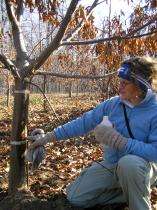
(PhysOrg.com) -- The demise of the American chestnut is one of the great ecological disasters of our time, according to a chestnut expert in Penn State's College of Agricultural Sciences, who envisions a day in the not-so-distant future when the huge trees will again be growing in American forests.
Through the first-half of the 20th century, the species (Castanea dentata) -- which was by far the dominant forest tree species in Pennsylvania and the East -- was virtually eliminated from the landscape by an Asiatic blight fungus (Cryphonectria parasitica) carried on exotic plant materials imported by plant explorers in the late 1800s.
A decades-long process of introducing blight resistance by cross-breeding Chinese chestnut trees with American chestnuts, and then back-crossing the hybrids with American chestnuts to select for desirable American chestnut form and traits, seems to be close to bearing fruit. "We have a six-generation breeding program -- we think that will be adequate for both full American character and blight-resistance," said Sara Fitzsimmons, Northern Appalachian regional science coordinator for the American Chestnut Foundation and a research support technologist in Penn State's School of Forest Resources.
"The fifth generation trees are currently planted at the Penn State Arboretum and at our Meadowview facility in southwestern Virginia. We collected seed from those trees last year and we actually have sixth-generation plants growing in pots right now at Penn State."
Those potted plants could be -- indeed should be – blight-resistant, according to Fitzsimmons. But it will be years until researchers know for sure. "Does this process work? Honestly, we don't know," she said. "But we will be testing it in the next 10 years to be sure the blight resistance is there."
The U.S. Forest Service will get 50 percent of the chestnut foundation's sixth-generation tree seedlings to plant in federal forests where blight resistance can be monitored, Fitzsimmons noted. Because most of the organization's hybrid trees are being grown in the South, blight-resistant candidate trees first will be planted in Jefferson National Forest in Virginia, Cherokee National Forest in North Carolina and Daniel Boone National Forest in Kentucky.
"It may take 100 or 150 years to see these trees restored to Eastern forests on any sort of large scale," Fitzsimmons conceded. "But it might not be much more than 10 or 15 years until folks can go to local garden stores or nurseries and buy blight-resistant chestnut trees. That's exciting."
Even if the sixth-generation trees now being grown don't produce satisfactory blight-resistant seed, Fitzsimmons is confident that blight-resistant American chestnut trees will be developed soon. "Even if this plant material doesn't pan out, we have so much material coming through the pipeline that it will do the trick," she said.
Fitzsimmons and four other scientists -- including Kim Steiner, professor of forest biology and director of the Arboretum at Penn State -- journeyed to China in September to research getting even more blight-resistant plant material to breed with American chestnut trees. Researchers believe a broad diversity of resistance genes will provide a lasting defense against the deadly blight.
"The chestnut blight is common in China — it just doesn't kill the trees," said Fitzsimmons. "What better place to get disease-resistant material than the place where resistance comes from?"
While in China, the American contingent conferred with a Chinese forest pathologist who has studied the blight. "The blight fungus is remarkably diverse in China, much more so than here, but that's because it evolved there over millions of years and is fairly new to North America," Fitzsimmons explained. "I look at disease resistance as a puzzle, and hopefully the material from China will be just another piece."
It would be hard to exaggerate the importance of the American chestnut in eastern United States forests. The tree was very densely populated with a range from Maine to Georgia. In Pennsylvania, more than 25 percent of the hardwoods were American chestnut trees. In virgin forests throughout their range, mature chestnuts are said to have averaged up to 5 feet in diameter and up to 100 feet tall. Many specimens of 8 to 10 feet in diameter were recorded, and there were rumors of trees bigger still.
"Due to their abundance and enormous size, the American chestnut once ranked as the most important wildlife plant in the eastern United States," said Fitzsimmons. "A large American chestnut tree could produce 10 bushels or more of nuts annually. Chestnut mast supported many species indigenous to Pennsylvania, including squirrels, wild turkeys, white-tailed deer, black bears, raccoons and grouse, which once depended on chestnuts as a major food source."
Because of the species’ capacity to regenerate from the root collar, the American chestnut continues to survive. Once the “king of the forest,” the American chestnut typically is found now only as a small stump sprout, rarely reaching more than 20 feet in height. Although the tree has escaped the threatened and endangered species list because of its fairly numerous population size, the blight fungus typically kills those stems before they can reach sexual maturity, reproduce and/or expand within its native range.
"Though hundreds of thousands of sprouts are thought to exist throughout the original range, recent Forest Inventory Analysis data suggest a reduction in overall number of chestnut stems throughout the eastern United States’ forests," said Fitzsimmons. "Different management strategies, the importation of other exotic and invasive species, and the influence of Pennsylvania’s ravenous deer herd all have had an effect on the species' capacity to continue surviving simply through resprouting."
Provided by Pennsylvania State University


