New record for information storage and retrieval lifetime advances quantum networks
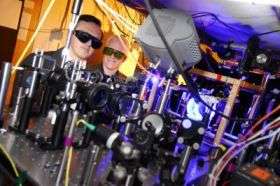
Physicists have taken a significant step toward creation of quantum networks by establishing a new record for the length of time that quantum information can be stored in and retrieved from an ensemble of very cold atoms. Though the information remains usable for just milliseconds, even that short lifetime should be enough to allow transmission of data from one quantum repeater to another on an optical network.
The new record – 7 milliseconds for rubidium atoms stored in a dipole optical trap – is scheduled to reported December 7 in the online version of the journal Nature Physics by researchers at the Georgia Institute of Technology. The previous record for storage time was 32 microseconds, a difference of more than two orders of magnitude.
"This is a really significant step for us, because conceptually it allows long memory times necessary for long-distance quantum networking," said Alex Kuzmich, associate professor in the Georgia Tech School of Physics and a co-author of the paper. "For multiple architectures with many memory elements, several milliseconds would allow the movement of light across a thousand kilometers."
The keys to extending the storage time included the use of a one-dimensional optical lattice to help confine the atoms and selection of an atomic phase that is insensitive to magnetic effects. The research was sponsored by the National Science Foundation, the A.P. Sloan Foundation and the U.S. Office of Naval Research.
The general purpose of quantum networking or quantum computing is to distribute entangled qubits – two correlated data bits that are either "0" or "1" – over long distances. The qubits would travel as photons across existing optical networks that are part of the global telecommunications system.
Because of loss in the optical fiber that makes up networks, repeaters must be installed at regular intervals – about every 100 kilometers – to boost the signal. Those repeaters will need quantum memory to receive the photonic signal, store it briefly and then produce a photonic signal that will carry the information to the next node, and on to its final destination.
For their memory, the Georgia Tech researchers used an ensemble of rubidium-87 atoms that is cooled to almost absolute zero to minimize atomic motion. To store information, the entire atomic ensemble is exposed to laser light carrying a signal, which allows each atom to participate in the storage as part of a "collective excitation."
In simple terms, each atom "sees" the incoming signal – which is a rapidly oscillating electromagnetic field – slightly differently. Each atom is therefore imprinted with phase information that can later be "read" from the ensemble with another laser.
Even though they are very cold, the atoms of the ensemble are free to move in a random way. Because each atom stores a portion of the quantum information and that data's usefulness depends on each atom's location in reference to other atoms, significant movement of the atoms could destroy the information.
"The challenge for us in implementing these long-lived quantum memories is to preserve the phase imprinting in the atomic ensemble for as long as possible," explained Stewart Jenkins, a School of Physics research scientist who participated in the research. "It turns out that is difficult to do experimentally."
To extend the lifetime of their memory, the Georgia Tech researchers took two approaches. The first was to confine the atoms using an optical lattice composed of laser beams. Because of the laser frequencies chosen, the atoms are attracted to specific locations within the lattice, though they are not held tightly in place.
Because the ensemble atoms are affected by environmental conditions such as magnetism, the second strategy was to use atoms that had been pumped to the so-called "clock transition state" that is relatively insensitive to magnetic fields.
"The most critical aspect to getting these long coherence times was the optical lattice," Jenkins explained. "Although atoms had been confined in optical lattices before, what we did was to use this tool in the context of implementing quantum memory."
Other research teams have stored quantum information in single atoms or ions. This simpler approach allows longer storage periods, but has limitations, he said.
"The advantage of using these ensembles as opposed to single atoms is that if we shine into them a 'read' laser field, because these atoms have a particular phase imprinted on them, we know with a high degree of probability that we are going to get a second photon – the idler photon – coming out in a particular direction," Jenkins explained. "That allows us to put a detector in the right location to read the photon."
Though the work significantly advances quantum memories, practical quantum networks probably are at least a decade away, Kuzmich believes.
"In practice, you will need to make robust repeater nodes with hundreds of memory elements that can be quickly manipulated and coupled to the fiber," he said. "There is likely to be slow progress in this area with researchers gaining better and better control of quantum systems. Eventually, they will get good enough so we can make a jump to having systems that can work outside the laboratory environment."
Source: Georgia Institute of Technology


