Men are red, women are green, researcher finds
December 8, 2008 Male or Female?

Enlarge

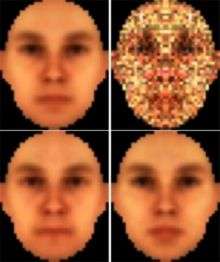
Test subjects tended to confirm subtle color differences associated with gender. Even when viewing pixelated or distorted images, subjects identified redder images as male and greener images as female. Credit: Michael J. Tarr/Brown University

Michael J. Tarr, a Brown University scientist, and graduate student Adrian Nestor have discovered this color difference in an analysis of dozens of faces. They determined that men tend to have more reddish skin and greenish skin is more common for women.

The finding has important implications in cognitive science research, such as the study of face perception. But the information also has a number of potential industry or consumer applications in areas such as facial recognition technology, advertising, and studies of how and why women apply makeup.

"Color information is very robust and useful for telling a man from a woman," said Tarr, the Fox Professor of Ophthalmology and Visual Sciences and professor of cognitive and linguistic sciences at Brown. "It's a demonstration that color can be useful in visual object recognition."

Tarr said the idea that color may help us to identify objects better has been controversial. But, he said, his and related findings show that color can nonetheless provide useful information.

Tarr and Nestor's research is reported in the journal Psychological Science. The paper will be published online Dec. 8 and in print a few weeks later.

To conduct the study, Tarr needed plenty of faces. His lab analyzed about 200 images of Caucasian male and female faces (100 of each gender) compiled in a data bank at the Max Planck Institute in Tübingen, Germany, photographed using a 3-D scanner under the same lighting conditions and with no makeup. He then used a MatLab program to analyze the amount of red and green pigment in the faces.

Additionally, Tarr and his lab relied on a large number of other faces photographed under similar controlled conditions. (Tarr has made them available on his web site, www.tarrlab.org.)

What he found: Men proved to have more red in their faces and women have more green, contrary to prior assumptions.

"If it is on the more red end of the spectrum (the face) had a higher probability of being male. Conversely, if it is on the green end of the spectrum (the face) had a higher probability of being female," Tarr said.

To test the concept further, Nestor and Tarr used an androgynous image compiled from the average of the 200 initial faces. Trial by trial, they randomly clouded the face with "visual noise" that either included more red or green. The "noise" was not unlike static that can appear on a television screen with no signal.

Subjects were then asked to decide on the gender of the image, using nothing more than the random shape and color patterns over the sexually ambiguous face as a guide. Tarr describes the effect as a "superstitious hallucination," similar to being in the shower and hearing the doorbell or telephone even when neither rings.

Three Brown University students participated in the experiment for pay, and they all had normal or corrected vision with no color blindness. Each observer handled about 20,000 trials spread across 10 one-hour sessions.

Once the study was complete, the images identified by subjects as male or female were divided into two piles according to gender.

Each pile of images was then analyzed to determine the average color content across various locations in the images.

Across much of both sets of face images, Nestor and Tarr found that the "male" piles were redder and the "female" piles greener.

Such differences are not absolute — some women's faces are much redder and some men's faces are much greener — but overall, across this and related studies, Tarr has determined that observers use the color of a face when trying to identify its gender. That is particularly true when the shape of the given face is ambiguous or hidden.

Another study found, for example, that observers are quite sensitive to the color of faces when the facial images are blurred to the point where the face shape is almost impossible to see.

Source: Brown University


print this article email this article download pdf blog this article bookmark this article     Stumble it Digg this share on Facebook retweet share on Reddit add to delicious
Rate this story - 4.1 /5 (21 votes)

Rank Filter

Move the slider to adjust rank threshold, so that you can hide some of the comments.


Display comments: newest first

  • Keter - Dec 08, 2008
    • Rank: 1 / 5 (2)
    "Green" might be simply anemic while red means not anemic. Not surprising, really, since many more women are anemic (due to menstruation) than men.
  • barakn - Dec 08, 2008
    • Rank: 1.4 / 5 (5)
    With only three test subjects, this study is just about worthless.
  • Nanotube - Dec 08, 2008
    • Rank: 1.8 / 5 (5)
    As Eddie Murphy said:
    "If the b*tch is green, something is wrong with the p*ssy!"
    :)
  • Roach - Dec 09, 2008
    • Rank: not rated yet
    So, love is blind, but homosexuality is colorblind... before I get a 1, get off your high horse, that was funny.

December 8, 2008 all stories

Comments: 4

4.1 /5 (21 votes)
  • Stumble this up

  • Digg this

  • share this

  • hide
  • Related Stories

  • Birds in captivity lose hippocampal mass
    created Oct 12, 2009 | popularity not rated yet | comments 0
  • Neural mapping paints a haphazard picture of odor receptors
    created Feb 03, 2009 | popularity not rated yet | comments 0
  • Was it the chicken salad or the swim?
    created Jan 26, 2009 | popularity not rated yet | comments 0
  • Scientists learn what's 'up' with a class of retinal cells in mice
    created Mar 27, 2008 | popularity not rated yet | comments 0
  • Possible hepatitis C vaccine
    created Sep 05, 2007 | popularity not rated yet | comments 0


  • hide
  • Relevant PhysicsForums posts

  • Multiple Sclerosis & CCSVI
    created 8 hours ago
  • 23 Years in a Vegetative State....or not?
    created Nov 25, 2009
  • Has the H1N1 vaccine been scientifically proven to work?
    created Nov 24, 2009
  • nesfatin
    created Nov 22, 2009
  • More from Physics Forums - Medical Sciences

Other News

eye

Over-the-counter eye drops raise concern over antibiotic resistance

Medicine & Health / Medications

created 52 minutes ago | popularity not rated yet | comments 0

(PhysOrg.com) -- The use of antibiotic eye drops for conjunctivitis has increased by almost half since they became available over the counter at chemists in 2005, data obtained by Oxford University researchers ...


More clarity needed on law of assisted suicide

More clarity needed on law of assisted suicide

Medicine & Health / Other

created 19 minutes ago | popularity not rated yet | comments 0

(PhysOrg.com) -- Doctors need more clarity on what they can and cannot do within the current law on assisted suicide, according to an editorial by Dr Richard Huxtable and Professor Karen Forbes in this week's ...


Hyperactivity associated with short sleep-time for young boys: study

Hyperactivity associated with short sleep-time for young boys: study

Medicine & Health / Psychology & Psychiatry

created 1hour ago | popularity not rated yet | comments 0

(PhysOrg.com) -- Hyperactive boys don't get enough sleep, which can worsen their condition according to new research. Published in the November issue of Pediatrics, the study is the first to examine a larg ...


School closure could reduce swine flu transmission by 21 percent

Medicine & Health / Diseases

created 1hour ago | popularity not rated yet | comments 0

A survey carried out in eight European countries has shown that closing schools in the event of an infectious disease pandemic could have a significant role in reducing illness transmission. Researchers writing in the open ...


Diabetes cases to double and costs to triple by 2034

Medicine & Health / Diseases

created 2 hours ago | popularity not rated yet | comments 1

In the next 25 years, the number of Americans living with diabetes will nearly double, increasing from 23.7 million in 2009 to 44.1 million in 2034. Over the same period, spending on diabetes will almost triple, rising from ...