Waste peel from pomegranate juice factories makes healthy cattle feed
December 8, 2008
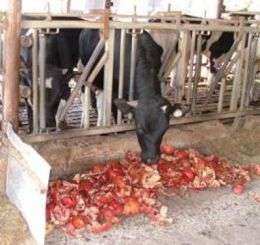
Feed supplemented with pomegranate peels could usher in healthier, antioxidant-rich meat, scientists report. Credit: Zalman Henkin
Pomegranate peel left over from production of the juice renowned for its potential health benefits can make a nutritious feed supplement for cattle, researchers in Israel report in an article in the November 12 issue of ACS' biweekly Journal of Agricultural and Food Chemistry. The peel packs some of the weight-boosting and health-enhancing effects of antibiotics and hormones without the detrimental effects, and researchers say it may yield meat with higher levels of beneficial antioxidants.
In the new study, Ariel Shabtay and colleagues note that consumption of pomegranate products is increasing amid reports that the fruit may help fight cancer, infections, and other diseases in humans due to its high levels of antioxidants. Recent studies also have shown that boosting antioxidant levels in the diet of cattle may help improve their health. Those findings seemed to make pomegranate peel, a waste product of the pomegranate industry with higher antioxidant levels than the juice itself, an attractive candidate as a nutritional supplement for cattle feed.
To find out, the scientists fed calves either normal cattle feed or feed supplemented with pomegranate peels. After eight weeks, the calves supplemented with pomegranate had higher blood levels of alpha-tocopherol, a form of vitamin E that may help retain nutrients and extend the shelf life of meat by preventing spoilage. The pomegranate-fed animals gained more weight than the animals on standard feed.
Article: "Nutritive and Antioxidative Potential of Fresh and Stored Pomegranate Industrial Byproduct as a Novel Beef Cattle Feed", http://pubs.acs.or … 21/ie801223b
Source: ACS
-
Study finds that sorghum bran has more antioxidants than blueberries, pomegranates
Sep 10, 2010 |
4.9 / 5 (14) |
2
-
Diet and supplements: What's good and bad for kidney disease patients
Nov 11, 2011 |
5 / 5 (1) |
1
-
How authentic is your pomegranate juice?
Nov 29, 2010 |
3.8 / 5 (5) |
2
-
Natural compounds in pomegranates may prevent growth of hormone-dependent breast cancer
Jan 05, 2010 |
not rated yet |
0
-
White tea could keep you healthy and looking young
Aug 11, 2009 |
4.7 / 5 (29) |
7
-
Engineers build first sub-10-nm carbon nanotube transistor
Feb 01, 2012 |
4.9 / 5 (32) |
30
-
Something old, something new: Evolution and the structural divergence of duplicate genes
Jan 31, 2012 |
4.6 / 5 (7) |
1
-
The hidden nanoworld of ice crystals: Revealing the dynamic behavior of quasi-liquid layers
Jan 30, 2012 |
5 / 5 (4) |
1
-
Stock market network reveals investor clustering
Jan 27, 2012 |
3.9 / 5 (23) |
8
-
Of microchemistry and molecules: Electronic microfluidic device synthesizes biocompatible probes
Jan 26, 2012 |
5 / 5 (2) |
0
More news stories
Scientists discover molecular secrets of 2,000-year-old Chinese herbal remedy
For roughly two thousand years, Chinese herbalists have treated Malaria using a root extract, commonly known as Chang Shan, from a type of hydrangea that grows in Tibet and Nepal. More recent studies suggest that halofuginone, ...
2 hours ago |
5 / 5 (6) |
1
|
New method to examine batteries -- MRI from the inside
There is an ever-increasing need for advanced batteries for portable electronics, such as phones, cameras, and music players, but also to power electric vehicles and to facilitate the distribution and storage of energy derived ...
Chemistry / Analytical Chemistry
2 hours ago |
5 / 5 (2) |
0
|
Hydrogen from acidic water: Researchers develop potential low cost alternative to platinum for splitting water
A technique for creating a new molecule that structurally and chemically replicates the active part of the widely used industrial catalyst molybdenite has been developed by researchers with the Lawrence Berkeley ...
Feb 09, 2012 |
4.8 / 5 (16) |
21
|
Fool's gold may prove an unlikely alternative to overexploited catalytic materials
Catalytic materials, which lower the energy barriers for chemical reactions, are used in everything from the commercial production of chemicals to catalytic converters in car engines. However, with current catalytic materials ...
Feb 10, 2012 |
4.4 / 5 (8) |
8
|
Research provides octagonal window of opportunity for carbon capture
(PhysOrg.com) -- Filtering carbon dioxide, a greenhouse gas, from factory smokestacks is a necessary, but expensive part of many manufacturing processes. However, a collaborative research team from the National ...
Feb 08, 2012 |
5 / 5 (2) |
5
|
Lab study raises questions over nano-particle impact
Tests involving chickens have raised questions about the impact on health from engineered nano-particles, the ultra-fine grains commonly used in drugs and processed foods, scientists said on Sunday.
Google might launch Drive for cloud storage soon
(PhysOrg.com) -- Google's next big move, according to the Wall Street Journal, is a cloud storage service called Drive. Hardly first to the plate, Google is simply catching up to introducing its cloud reposi ...
A mitosis mystery solved: How chromosomes align perfectly in a dividing cell
Although the process of mitotic cell division has been studied intensely for more than 50 years, Whitehead Institute researchers have only now solved the mystery of how cells correctly align their chromosomes during symmetric ...
Starve a virus, feed a cure? Findings show how some cells protect themselves against HIV
A protein that protects some of our immune cells from the most common and virulent form of HIV works by starving the virus of the molecular building blocks that it needs to replicate, according to research published online ...
Researchers find extensive RNA editing in human transcriptome
In a new study published online in Nature Biotechnology, researchers from BGI, the world's largest genomics organization, reported the evidence of extensive RNA editing in a human cell line by analysis of RNA-seq data, demons ...
The proteins ensuring genome protection
Researchers from the University of Geneva (UNIGE), Switzerland, have discovered the crucial role of two proteins in developing a cell 'anti-enzyme shield'. This protection system, which operates at the level of molecular ...
Dec 08, 2008
Rank: 1 / 5 (1)
protn7@att.net