CT scans reveal that dinosaurs were airheads
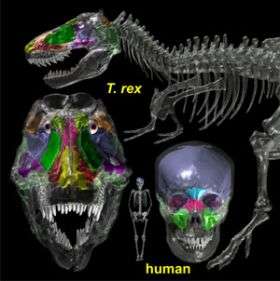
(PhysOrg.com) -- Paleontologists have long known that dinosaurs had tiny brains, but they had no idea the beasts were such airheads.
A new study by Ohio University researchers Lawrence Witmer and Ryan Ridgely found that dinosaurs had more air cavities in their heads than expected. By using CT scans, the scientists were able to develop 3-D images of the dinosaur skulls that show a clearer picture of the physiology of the airways.
"I've been looking at sinuses for a long time, and indeed people would kid me about studying nothing—looking at the empty spaces in the skull. But what's emerged is that these air spaces have certain properties and functions," said Witmer, Chang Professor of Paleontology in Ohio University's College of Osteopathic Medicine.
Witmer and Ridgely examined skulls from two predators, Tyrannosaurus rex and Majungasaurus, and two ankylosaurian dinosaurs, Panoplosaurus and Euoplocephalus, both plant eaters with armored bodies and short snouts. For comparison, the scientists also studied scans of crocodiles and ostriches, which are modern day relatives of dinosaurs, as well as humans.
The analysis of the predatory dinosaurs revealed large olfactory areas, an arching airway that went from the nostrils to the throat, and many sinuses—the same cavities that give us sinus headaches. Overall, the amount of air space was much greater than the brain cavity.
The CT scans also allowed Witmer and Ridgely to calculate the volume of the bone, air space, muscle and other soft tissues to make an accurate estimate of how much these heads weighed when the animals were alive. A fully fleshed-out T. rex head, for example, weighed more than 1,100 pounds.
"That's more than the combined weight of the whole starting lineup of the Cleveland Cavaliers," Witmer said.
Witmer suggests that the air spaces helped lighten the load of the head, making it about 18 percent lighter than it would have been without all the air. That savings in weight could have allowed the predators to put on more bone-crushing muscle or even to take larger prey.
These sinus cavities also may have played a biomechanical role by making the bones hollow, similar to the hollow beams used in construction — both are incredibly strong but don't weigh as much their solid counterparts. A light but strong skull enabled these predators to move their heads more quickly and helped them hold their large heads up on cantilevered necks, explained Witmer, who published the findings in a recent issue of The Anatomical Record.
Though most researchers have assumed that the nasal passages in armored dinosaurs would mimic the simple airways of the predators, Witmer and Ridgely found that these spaces actually were convoluted and complex. The passages were twisted and corkscrewed in the beasts' snouts and didn't funnel directly to the lungs or air pockets.
"Not only do these guys have nasal cavities like crazy straws, they also have highly vascular snouts. The nasal passages run right next to large blood vessels, and so there's the potential for heat transfer. As the animal breathes in, the air passed over the moist surfaces and cooled the blood, and the blood simultaneously warmed the inspired air," said Witmer, whose research is funded by the National Science Foundation. "These are the same kinds of physiological mechanisms we find all the time in warm-blooded animals today."
These twisty nasal passages also acted as resonating chambers that affected how the ankylosaurs vocalized. The complex airways would have been somewhat different in each animal and might have given the dinosaurs subtle differences in their voices.
"It's possible that these armored dinosaurs could recognize individuals based on the voice," said Witmer, who noted that his research team's studies of the inner ear revealed a hearing organ that probably had the capability to discriminate these subtle vocal nuances.
Though Witmer found few similarities between the dinosaur and human sinuses — our brain cavities take up much more space relative to our sinuses — the scientist did find a resemblance between the air spaces of the crocodiles and ostriches and the ancient beasts under study.
"Extra air space turns out to be a family characteristic," he said, "but the sinuses may be performing different roles in different species. Scientists have tended to focus on things such as bones and muscle, and ignored these air spaces. If we're going to decipher the mysteries of these extinct animals, maybe we need to figure out just why it is that these guys were such airheads."
Provided by Ohio University


