Moon geology could solve three mysteries of early Earth
December 8th, 2008 By Lisa Zyga Moon and Earth

Enlarge

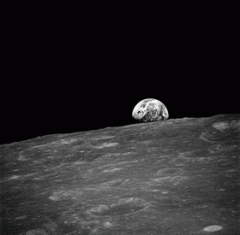
Photo of the Earth rising over the moon’s horizon, taken from the Apollo 8 mission. Image credit: NASA.

(PhysOrg.com) -- Not much is known about the Earth before 4 billion years ago, the earliest period in the planet’s 4.5-billion-year history. Because Earth has lost almost all geological records of this era from its surface, it’s often considered the planet’s dark ages.

This lack of data on the early Earth is not merely trivial. Without knowing the conditions of early Earth, researchers haven’t been able to answer some fundamental questions of earth science: when the Earth’s magnetic field originated, how the Earth’s relationship with the moon changes over time, and when oxygen first appeared in the atmosphere (and, incidentally, when life originated on Earth).

Recently, a team of researchers consisting of Minoru Ozima and Yayoi N. Miura from the University of Tokyo; Qing-Zhu Yin from the University of California, Davis; and Frank Podosek from Washington University in St. Louis, Missouri, have proposed a series of experiments that could answer these three mysteries, independent of other observations that sometimes give conflicting results. They hope that their proposal might serve as a useful guide for future investigation.

“I speculate that heavy bombardment by meteorite showers at around 4 billion years ago – which is well-recorded on the lunar surface as numerous craters and is known as lunar cataclysm – may also have almost totally erased surface records on the Earth [before 4 billion years ago],” Ozima told PhysOrg.com.

To make up for the lack of early geological evidence on Earth, Ozima and his coauthors suggest that examining the lunar soil for light elements such as helium, nitrogen, oxygen, neon, and argon could shed light on these questions. Previous research has shown that light elements from Earth‘s early atmosphere could be transported into space by the Solar wind and Earth’s wind, and some of these elements should reach the Moon’s near surface. However, such element transportation would be favorable only under certain conditions: namely, if the Earth did not have a permanent geomagnetic field, and if the distance between the Earth and Moon was much shorter than the present distance.

These requirements could be met by the Earth in its very early days. Scientists know that the Earth’s geomagnetic field is caused by the motion of the planet’s liquid iron core (which formed with the Earth around 4.5 billion years ago). However, the sustained geomagnetic field might also require the crystallization of a solid inner core, possibly placing the field’s origins as recently as 3.5 billion years ago, when geologists have evidence of its existence. Other studies have shown that, due to the slow loss of tidal energy, the Moon is drifting further and further from the Earth. Today, scientists estimate that the Moon is twice as far away as it was 4 billion years ago.

Therefore, carefully analyzing the amount and content of light terrestrial elements on the Moon could impose a constraint on the onset time of the Earth’s geomagnetic field. An analysis could reveal information regarding the variation of the Earth-Moon system, such as confirming the increasing day length (estimated at 0.002 seconds per day per century) in order to conserve angular momentum as the Moon drifts farther out. Since the far side of the moon has always faced away from us shortly after the moon’s formation, the research team predicts that almost no terrestrial elements should be observed in lunar soils on the far side.

Ionized oxygen could also escape from the Earth even with the Earth’s geomagnetic field, although the amount would differ. The researchers explained that if oxygen originating from Earth’s atmosphere were identified in the top 50 nanometers of suitable mineral grains collected on the Moon’s surface, augmented by the age of the mineral grains determined by radiometric dating techniques, it could provide unambiguous proof for the rise of oxygen in the Earth’s atmosphere in an early period. Because oxygen in the Earth’s atmosphere is generally attributed to photosynthesis, the first appearance of oxygen is often regarded as synonymous with the origin of life on Earth. On this issue, sulfur isotopic records have shown conflicting results, ranging from 2.5 billion years ago to much earlier for oxygen’s appearance.

Although such experiments would require extremely precise isotopic measurements of tiny concentrations in lunar soils, the researchers said that such investigations are feasible today with minor technical improvements. Ozima said that the most challenging part of carrying out the proposed experiments is organizing a large-scale international laboratory.

“Firstly, we need to collect hundreds of thousands of lunar ilmenite grains from lunar soils, not only from the near side, but also from the far side,” he said. “And then we need tens of thousands of isotopic analyses of high precision of lunar ilmenite grains. Even a well-equipped and stuffed contemporary laboratory would be capable of a few hundred analyses at most.”

The proposed experiments show that, despite the great distance between the Earth and the Moon, our natural satellite could tell us more about our planet than we can find here. As Ozima added, answering these questions on the Earth’s earliest days could help scientists understand the origin of the solar system – “the most fundamental issue not only in Earth and Planetary Science, but also in the intellectual challenge of human beings,” he said.

More information: Ozima, Minoru; Yin, Qing-Zhu; Podosek, Frank A.; and Miura, Yayoi N. “Toward understanding early Earth evolution: Prescription for approach from terrestrial noble gas and light element records in lunar soils.” Proceedings of the National Academy of Sciences, November 18, 2008, vol. 105, no. 46, 17654-17658.

Copyright 2008 PhysOrg.com.
All rights reserved. This material may not be published, broadcast, rewritten or redistributed in whole or part without the express written permission of PhysOrg.com.


print this article email this article download pdf blog this article bookmark this article     Digg this Stumble it share on Facebook share on Reddit add to delicious save to Yahoo! bookmarks
4.1/5 after 37 votes

Rank Filter

Move the slider to adjust rank threshold, so that you can hide some of the comments.


Display comments: newest first

  • brant - Dec 08, 2008
    • Rank: 3.3 / 5 (10)
    Assuming the Earth and moon are related....
  • Ashibayai - Dec 09, 2008
    • Rank: 2.7 / 5 (6)
    Uhh...What they're suggesting is that they're related by location, not formation.
  • Thecis - Dec 09, 2008
    • Rank: 3.8 / 5 (4)
    No matter how you look at it, at this moment (at for the last couple of years) the two are related.
    There are several ideas about how the moon originated and the most common idea is that the two have collided and that the moon was trapped afterwards. It does mean however, that a lot of material from the early earth has been transferred from earth to the moon. Hopefully, it can still be found and give answers to some of our questions.
    The main question remains if this idea is correct is when this had happened. If it was in an very early state, we can go back a long time, maybe even to the origin of the earth.
  • out7x - Dec 09, 2008
    • Rank: 3.3 / 5 (7)
    Photosynthesis occurs in oceans also, and is not indicative of first life. Methanogens or deep sea bacteria are not photosynthetic.
  • Thecis - Dec 09, 2008
    • Rank: 4.5 / 5 (4)
    It is most propable that the first signs of life didnt use photosynthesis at all but used (like other deep-sea life) chemosynthesis or thermosynthesis
  • BeastOfBodmin - Dec 09, 2008
    • Rank: 5 / 5 (3)
    "Because oxygen in the Earth%u2019s atmosphere is generally attributed to photosynthesis, the first appearance of oxygen is often regarded as synonymous with the origin of life on Earth."

    Really? I understand that the the Earth originally had life which existed in a reducing atmosphere. Photosynthesis came later (and might have been the cause of a mass extinction).
  • earls - Dec 11, 2008
    • Rank: 1 / 5 (1)
    "How the Moon arose has long stumped scientists. Now Dutch geophysicists argue that it was created not by a massive collision 4.5 billion years ago, but by a runaway nuclear reaction deep inside the young Earth."

    http://www.cosmos...rth-moon

    Currently (12:35 PM 12/11/08) Slashdotted.
  • Mercury_01 - Dec 27, 2008
    • Rank: not rated yet
    I doubt that.

December 8th, 2008 all stories
Space & Earth / Earth Sciences

Comments: 8
Rank: 4.1/5 after 37 votes

  • Stumble this up

  • Digg this

  • Share it:
  • share on Facebook
  • share on MySpace
  • share on Slashdot
  • rss-newsfeed
  • share on Google
  • share on Reddit
  • add to delicious
  • save to Yahoo! bookmarks
  • share on Windows Live
  • Add to Mixx!
Rating: 4.1/5 after 37 votes

  • Related Stories

  • Forty years ago man first walked on the moon
    created Jul 05, 2009 | popularity not rated yet | comments 0
  • Coolest spacecraft ever in orbit around L2
    created Jul 03, 2009 | popularity not rated yet | comments 0
  • Moon Magic: Researchers Develop New Tool To Visualize Past, Future Lunar Eclipses (w/ Video)
    created Jun 29, 2009 | popularity not rated yet | comments 0
  • Space Station Room With a View
    created Jun 29, 2009 | popularity not rated yet | comments 0
  • NASA's new moon probe sends back moon shots
    created Jun 24, 2009 | popularity not rated yet | comments 0


  • Physicists Demonstrate Quantum Memory with Matter Qubits
    Physicists Demonstrate Quantum Memory with Matter Qubits
    Physics / General Physics
    created Jul 03, 2009 | popularity 4.4 / 5 (17) | comments 1
  • 'Holey' Nanosheets for Wastewater Dye Removal
    Nanotechnology / Nanomaterials
    created Jul 01, 2009 | popularity 5 / 5 (5) | comments 1
  • Jellyfish Robot Swims Like its Biological Counterpart
    Jellyfish Robot Swims Like its Biological Counterpart
    Electronics / Robotics
    created Jun 26, 2009 | popularity 4.4 / 5 (8) | comments 1
  • Could Maxwell's Demon Exist in Nanoscale Systems?
    Could Maxwell's Demon Exist in Nanoscale Systems?
    Physics / General Physics
    created Jun 24, 2009 | popularity 4.4 / 5 (18) | comments 29
  • Living Safely with Robots, Beyond Asimov's Laws
    Living Safely with Robots, Beyond Asimov's Laws
    Electronics / Robotics
    created Jun 22, 2009 | popularity 4.6 / 5 (54) | comments 40
  • Other News

    China environmental phenomena monitored from space

    Space & Earth / Earth Sciences

    created 2 hours ago | popularity not rated yet | comments 0

    China is in a very seismically active area and has had many catastrophic earthquakes during its history. A joint European-Chinese team is using satellite radar data to monitor ground deformation across major continental faults ...


    California to require sun-blocking car windows

    Space & Earth / Environment

    created 4 hours ago | popularity 2 / 5 (4) | comments 6

    New cars sold in California must include windshields that block or absorb the sun's rays beginning in 2012, the state's Air Resources Board recently ruled.


    Steam billows from the cooling towers at a nuclear power generating station in Byron

    Tropical zone expanding due to climate change: study

    Space & Earth / Earth Sciences

    created 7 hours ago | popularity 3.6 / 5 (7) | comments 3

    Climate change is rapidly expanding the size of the world's tropical zone, threatening to bring disease and drought to heavily populated areas, an Australian study has found.


    Scientists: Silent tremors may foretell next Big One

    Space & Earth / Earth Sciences

    created 4 hours ago | popularity 5 / 5 (1) | comments 0

    The seismometer is snugged in its hole and tamped over with dirt. Now it's time for the stomp test.


    The least sea ice in 800 years

    The least sea ice in 800 years

    Space & Earth / Earth Sciences

    created Jul 01, 2009 | popularity 4.1 / 5 (65) | comments 61

    New research, which reconstructs the extent of ice in the sea between Greenland and Svalbard from the 13th century to the present indicates that there has never been so little sea ice as there is now. The ...