New hybrid nanostructures detect nanoscale magnetism
December 8, 2008 New Hybrid Nanostructure

Enlarge

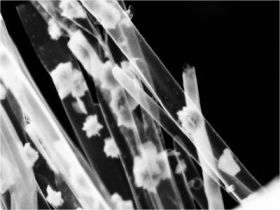
Pictured is a scanning electron micrograph of cobalt nanoclusters embedded in multi-walled carbon nanotubes. Researchers at Rensselaer used these new hybrid structures, the first of their kind, to detect magnetism at the nanoscale. Credit: Image credit: Saikat Talapatra/Caterina Soldano

A key challenge of nanotechnology research is investigating how different materials behave at lengths of merely one-billionth of a meter. When shrunk to such tiny sizes, many everyday materials exhibit interesting and potentially beneficial new properties.

Magnetic behavior is one such phenomenon that can change significantly depending on the size of the material. However, the sheer challenge of observing the magnetic properties of nanoscale material has impeded further study of the topic.

Researchers at Rensselaer Polytechnic Institute have developed and demonstrated a new method for detecting the magnetic behaviors of nanomaterials. They created a new process for growing a single multi-walled carbon nanotube that is embedded with cobalt nanostructures. The cobalt clusters measure from 1 nanometer to 10 nanometers.

After a series of experiments, the research team has concluded that the electrical conductance of carbon nanotubes is sensitive enough to detect and be affected by trace amounts of magnetic activity, such as those present in the embedded cobalt nanostructures. It is believed to be the first instance of demonstrating the detection of magnetic fields of such small magnets using an individual carbon nanotube.

Results of the study were reported in the paper "Detection of Nanoscale Magnetic Activity Using a Single Carbon Nanotube" recently published by Nano Letters.

"Since the cobalt clusters in our system are embedded inside the nanotube rather than on the surface, they do not cause electron scattering and thus do not seem to impact the attractive conductive properties of the host carbon nanotube," said Swastik Kar, research assistant professor in Rensselaer's Department of Physics, Applied Physics, & Astronomy, who led the project. "From a fundamental point of view, these hybrid nanostructures belong to a new class of magnetic materials."

"These novel hybrid nanostructures open up new avenues of research in fundamental and applied physics, and pave the way for increased functionality in carbon nanotube electronics utilizing the magnetic degree of freedom that could give rise to important spintronics applications," said Saroj Nayak, an associate professor in Rensselaer's Department of Department of Physics, Applied Physics, and Astronomy, who also contributed to the project.

Potential applications for such a material include new generations of nanoscale conductance sensors, along with new advances in digital storage devices, spintronics, and selective drug delivery components.

Source: Rensselaer Polytechnic Institute


Rate this story - 4.5 /5 (11 votes)


December 8, 2008 all stories

Comments: 0

4.5 /5 (11 votes)

  • hide
  • Related Stories

  • Using superconducting probes to get a picture of what it's like inside CNTs
    created Nov 20, 2009 | popularity not rated yet | comments 0
  • What Comes After Hard Drives?
    created Oct 23, 2009 | popularity not rated yet | comments 0
  • Golden Nanotubes Used for Imaging Agent to Detect Tumor Cells, Map Sentinel Lymph Node
    created Aug 26, 2009 | popularity not rated yet | comments 0
  • Researchers make carbon nanotubes without metal catalyst
    created Aug 10, 2009 | popularity not rated yet | comments 0
  • Stretchable Nanotube Films May Advance Medical Electronics (Update)
    created May 04, 2009 | popularity not rated yet | comments 0


  • hide
  • Relevant PhysicsForums posts

  • Water drop microscope!
    created 1hour ago
  • Light powered spaceship
    created 2 hours ago
  • What would a voltmeter read if it were connected between the surface of the cylinder
    created 2 hours ago
  • Interception angle
    created 4 hours ago
  • More from Physics Forums - General Physics

Other News

Nanoscale Structures with Superior Mechanical Properties Developed

Nanoscale Structures with Superior Mechanical Properties Developed

Nanotechnology / Nanomaterials

created 19 hours ago | popularity 4.6 / 5 (10) | comments 2 | with audio podcast

(PhysOrg.com) -- Researchers at the California Institute of Technology have developed a way to make some notoriously brittle materials ductile -- yet stronger than ever -- simply by reducing their size.


Spray-on liquid glass

Spray-on liquid glass is about to revolutionize almost everything

Nanotechnology / Nanomaterials

created Feb 02, 2010 | popularity 4.7 / 5 (240) | comments 93 | with audio podcast report

(PhysOrg.com) -- Spray-on liquid glass is transparent, non-toxic, and can protect virtually any surface against almost any damage from hazards such as water, UV radiation, dirt, heat, and bacterial infections. ...


IBM Scientists Demonstrate World's Fastest Graphene Transistor

IBM Scientists Demonstrate World's Fastest Graphene Transistor

Nanotechnology / Nanophysics

created Feb 05, 2010 | popularity 4.9 / 5 (38) | comments 25 | with audio podcast

(PhysOrg.com) -- In a just-published paper in the magazine Science, IBM researchers demonstrated a radio-frequency graphene transistor with the highest cut-off frequency achieved so far for any graphene device ...


Conductive eTextiles: Stanford finds a new use for cloth

Conductive eTextiles: Researchers move from making batteries from paper to making batteries from cloth

Nanotechnology / Nanomaterials

created Feb 05, 2010 | popularity 4.3 / 5 (7) | comments 4 | with audio podcast

(PhysOrg.com) -- Stanford researchers have moved from making batteries from paper to making batteries from cloth. Your-T-shirt could become a lighted, moving display.


Carbon Based Chips May One Day Replace Silicon Transistors

Carbon Based Chips May One Day Replace Silicon Transistors

Nanotechnology / Nanomaterials

created Feb 03, 2010 | popularity 4.7 / 5 (18) | comments 3 | with audio podcast weblog

(PhysOrg.com) -- IBM researchers are hopeful that, over the next decade, silicon-based transistors will be replaced by carbon-based transistors. IBM has already laid out the ground work for carbon-based transistors.