Rivers of Gas Flow Around Stars in New Space Image
December 8, 2008
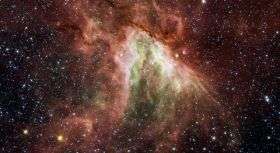
An infrared view of the choppy star-making cloud called M17, or the Swan nebula. Image credit: NASA/JPL-Caltech/Univ. of Wisc.
(PhysOrg.com) -- A new image from NASA's Spitzer Space Telescope shows a turbulent star-forming region, where rivers of gas and stellar winds are eroding thickets of dusty material.
The picture provides some of the best examples yet of the ripples of gas, or bow shocks, that can form around stars in choppy cosmic waters.
"The stars are like rocks in a rushing river," said Matt Povich of the University of Wisconsin, Madison. "Powerful winds from the most massive stars at the center of the cloud produce a large flow of expanding gas. This gas then piles up with dust in front of winds from other massive stars that are pushing back against the flow." Povich is lead author of a paper describing the new findings in the Dec. 10 issue of the Astrophysical Journal.
Spitzer's new infrared view of the stormy region, called M17, or the Swan nebula, is online at http://www.nasa.go … 0081208.html . The Swan is located about 6,000 light-years away in the constellation Sagittarius.
Dominating the center of the Swan is a group of massive stars, some exceeding 40 times the mass of our sun. These central stars are 100,000 to one million times as bright as the sun, and roar with radiation and fierce winds made of charged particles that speed along at up to 7.2 million kilometers per hour (4.5 million miles per hour). Both the wind and radiation carve out a deep cavity at the center of the picture -- an ongoing process thought to trigger the birth of new stars.
The growth of this cavity pushes gas up against winds from other massive stars, causing "smiley-faced" bow shocks -- three of which can be seen in the new picture. The direction of the bow shocks tells researchers exactly which way the "wind is blowing."
"The bow shocks are like interstellar weather vanes, indicating the direction of the stellar winds in the nebula," said Povich.
Povich and his colleagues also used Spitzer to take an infrared picture of a star-forming region called RCW 49. Both photographs are described in the same Astrophysical Journal paper, and both provide the first examples of multiple bow shocks around the massive stars of star-forming regions.
Spitzer was able to spot the bow shocks because its infrared eyes can pierce intervening dust, and because it can photograph large swaths of sky quickly.
Ultimately, the new observations will help researchers understand how solar systems like our own are able to form and persist in the rough, celestial seas of space.
"The gas being lit up in these star-forming regions looks very wispy and fragile, but looks can be deceiving," said co-author Robert Benjamin of the University of Wisconsin, Whitewater. "These bow shocks serve as a reminder that stars aren't born in quiet nurseries but in violent regions buffeted by winds more powerful than anything we see on Earth."
Other authors include Barbara A. Whitney of the Space Science Institute, Boulder, Colo.; Brian L. Babler, Marilyn R. Meade and Ed Churchwell of the University of Wisconsin, Madison; and Remy Indebetouw of the University of Virginia, Charlottesville.
Provided by NASA
-
Help! My stars are leaking!
Sep 16, 2011 |
4.7 / 5 (3) |
6
-
Hubble movies provide unprecedented view of supersonic jets from young stars
Aug 31, 2011 |
5 / 5 (6) |
7
-
The shocking environment of hot Jupiters
Apr 19, 2011 |
4.7 / 5 (3) |
0
-
Speed demon creates a shock
Mar 11, 2011 |
5 / 5 (4) |
2
-
Hubble Finds Stars That 'Go Ballistic'
Jan 07, 2009 |
4.8 / 5 (13) |
2
-
Engineers build first sub-10-nm carbon nanotube transistor
Feb 01, 2012 |
4.9 / 5 (31) |
30
-
Something old, something new: Evolution and the structural divergence of duplicate genes
Jan 31, 2012 |
4.6 / 5 (7) |
1
-
The hidden nanoworld of ice crystals: Revealing the dynamic behavior of quasi-liquid layers
Jan 30, 2012 |
5 / 5 (3) |
1
-
Stock market network reveals investor clustering
Jan 27, 2012 |
3.9 / 5 (23) |
8
-
Of microchemistry and molecules: Electronic microfluidic device synthesizes biocompatible probes
Jan 26, 2012 |
5 / 5 (1) |
0
-
Never ending outer space.....
11 hours ago
-
Neutron Star fragments?
13 hours ago
-
stationary or not?
17 hours ago
-
Scale of the Universe
Feb 10, 2012
-
Titan's lack of impact craters
Feb 09, 2012
-
Real pictures of black hole eating a star?
Feb 08, 2012
- More from Physics Forums - General Astronomy
More news stories
Latin America mining boom clashes with conservation
Latin America is experiencing a mining boom as prices rise fuelled by a hike in global demand, but the region is also being hit by a wave of violent protests, strikes and rallies by environmentalists.
4 hours ago |
not rated yet |
0
Political leaders play key role in how worried Americans are by climate change: study
More than extreme weather events and the work of scientists, it is national political leaders who influence how much Americans worry about the threat of climate change, new research finds.
Feb 06, 2012 |
5 / 5 (6) |
72
NASA budget will axe Mars deal with Europe: scientists
US President Barack Obama's budget proposal to be submitted next week for 2013 will cut NASA's budget by 20 percent and eliminate a major partnership with Europe on Mars exploration, scientists said Thursday.
Space & Earth / Space Exploration
Feb 10, 2012 |
5 / 5 (3) |
55
Humans may have helped the decline of African rainforests 3000 years ago
(PhysOrg.com) -- Large areas of rainforests in Central Africa mysteriously disappeared over three thousand years ago, to be replaced by savannas. The prevailing theory has been that the cause was a change ...
High planetary tilt lowers odds for life?
Highly-tilted worlds would have extreme seasons, subjecting life to alternating periods of scorching and subzero temperatures. This could make the development of all but hardiest, simplest creatures a long ...
Space & Earth / Space Exploration
Feb 06, 2012 |
4.8 / 5 (12) |
14
|
Google might launch Drive for cloud storage soon
(PhysOrg.com) -- Google's next big move, according to the Wall Street Journal, is a cloud storage service called Drive. Hardly first to the plate, Google is simply catching up to introducing its cloud reposi ...
Walney offshore wind farm is world's biggest (for now)
(PhysOrg.com) -- The Walney wind farm on the Irish Sea--characterized by high tides, waves and windy weather--officially opened this week. The farm is treated in the press as a very big deal as the Walney ...
Love a click away in Indonesia's Twitter Republic
He was a geeky kid from Yogyakarta, she a glamorous city girl in Jakarta. In a country with one of the world's most vibrant social networking scenes they fell in love on Twitter.
Europeans protest controversial Internet pact
Tens of thousands of people marched in protests in more than a dozen European cities Saturday against a controversial anti-online piracy pact that critics say could curtail Internet freedom.
Navy to begin tests on electromagnetic railgun prototype launcher
The Office of Naval Research (ONR)'s Electromagnetic (EM) Railgun program will take an important step forward in the coming weeks when the first industry railgun prototype launcher is tested at a facility ...
Explained: Sigma
It's a question that arises with virtually every major new finding in science or medicine: What makes a result reliable enough to be taken seriously? The answer has to do with statistical significance -- but ...
Dec 09, 2008
Rank: 4.3 / 5 (3)
Other questions will arise from that, so the search will probably never end.
Dec 09, 2008
Rank: 1 / 5 (5)
Dec 09, 2008
Rank: 1 / 5 (5)
http://www.presto...ndex.htm
Dec 09, 2008
Rank: 1 / 5 (1)
Dec 09, 2008
Rank: 1 / 5 (2)
Dec 09, 2008
Rank: 1 / 5 (3)
http://www.presto...ndex.htm
Dec 14, 2008
Rank: 1 / 5 (1)
Yeah, AGM theory seems to be basically dark matter with a different name. AS for antimatter, it has been observed in particle accelerators. Any theory about the universe must include antimatter.