Researcher Finds Early Photon Imaging Detects Lung Cancer
December 8th, 2008 Researcher Finds Early Photon Imaging Detects Lung Cancer

(PhysOrg.com) -- A novel, high-resolution fluorescence imaging system may be used to detect lung cancer at early stages. According to a report recently published in the Proceedings of the National Academy of Sciences, researchers from Northeastern University and the Technical University of Munich have developed a way to use near-infrared light in molecular imaging to peer deep into the body's diseased cells and tissues.

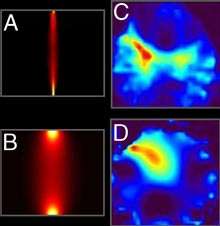
The near-infrared imaging system uses an ultra-fast laser source and high-speed cameras to generate three-dimensional images of fluorescent bio-markers. So far this system has been used to create richer, high-fidelity images of lung cancer in mice and associated biochemical changes in surrounding tissues.

The team, including lead author Mark Niedre, assistant professor of Electrical and Computer Engineering at Northeastern University, and Vasilis Ntziachristos, professor and Chair for Biological Imaging at the Technical University of Munich, used a fluorescent molecular probe that was specific to a tumor-associated protease to image the lung cancer.

"We were able to capture fluorescent photons that arrived at the detector earliest and therefore underwent significantly less scattering" said Niedre. "In doing so, we were surprised to find that, not only were we able to see tumors in lungs with more clarity, but we were able to resolve features in the image that were not visible with more conventional optical methods."

The enhanced images allowed detection of primary tumors, but also systemic biochemical changes in surrounding tissue associated with inflammatory response and disease progression, in this case yielding complementary information to that obtained with standard X-ray CT. Although at an early stage of development, researchers are hopeful that the technique will become a valuable biomedical research tool, and one day possibly even applied clinically.

Titled "Early photon tomography allows fluorescence detection of lung carcinomas and disease progression in mice in vivo," the study was conducted while Niedre was a post-doctoral fellow at Massachusetts General Hospital in Boston. Niedre is continuing his research at Northeastern University where his interests include diffuse fluorescence tomography, time-domain imaging and photodynamic therapy.

Provided by Northeastern University


print this article email this article download pdf blog this article bookmark this article     Digg this Stumble it share on Facebook share on Reddit add to delicious save to Yahoo! bookmarks
5/5 after 1 votes


December 8th, 2008 all stories
Medicine & Health / Cancer

Comments: 0
Rank: 5/5 after 1 votes

  • Stumble this up

  • Digg this

  • Share it:
  • share on Facebook
  • share on MySpace
  • share on Slashdot
  • rss-newsfeed
  • share on Google
  • share on Reddit
  • add to delicious
  • save to Yahoo! bookmarks
  • share on Windows Live
  • Add to Mixx!
Rating: 5/5 after 1 votes

  • Related Stories

  • Electric fish could spark healthcare innovation
    created Jun 19, 2009 | popularity not rated yet | comments 0
  • Hungry cells
    created Jun 16, 2009 | popularity not rated yet | comments 0
  • Activated stem cells in damaged lungs could be first step toward cancer
    created May 26, 2009 | popularity not rated yet | comments 0
  • Legalize it? Medical evidence on marijuana blows both ways
    created May 25, 2009 | popularity not rated yet | comments 0
  • Picture is cloudy over virtual colon exam
    created May 15, 2009 | popularity not rated yet | comments 0


  • Physicists Demonstrate Quantum Memory with Matter Qubits
    Physicists Demonstrate Quantum Memory with Matter Qubits
    Physics / General Physics
    created Jul 03, 2009 | popularity 4.4 / 5 (17) | comments 1
  • 'Holey' Nanosheets for Wastewater Dye Removal
    Nanotechnology / Nanomaterials
    created Jul 01, 2009 | popularity 5 / 5 (5) | comments 1
  • Jellyfish Robot Swims Like its Biological Counterpart
    Jellyfish Robot Swims Like its Biological Counterpart
    Electronics / Robotics
    created Jun 26, 2009 | popularity 4.4 / 5 (8) | comments 1
  • Could Maxwell's Demon Exist in Nanoscale Systems?
    Could Maxwell's Demon Exist in Nanoscale Systems?
    Physics / General Physics
    created Jun 24, 2009 | popularity 4.4 / 5 (18) | comments 29
  • Living Safely with Robots, Beyond Asimov's Laws
    Living Safely with Robots, Beyond Asimov's Laws
    Electronics / Robotics
    created Jun 22, 2009 | popularity 4.6 / 5 (52) | comments 40
  • Other News

    Caffeine reverses memory impairment in Alzheimer's mice

    Caffeine reverses memory impairment in Alzheimer's mice

    Medicine & Health / Research

    created 39 minutes ago | popularity not rated yet | comments 0

    Coffee drinkers may have another reason to pour that extra cup. When aged mice bred to develop symptoms of Alzheimer's disease were given caffeine - the equivalent of five cups of coffee a day - their memory ...


    Researchers find possible environmental causes for Alzheimer's, diabetes

    Medicine & Health / Diseases

    created 41 minutes ago | popularity not rated yet | comments 0

    A new study by researchers at Rhode Island Hospital have found a substantial link between increased levels of nitrates in our environment and food with increased deaths from diseases, including Alzheimer's, diabetes mellitus ...


    Variations in 5 genes raise risk for most common brain tumors

    Medicine & Health / Genetics

    created 16 hours ago | popularity not rated yet | comments 1

    Common genetic variations spread across five genes raise a person's risk of developing the most frequent type of brain tumor, an international research team reports online in Nature Genetics.


    Researchers highlight new direction for drug discovery

    Medicine & Health / Research

    created 14 hours ago | popularity not rated yet | comments 0

    In a discovery that rebuffs conventional scientific thinking, researchers at Georgetown University Medical Center (GUMC) have discovered a novel way to block the activity of the fusion protein responsible for Ewing's sarcoma, ...


    Wind power may have its own environmental problems

    Medicine & Health / Health

    created 16 hours ago | popularity 3.7 / 5 (6) | comments 4

    Wind power generation is expected to be a clean and environmentally friendly natural energy source, but a new kind of environmental problem has surfaced as infrasonic waves caused by windmills are suspected of causing health ...