UV-B light sensing mechanism discovered in plant roots
December 8, 2008 Arabidopsis Seedling

Enlarge

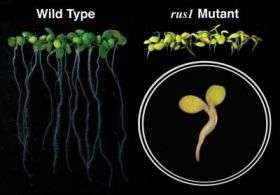
An Arabidopsis early seedling developing normally (left) compared with the same plant with a mutated RUS1 gene (right) which shows stunted growth. Credit: SFSU

Scientists have discovered that plant roots can sense UV-B light and have identified a specific gene that is a vital player in UV-B signaling, the communication between cells.

A study published Dec. 8 in the Early Edition of PNAS reveals that the gene RUS1 measures UV-B light levels and passes this information on to other parts of the plant responsible for growth and development. A low dosage of UV-B light, for example the levels found in shady conditions or under fluorescent lighting, can provide important signals to the rest of the plant and is therefore beneficial to normal plant growth. It helps young plants stay on the right track of development and aids seedling morphogenesis, but too much UV-B light can be toxic.

The study found that plants with a mutated UV-B light sensor gene become hypersensitive to UV-B light and even under low intensity levels of UV-B light, their root growth is stunted and they fail to grow leaves. Therefore the RUS1 gene is responsible for ensuring that young seedlings develop normally even when their roots are exposed to UV-B light.

It's unusual that roots, normally covered in soil, should have sensors for UV-B light, but the RUS1 gene is crucial at the young seedling stage when a plant's roots are resting on the soil surface. Later in a plant's life, roots can be exposed after rainwash, geological movements or animal activity.

The discovery of RUS1 provides scientists with a platform to examine other key genes that receive UV-B light and translate light information into how the plant should develop.

Source: San Francisco State University


print this article email this article download pdf blog this article bookmark this article     Stumble it Digg this share on Facebook retweet share on Reddit add to delicious
Rate this story - 4 /5 (4 votes)


December 8, 2008 all stories

Comments: 0

4 /5 (4 votes)
  • Stumble this up

  • Digg this

  • share this

  • hide
  • Related Stories

  • Lettuce gets a healthy suntan
    created May 18, 2009 | popularity not rated yet | comments 0
  • Safer suntans through science
    created Sep 26, 2006 | popularity not rated yet | comments 0
  • Shade myths: How to really stay safe
    created Aug 21, 2009 | popularity not rated yet | comments 0
  • The Medical Minute: Melanoma - The dark side of the sun
    created May 27, 2009 | popularity not rated yet | comments 0
  • Research says older people need more sun
    created May 11, 2009 | popularity not rated yet | comments 0


Other News

Wild chimps have near human understanding of fire, says study

Wild chimps have near human understanding of fire, study says

Biology / Plants & Animals

created 19 minutes ago | popularity 5 / 5 (1) | comments 0

(PhysOrg.com) -- The use and control of fire are behavioral characteristics that distinguish humans from other animals. Now, a new study by Iowa State University anthropologist Jill Pruetz reports that savanna ...


Study shows loss of 15-42 percent of mammals in North America

Biology / Ecology

created 3 hours ago | popularity 5 / 5 (1) | comments 4

If the planet is headed for another mass extinction like the previous five, each of which wiped out more than 75 percent of all species on the planet, then North American mammals are one-fifth to one-half the way there, according ...


New report underlines multiple benefits but also new challenges to biodiversity-rich sites

Biology / Ecology

created 4 hours ago | popularity 5 / 5 (1) | comments 0

An agreement in Copenhagen to fund reduced emissions from deforestation may generate multiple environmental and economic benefits if investments simultaneously target sites that are both carbon and biodiversity-rich.


Umbilical cord could be new source of plentiful stem cells, researchers say

Biology / Biotechnology

created 5 hours ago | popularity not rated yet | comments 0

Stem cells that could one day provide therapeutic options for muscle and bone disorders can be easily harvested from the tissue of the umbilical cord, just as the blood that goes through it provides precursor cells to treat ...


Christmas Tree

Scientists works to develop Christmas tree that doesn't shed needles

Biology / Biotechnology

created 2 hours ago | popularity not rated yet | comments 0

After chasing the perfect Christmas tree for three decades, Gary Chastagner could be getting close.