Psychologists report that a gender gap in spatial skills starts in infancy
December 9, 2008
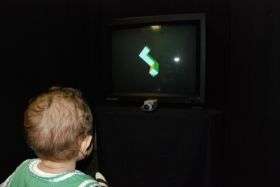
Infant in the UCLA Baby Lab

Enlarge

Infant in the UCLA Baby Lab

(PhysOrg.com) -- Men tend to perform better than women at tasks that require rotating an object mentally, studies have indicated. Now, developmental psychologists at Pitzer College and UCLA have discovered that this type of spatial skill is present in infancy and can be found in boys as young as 5 months old.

While women tend to be stronger verbally than men, many studies have shown that adult men have an advantage in the ability to imagine complex objects visually and to mentally rotate them. Does this advantage go back to infancy?

"We found the answer is yes," said Scott P. Johnson, a UCLA professor of psychology and an expert in infant perception, brain development, cognition and learning. "Infants as young as 5 months can perform the skill, but only boys — at least in our study."

"We've known for approximately 30 years that men and women can see an object from one perspective and then recognize that object after it has been rotated in space into a new position," said David S. Moore, professor of psychology at Pitzer College and Claremont Graduate University, both in Claremont, Calif., and an expert in the development of perception and cognition in infants. "In addition, while we have known that all people can do this, it turns out that men are quite a bit faster at it than women are. Previous studies have shown that this sex difference can be detected in children as young as 4 years of age, but our study is the first to have successfully found a way to assess the situation in young infants.

"Although we did not expect to find any sex differences in babies this young, our results suggest that the 5-month-old boys in our study used mental rotation to complete our task while the 5-month-old girls in our study did not," Moore said.

However, with most psychological characteristics, Johnson and Moore note, there are no differences between groups of men and groups of women.

Mental rotation involves taking a mental representation of a three-dimensional object and imagining it in a different orientation — basically rotating the object in your mind.

Moore and Johnson will report their findings in the Dec. 12 issue of the journal Psychological Science.

The psychologists tested 20 boys and 20 girls in the study, each 5 months old.

They used a common method in infant perception research: They had the infants look at something repeatedly until their amount of looking waned to less than half its original level. The researchers showed them a computer-generated image of a 3-D object that resembled an "L," constructed of multicolored cubes. Once the infants were bored with the object, the researchers showed them the same object from a different vantage point, and then the mirror image of the object.

"We're requiring the infants to rotate mentally in three dimensions," Johnson noted.

The 5-month-old boys looked at the mirror image about 1.5 seconds longer than they looked at the more familiar image, a "statistically robust difference" (although girls looked at both images longer than boys did), Moore and Johnson report. The 5-month-old girls looked at the mirror image for slightly less time than they looked at the familiar image.

The boys looked longer at the mirror image, the researchers said, because they recognized that the mirror image was completely new and that the other object was simply the original L-shaped image they had become bored with, shown from a different vantage point — a task that required them to rotate the remembered original object mentally.

"We don't know why men are better than women at this task or why boys are better than girls at this, but we do now know that this difference extends all the way back to 5 months of age," Johnson said. "We have shown that this gender difference is present in a pre-verbal population, a population too young to have learned it from manual experience with objects or from extensive learning processes, although learning certainly could be involved."

"We are interested in this question because the visual-spatial skills of male and female adults, on average, are different, and as developmentalists, we are interested in exploring the origins of these differences," Moore said. "While we believe we have found a phenomenon worthy of additional study, good science entails a circumspect approach to our conclusions; it would not be prudent to draw particularly strong or wide-ranging conclusions from the results of this single study."

Provided by University of California - Los Angeles

4.6 /5 (16 votes)  

Filter


Move the slider to adjust rank threshold, so that you can hide some of the comments.


Display comments: newest first

magpies
Dec 09, 2008

Rank: 1 / 5 (2)
I think it would help for women and men to have the same type of toys as children. That is to say that boys and girls should get as many toys of as many kinds when they are kids and we should not be so quick to toss a toy in the trash just because it is old. Toys can enhance the imagniation and teach many life leasons through the childs own eyes. I also think its cool that children get to see what the adult world is like both good and bad parts so they can better cope or reject the parts of it they dont agree or do agree with when they get older.
zbarlici
Dec 09, 2008

Rank: 3.8 / 5 (4)
So this kind of explains why guys tend to "undress" ladies a lot more so than vice versa. It`s not because we`re assholes, its because the ladies aren`t as proficient at it. :P
Edward3
Dec 09, 2008

Rank: 4 / 5 (4)
" It would not be prudent to draw strong conclusions" - or should that be "not politically correct" !!???
D666
Dec 09, 2008

Rank: 3.7 / 5 (3)
So this kind of explains why guys tend to "undress" ladies a lot more so than vice versa. It`s not because we`re assholes, its because the ladies aren`t as proficient at it. :P


I'm all for helping them with this deficit :-)
D666
Dec 09, 2008

Rank: 5 / 5 (5)

I think it would help for women and men to have the same type of toys as children. That is to say that boys and girls should get as many toys of as many kinds when they are kids and we should not be so quick to


Friends of mine, who have a daughter and a son, specifically tried this -- a bit of a social experiment, I guess, although I'm not positive what their motives were. They made a point of making both "male-oriented" and "female-oriented" toys available to both children and made a concerted effort not to "lead" the kids in any way. In the end though, the kids played with the stereotypical toys. Granted it's a sample of one, but accordign to my friends their children actively resisted playing with the alternate-gender toys.

On another front, my wife is a preschool teacher, and she can see clear differences between boys and girls at play. For instance, when playing with toy cars, the girls will have the cars having conversations; the boys will have the cars having spectacular crashes.
marjon
Dec 09, 2008

Rank: 5 / 5 (2)
Will Harvard reinstate Larry Summers?
JayDub
Dec 09, 2008

Rank: 3 / 5 (2)
Nikola Tesla is a perfect example. He took his spatial skills to the nth level and developed working models of dynamos and etc all within the confines of his mind. He was able to develop, build and test his ideas entirely in his mind.
Fascinating.
theophys
Dec 09, 2008

Rank: 5 / 5 (1)
I wonder if there are any ways to improve this ability to mentaly rotate objects that could easily be introduced to the education system.
Mauricio
Dec 09, 2008

Rank: 1.7 / 5 (3)
Female monkeys and male monkeys tend to play with dolls and cars respectively.

Little boys brains react strongly to motion, and little girls brains react strongly to detail.

This culture of women trying to be men and men trying to be women is a disaster. It inhibits science and it does damage to society.

One day they will say that we all can fly and breath underwater.... because "we are all the same, is just learning"

After men shaving their faces, they should start to inject hormones to see if they can breastfeed too....
Arikin
Dec 09, 2008

Rank: not rated yet
Reminds me of the experiments on mice and a food goal in the maze. The male mice were quicker in finding the food using spatial location. Of course the mice have smell to enhance efficiency.
axemaster
Dec 10, 2008

Rank: 5 / 5 (3)
"Nikola Tesla is a perfect example. He took his spatial skills to the nth level and developed working models of dynamos and etc all within the confines of his mind. He was able to develop, build and test his ideas entirely in his mind.
Fascinating."

No... That just means he was smart...
Soylent
Dec 10, 2008

Rank: not rated yet
I wonder if there are any ways to improve this ability to mentaly rotate objects that could easily be introduced to the education system.


Tetris? Rubik's cube?
lengould100
Dec 10, 2008

Rank: 5 / 5 (1)
My daughter has two kids, a girl and a boy. Both she and her husband are very aware of their childrens development (you know, only TV is baby Einstein videos, etc.) Anyway, the kids have been provided any interactive toys they wanted, no pressures at all. If the guy had wanted dolls he would have had as many as he wanted. The girl has always liked a wide variety of toys, more interactive the better, likes to figure out complex stuff of all sorts, drawing, etc. The boy, just turned three yrs, has a collection of about 500 cars and trucks of every sort. When he visits, he gets out his bag of cars on the coffee table and spends most of his time staring up close at how they roll along the edge of the table, effects of steering, bumping into each other. Its almost erie how absorbed he is with them. The girl, just turned eight is now skipping grade 3-4, is brilliant. Boy is very sharp, but hasn't advanced verbally as fast as the girl did.

Interesting stuff.
Hoarsesenz
Dec 10, 2008

Rank: 5 / 5 (1)
With respect to those doing useful, creative and interesting things to help their children, in this particular instance, all children would need is contact with their peers or watching cartoons to "warp" their sense of what's appropriate for them.
Rank 4.6 /5 (16 votes)
Relevant PhysicsForums posts
  • Is Everyday Technology Killing Us?
    createdFeb 08, 2012
  • Exercise and weight loss
    createdFeb 08, 2012
  • Why do we have head aches? Our brains can't feel anything.
    createdFeb 07, 2012
  • "The end of diseases" by David Agus, interview from Daily Show with Jon Stewart
    createdFeb 04, 2012
  • Oncolytic adenovirus
    createdFeb 04, 2012
  • Nutrition label stuffs and diets
    createdFeb 02, 2012
  • More from Physics Forums - Medical Sciences

More news stories

FDA-approved drug rapidly clears amyloid from the brain, reverses Alzheimer's symptoms in mice

Neuroscientists at Case Western Reserve University School of Medicine have made a dramatic breakthrough in their efforts to find a cure for Alzheimer's disease. The researchers' findings, published in the journal Science, show t ...

Medicine & Health / Neuroscience

created 13 hours ago | popularity 4.9 / 5 (32) | comments 14 | with audio podcast

Anyone can learn to be more inventive, cognitive researcher says

There will always be a wild and unpredictable quality to creativity and invention, says Anthony McCaffrey, a cognitive psychology researcher at the University of Massachusetts Amherst, because an "Aha moment" is rare and ...

Medicine & Health / Psychology & Psychiatry

created 9 hours ago | popularity 4.7 / 5 (7) | comments 1 | with audio podcast

Researchers weigh in on ethics of H5N1 research

(Medical Xpress) -- In a commentary on the biosecurity controversy surrounding publication of bird flu research details, a bioethicist and a vaccine expert at Johns Hopkins reaffirm that "all scientists have an affirmativ ...

Medicine & Health / Other

created 11 hours ago | popularity not rated yet | comments 0 | with audio podcast

Cell biologists describes mechanism by which some people may be more susceptible to colon cancer

An international research team led by cell biologists at the University of California, Riverside has uncovered a new insight into colon cancer, the third leading cause of cancer-related deaths in the United ...

Medicine & Health / Cancer

created 9 hours ago | popularity 5 / 5 (3) | comments 0 | with audio podcast

To perform with less effort, practice beyond perfection

Whether you are an athlete, a musician or a stroke patient learning to walk again, practice can make perfect, but more practice may make you more efficient, according to a surprising new University of Colorado Boulder study.

Medicine & Health / Neuroscience

created 12 hours ago | popularity 4.6 / 5 (9) | comments 3 | with audio podcast


'Dark plasmons' transmit energy

Microscopic channels of gold nanoparticles have the ability to transmit electromagnetic energy that starts as light and propagates via "dark plasmons," according to researchers at Rice University.

Hydrogen from acidic water: Researchers develop potential low cost alternative to platinum for splitting water

A technique for creating a new molecule that structurally and chemically replicates the active part of the widely used industrial catalyst molybdenite has been developed by researchers with the Lawrence Berkeley ...

Ultraviolet protection molecule in plants yields its secrets

Lying around in the sun all day is hazardous not just for humans but also for plants, which have no means of escape. Ultraviolet (UV) radiation from the sun can damage proteins and DNA inside cells, leading ...

Soraa LED light may dim 50-watt halogen rivals

(PhysOrg.com) -- Soraa, a Fremont, California company founded in 2008, this week launched its first product, a light that uses LEDS (light emitting diodes). The "Soraa LED MR16 lamp" is the "perfect" replacement ...

Flexible paper robots

(PhysOrg.com) -- These inexpensive robots can stretch, bend and twist under control, and lift objects up to 120 times their own weight. Being soft, they can apply gentle and even pressure, and adapt to varied ...

Engineers find inspiration for new materials in Piranha-proof armor

(PhysOrg.com) -- It’s a matchup worthy of a late-night cable movie: put a school of starving piranha and a 300-pound fish together, and who comes out the winner?