Baby fish in polluted San Francisco estuary waters are stunted and deformed
December 9th, 2008 Baby fish in polluted San Francisco estuary waters are stunted and deformed

Enlarge

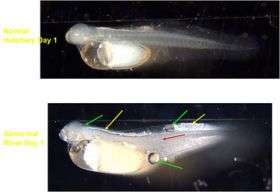
The top fish is a normal striped bass larva from hatchery mother. The bottom fish is an abnormal striped bass larva from a river mother. The green arrows indicate areas of abnormal fluid accumulation, yellow areas indicate blistering and dead tissue, and red arrow indicates skeletal abnormality/curvature of the spinal cord. (David Ostrach/UC Davis)

(PhysOrg.com) -- Striped bass in the San Francisco Estuary are contaminated before birth with a toxic mix of pesticides, industrial chemicals and flame retardants that their mothers acquire from estuary waters and food sources and pass on to their eggs, say UC Davis researchers.

Using new analytical techniques, the researchers found that offspring of estuary fish had underdeveloped brains, inadequate energy supplies and dysfunctional livers. They grew slower and were smaller than offspring of hatchery fish raised in clean water.

"This is one of the first studies examining the effects of real-world contaminant mixtures on growth and development in wildlife," said study lead author David Ostrach, a research scientist at the UC Davis Center for Watershed Sciences. He said the findings have implications far beyond fish, because the estuary is the water source for two-thirds of the people and most of the farms in California.

"If the fish living in this water are not healthy and are passing on contaminants to their young, what is happening to the people who use the water, are exposed to the same chemicals or eat the fish?" Ostrach said.

"We should be asking hard questions about the nature and source of these contaminants, as well as acting to stop the ongoing pollution and mitigate these current problems."

The new study, published online Nov. 24 by the journal Proceedings of the National Academy of Sciences, is one of a series of reports by Ostrach and UC Davis colleagues on investigations they began in 1988. Their goal is to better understand the reasons for plummeting fish populations in the estuary, an enormous California region that includes the Sacramento-San Joaquin River Delta and San Francisco Bay.

The estuary is one of the world's most important water supplies for urban use and agriculture, and is also one of the most contaminated aquatic ecosystems.

The ominous decline in estuary populations of striped bass, delta smelt, longfin smelt and threadfin shad, named the "pelagic organism decline," or POD, by the region's environmental scientists, was first reported at the turn of the century and has continued to worsen through 2007.

Ostrach's lab at UC Davis is part of the multi-agency POD research team and charged with understanding contaminant effects and other environmental stressors on the entire life cycle of striped bass.

Studies of striped bass are useful because, first, they are a key indicator of San Francisco Estuary ecosystem health and, second, because contaminant levels and effects in the fish could predict the same in people. For example, one of the contaminants found in the fish in this study, PDBEs, have been found in Bay Area women's breast milk at levels 100 times those measured in women elsewhere in the world.

The new study details how Ostrach and his team caught gravid female striped bass in the Upper Sacramento River, then compared the river fishes' eggs and hatchlings (larvae) to offspring of identical but uncontaminated fish raised in a hatchery.

In the river-caught fishes' offspring, the UC Davis researchers found harmful amounts of PBDEs, PCBs and 16 pesticides.

PBDEs (polybrominated diphenyl ethers) are widely used flame retardants; PCBs (polychlorinated biphenyls) are chemicals once used in making a range of products, from paper goods to electric transformers; and the pesticides detected include some currently widely used in agriculture, such as chlorpyrifos and dieldren, and others banned decades ago, such as DDT.

These compounds are known to cause myriad problems in both young and adult organisms, including skeletal and organ deformities and dysfunction; changes in hormone function (endocrine disruption); and changes in behavior. Some of the effects are permanent. Furthermore, Ostrach said, when the compounds are combined, the effects can be increased by several orders of magnitude.

Full study: "Maternal Transfer of Xenobiotics and Effects on Larval Striped Bass in the San Francisco Estuary" http://www.pnas.org

Source: University of California - Davis


print this article email this article download pdf blog this article bookmark this article     Digg this Stumble it share on Facebook share on Reddit add to delicious save to Yahoo! bookmarks
4.2/5 after 14 votes

Rank Filter

Move the slider to adjust rank threshold, so that you can hide some of the comments.


Display comments: newest first

  • zbarlici - Dec 09, 2008
    • Rank: 1 / 5 (3)
    quite alarming... but whatwill be done about it?

    ...I would like to see a study done to compare the US to some european country(some non-GM food consumer), when it comes to infant sickness/deformity/mental retardation, and see what the numbers are.
  • Soylent - Dec 09, 2008
    • Rank: 3.4 / 5 (5)
    ...I would like to see a study done to compare the US to some european country(some non-GM food consumer), when it comes to infant sickness/deformity/mental retardation, and see what the numbers are.


    Not with my tax money you don't; there's no reason other than sheer scientific illiteracy to even suspect such a link.
  • zbarlici - Dec 10, 2008
    • Rank: 1 / 5 (3)
    ok soylent, i`ll bite...

    "Another worry, expressed by FDA scientists, was that GM plants might gather toxic substances from the environment such as pesticides or heavy metals, or that toxic substances in GM animal feed might bio-accumulate into milk and meat products. Higher levels of such toxic residues could also be the cause of allergic reactions."

    GM crops are clearly linked to allergic reactions.

    http://tinyurl.com/58jbqa
  • zbarlici - Dec 10, 2008
    • Rank: 1.7 / 5 (3)
    Its true the GM foods is a blessing, but i would just like to know at what cost, and not just take the producer`s word for it... not enough studies done
  • Soylent - Dec 10, 2008
    • Rank: 3.4 / 5 (5)
    zbarlici; out of context and unsourced claims from fruit-loop organizations like "Institute for Responsible Technology" which has as it mission statement to be anti-GM hardly constitute evidence of anything.

    Unless you're messing with a plant's nutrient absorbtion or metabolism there is no potential to affect it's uptake of heavy metals/pesticides.

    The only difference between "natural" breeding techniques and GM is that with GM technology you know what the gene you are introducing will do.

    Unless you're introducing a gene specifically to produce proteins that may be allergens there's no potential for GM food to be allergenic. Your body can't tell the difference between "natural" and "artificial" DNA fragments or the proteins they produce because they are exactly identical.

    Not enough studies? Non-GM food recieves NO safety studies what so ever and you haven't the faintest idea what mutations caused a plant to become more draught resistant or have higher yields.
  • zbarlici - Dec 10, 2008
    • Rank: 2 / 5 (3)
    Your comment - about testing something that nature has evelved into what it is, for millions of years... i think i`ll trust that food without any studies..
  • deepsand - Dec 10, 2008
    • Rank: 2.5 / 5 (4)
    ...I would like to see a study done to compare the US to some european country(some non-GM food consumer), when it comes to infant sickness/deformity/mental retardation, and see what the numbers are.

    Perhaps you are too young to remember thalidomide babies.

    Not with my tax money you don't; there's no reason other than sheer scientific illiteracy to even suspect such a link.
  • deepsand - Dec 10, 2008
    • Rank: 2.5 / 5 (4)
    Not with my tax money you don't; there's no reason other than sheer scientific illiteracy to even suspect such a link.

    Perhaps you are too young to remember thalidomide babies.
  • MikeB - Dec 10, 2008
    • Rank: 5 / 5 (3)
    Thalidomide babies were not the result of pregnant women eating fish that had ppms of pesticides.
  • zbarlici - Dec 10, 2008
    • Rank: 1 / 5 (3)
    true, but the thalidomine story goes to show how much influence the drug companies have over regulatory bodies.. Family practicioners get loads of "trial-medicine", which i hear that they feel pressured to give out to patients.. wtf?

    But i guess there are draw-backs to making drug legislation a lot stricter than it is.. if some pharmaceutical company comes out with an amazing wonderdrug of some sort, it would take forever and a day to bring that drug to the public.

    That aside, I think the laws are too lax :P you`ve got sooo many products shooshting out of the perscription drug companies` ying-yangs that you don`t know what to do with them all...
  • zbarlici - Dec 10, 2008
    • Rank: 1.3 / 5 (3)
    ..Is it quite uncommon for unsafe products to enter the public domain? Here`s another example of how a blunder gives the go-ahead for a huge range of products to enter the marketplace... This one straight from physorg.

    http://tinyurl.com/6j9lyn

    There already are numerous nanotech poducts manufactured and sold, and the National Research Council is saying that studies on nanotech have not been done... heh, shoost first and ax questions later?
  • Velanarris - Dec 11, 2008
    • Rank: 3 / 5 (2)
    ..Is it quite uncommon for unsafe products to enter the public domain? Here`s another example of how a blunder gives the go-ahead for a huge range of products to enter the marketplace... This one straight from physorg.

    http://tinyurl.com/6j9lyn

    There already are numerous nanotech poducts manufactured and sold, and the National Research Council is saying that studies on nanotech have not been done... heh, shoost first and ax questions later?
    Yeah and they used to let kids play with lawn darts.

    Everything has a potential to be dangerous. GM foods are a known quantity. Natural plant evolution, as you put it above, is completely random.

    Plants evolve chemical defenses against their predators. This is how poisons are introduced into previously benign species of food stuffs.

    Take an apple that came from GM, and a high yield apple from a natural source. I'm willing to bet the natural apple will have higher contents of stricnyne, arsenic, and heavy metals by virtue of plant evolution.
  • zbarlici - Dec 11, 2008
    • Rank: 1 / 5 (1)
    "GM foods are a known quantity. Natural plant evolution, as you put it above, is completely random."

    ..so you suggest that naturally grown non-GM plants are safer and healthier? heh

    Take the GM tomato and compare it to a naturally-grown, non-GM tomato. First thing you will notice is that the GM tomato has absolutely no fragrance/taste, when compared to the other... The only time i get to try a real fruit is when i visit my home country, and everytime the vegetable tastes blow me away...
  • MikeB - Dec 11, 2008
    • Rank: 5 / 5 (1)
    OK, I examined the pictures above a little more carefully. It seems like the wild fish is bigger and stronger than the hatchery fish, also it appears to have better developed fins. The damage to the fins could be explained by the tougher existence in the wild, and fluid accumulations could be explained the same way. Did every wild fish display the curved spine, or could it be evidence of an injury? Did every hatchery fish display the straight spine or were some of them also curved? If these two fish were followed to adult stage, which would fare better in the wild? Was the wild fish carefully chosen or is it representative of it's class? Was the hatchery fish carefully chosen? How many gravid river fish were captured? Exactly how many parts per million of PBDEs, PCBs and the 16 pesticides were there?

    "Ostrach said, when the compounds are combined, the effects can be increased by several orders of magnitude."

    Is there any proof of this comment or it it only Mr. Ostrach's opinion?
  • Velanarris - Dec 12, 2008
    • Rank: 3.7 / 5 (3)
    "GM foods are a known quantity. Natural plant evolution, as you put it above, is completely random."

    ..so you suggest that naturally grown non-GM plants are safer and healthier? heh

    Take the GM tomato and compare it to a naturally-grown, non-GM tomato. First thing you will notice is that the GM tomato has absolutely no fragrance/taste, when compared to the other... The only time i get to try a real fruit is when i visit my home country, and everytime the vegetable tastes blow me away...


    No I'm suggesting the exact opposite. GM foods are far safer than the standard fare.

    As for the taste of an item, that's more directly related to the soil in which it grows, not the genetics of the plant. If the nutrients that trigger the taste are not present then the tomatoes will be tasteless and watery, where as if there are plenty of nutrients you will get a tasty item either way.

    Grow GM tomatoes directly next to non-GM tomatoes and try to detect a difference in the taste or smell.

    Without the visual you'd be hard pressed to know which is which.
  • superhuman - Dec 12, 2008
    • Rank: 1.3 / 5 (3)
    zbarlici; out of context and unsourced claims from fruit-loop organizations like "Institute for Responsible Technology" which has as it mission statement to be anti-GM hardly constitute evidence of anything.

    Unless you're messing with a plant's nutrient absorbtion or metabolism there is no potential to affect it's uptake of heavy metals/pesticides.

    The only difference between "natural" breeding techniques and GM is that with GM technology you know what the gene you are introducing will do.

    Unless you're introducing a gene specifically to produce proteins that may be allergens there's no potential for GM food to be allergenic. Your body can't tell the difference between "natural" and "artificial" DNA fragments or the proteins they produce because they are exactly identical.


    You are wrong, it is quite possible for a say anti fungal protein added to a crop to interfere with plant's proteins and lead to unexpected results.

    For example let's consider heavy metals, we insert a gene which produces anti fungal protein into corn thereby making it more resistant.

    However it can be the case that this protein binds to a transcription factor which normally negatively regulates plasma membrane heavy metal transporters. So with negative regulator sequestered by an alien protein corn will now produce much more metal transporters then would normally be the case. Those extra metal ions will most likely end up in vacuoles so they might have no effect on growth yet the food from such corn will now be contaminated with heavy metals.

    This is just one example but there is plenty of stuff that can go wrong when you add alien proteins to the cell.

    In a similar way an allergenic protein normally present in low concentrations can be significantly upregulated even though the inserted protein is not allergenic in itself.

    Thats why such food will always be riskier then natural one consumed for generations.

    With proper testing of GMOs those risks can be significantly lowered but never eliminated. That is why if you have a choice always pick natural food over GMOs unless some other factors like economy make up for increased risk.

  • GrayMouser - Dec 15, 2008
    • Rank: 5 / 5 (1)
    ... Family practicioners get loads of "trial-medicine", which i hear that they feel pressured to give out to patients...


    Wrong. Drug companies give out trial packs of released medicines (a couple of days worth normally). No doctor is given trial drugs unless it's part of a controlled study and their patients have to be informed and provided signed releases.
  • GrayMouser - Dec 15, 2008
    • Rank: 5 / 5 (2)
    OK, I examined the pictures above a little more carefully. It seems like the wild fish is bigger and stronger than the hatchery fish,...


    This is a common problem with hatchery fish (and even other species raised in controlled environments for release in the wild.) The rules for natural selection do not operate and you get genetically weaker fish.

    Another issue with the S.F. Bay is that a lot of the water from the Sacramento river is diverted down to LA and this means that there isn't as much of a natural cleansing of the bay.

December 9th, 2008 all stories
Space & Earth / Environment

Comments: 18
Rank: 4.2/5 after 14 votes

  • Stumble this up

  • Digg this

  • Share it:
  • share on Facebook
  • share on MySpace
  • share on Slashdot
  • rss-newsfeed
  • share on Google
  • share on Reddit
  • add to delicious
  • save to Yahoo! bookmarks
  • share on Windows Live
  • Add to Mixx!
Rating: 4.2/5 after 14 votes


  • Physicists Demonstrate Quantum Memory with Matter Qubits
    Physicists Demonstrate Quantum Memory with Matter Qubits
    Physics / General Physics
    created Jul 03, 2009 | popularity 4.4 / 5 (17) | comments 1
  • 'Holey' Nanosheets for Wastewater Dye Removal
    Nanotechnology / Nanomaterials
    created Jul 01, 2009 | popularity 5 / 5 (5) | comments 1
  • Jellyfish Robot Swims Like its Biological Counterpart
    Jellyfish Robot Swims Like its Biological Counterpart
    Electronics / Robotics
    created Jun 26, 2009 | popularity 4.4 / 5 (8) | comments 1
  • Could Maxwell's Demon Exist in Nanoscale Systems?
    Could Maxwell's Demon Exist in Nanoscale Systems?
    Physics / General Physics
    created Jun 24, 2009 | popularity 4.4 / 5 (18) | comments 29
  • Living Safely with Robots, Beyond Asimov's Laws
    Living Safely with Robots, Beyond Asimov's Laws
    Electronics / Robotics
    created Jun 22, 2009 | popularity 4.6 / 5 (52) | comments 40
  • Other News

    Steam billows from the cooling towers at a nuclear power generating station in Byron

    Tropical zone expanding due to climate change: study

    Space & Earth / Earth Sciences

    created 1hour ago | popularity 5 / 5 (2) | comments 0

    Climate change is rapidly expanding the size of the world's tropical zone, threatening to bring disease and drought to heavily populated areas, an Australian study has found.


    US ambitions to send astronauts back to the moon as a prelude to missions to Mars have been put in doubt

    Forty years ago man first walked on the moon

    Space & Earth / Space Exploration

    created 23 hours ago | popularity 4.3 / 5 (4) | comments 2

    Forty years ago on July 20, 1969, American astronaut Neil Armstrong realized the oldest dream of human civilizations when he became the first man to walk on the moon.


    The least sea ice in 800 years

    The least sea ice in 800 years

    Space & Earth / Earth Sciences

    created Jul 01, 2009 | popularity 4.1 / 5 (65) | comments 60

    New research, which reconstructs the extent of ice in the sea between Greenland and Svalbard from the 13th century to the present indicates that there has never been so little sea ice as there is now. The ...


    Gas around young galaxy

    Intense heat killed the Universe's would-be galaxies, researchers say

    Space & Earth / Astronomy

    created Jul 01, 2009 | popularity 3.4 / 5 (21) | comments 27

    (PhysOrg.com) -- Our Milky Way galaxy only survived because it was already immersed in a large clump of dark matter which trapped gases inside it, scientists led by Durham University's Institute for Computational ...


    Scientists' Drill Hits Magma: Only Third Time on Record

    Scientists' Drill Hits Magma: Only Third Time on Record

    Space & Earth / Earth Sciences

    created Jun 29, 2009 | popularity 4.7 / 5 (22) | comments 21

    (PhysOrg.com) -- Scientists drilling a borehole deep into Iceland’s rocky crust to explore new methods of using geothermal energy hit a major roadblock on Thursday: Their drill ran into molten rock at a depth ...