First 3D images obtained of core component of molecular machinery used for cell reproduction
December 9, 2008 Structure of Mcm10 Protein

Enlarge

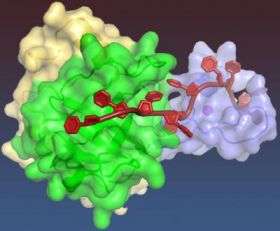
Mcm10 is shown in a surface view interacting with a single strand of DNA (depicted in red). Mcm10 contains two classic binding scaffolds. One is an OB-fold (OB stands for oligonucleotide/oligosaccharide) shown in green. The other is a structure called a zinc finger shown in blue. Proteins typically use OB-folds to interact with single-stranded DNA, while zinc fingers are used normally to recognize double-stranded DNA segments. Image: Brandt Eichman, Vanderbilt University

For the first time, structural biologists have managed to obtain the detailed three-dimensional structure of one of the proteins that form the core of the complex molecular machine, called the replisome, that plant and animal cells assemble to copy their DNA as the first step in cell reproduction.

The molecular structure of the protein, Mcm10, was published online by the journal Structure on Dec. 9. Its discovery was a collaborative effort by Brandt Eichman, assistant professor of biological sciences at Vanderbilt University, and Walter Chazin, Chancellor's Professor of Biochemistry and Physics at Vanderbilt, working with Anja Katrin-Bielinsky at the University of Minnesota.

Currently, the process of DNA replication in eukaryote cells – cells that have their genetic information contained in a nucleus – is a "black box." Biologists know what goes in and what comes out but they know very little about how the process actual works at the molecular level. Because form causes function in the protein world, determining the 3D structure of the 30-40 proteins that combine to form the replisome is a necessary first step to figuring out the details of this critical process and understanding how it can go wrong.

The structure of Mcm10 was determined using cells from the African clawed frog (Xenopus laevis); the structures of analogous proteins in human and other animal cells should be nearly identical, the researchers maintain. The Mcm10 structure reveals a special feature, called the OB-fold, that proteins use to interact with single-stranded DNA and a series of three loops that the researchers believe are used to clamp down on the DNA. The protein also contains a protrusion – called a zinc finger because it is built around a zinc atom – that proteins normally use to recognize specific double-stranded DNA segments. In this case the zinc finger appears to be modified in a way that allows it to detect generic DNA.

The researchers think that Mcm10 may play a role in positioning the other proteins in the replisome onto the single DNA strand so that it may be correctly read and duplicated, while acknowledging that they have very little information about how it functions.

Source: Vanderbilt University


print this article email this article download pdf blog this article bookmark this article     Stumble it Digg this share on Facebook retweet share on Reddit add to delicious
Rate this story - 4.3 /5 (3 votes)


December 9, 2008 all stories

Comments: 0

4.3 /5 (3 votes)
  • Stumble this up

  • Digg this

  • share this

  • hide
  • Related Stories


Other News

Wiggling and waggling: Study sheds light on amazing bee brain

Wiggling and waggling: Study sheds light on amazing bee brain

Biology / Plants & Animals

created 8 hours ago | popularity 5 / 5 (5) | comments 0

(PhysOrg.com) -- Their brains are tiny - about the size of sesame seeds - and yet the behaviour of the humble honey bee is so advanced it has scientists scratching their heads in disbelief.


The past matters to plants

The past matters to plants

Biology / Plants & Animals

created 5 hours ago | popularity not rated yet | comments 0

(PhysOrg.com) -- It's commonly known that plants interact with each other on an everyday basis: they shade each other out or take up nutrients from the soil before neighboring plants can get them. Now, researchers ...


Limestone leaf warbler: New bird species discovered

Biology / Plants & Animals

created 5 hours ago | popularity not rated yet | comments 0

(PhysOrg.com) -- A diminutive, colorful bird living in the rocky forests of Laos and Vietnam has been discovered by a team of scientists from the Wildlife Conservation Society, Lao PDR Department of Forestry, Swedish University ...


Why don't robins get fat?

Why don't robins get fat?

Biology / Ecology

created 3 hours ago | popularity not rated yet | comments 0

(PhysOrg.com) -- New research by the School of Biosciences is shedding light on the reasons why the European robin doesn’t get fat -even though they are feeding for much longer.


IKK may act as both inhibitor and promoter of Huntington's disease

Biology / Cell & Microbiology

created 13 hours ago | popularity not rated yet | comments 0

The kinase IKK phosphorylates the protein mutated in Huntington's disease to promote its removal and neuron survival, but IKK may be a double-edged sword that increases neurotoxicity in later stages of the disease. The study, ...