New polymer coatings prevent corrosion, even when scratched
December 9, 2008
New polymer coatings prevent corrosion, even when scratched

Enlarge

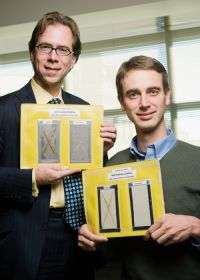
Illinois researchers Paul Braun, right, and Scott White have created self-healing coatings that automatically repair themselves and prevent corrosion of the underlying substrate. Photo by L. Brian Stauffer

Imagine tiny cracks in your patio table healing by themselves, or the first small scratch on your new car disappearing by itself. This and more may be possible with self-healing coatings being developed at the University of Illinois.

The new coatings are designed to better protect materials from the effects of environmental exposure. Applications range from automotive paints and marine varnishes to the thick, rubbery coatings on patio furniture and park benches.

"Starting from our earlier work on self-healing materials at the U. of I., we have now created self-healing coatings that automatically repair themselves and prevent corrosion of the underlying substrate," said Paul Braun, a University Scholar and professor of materials science and engineering. Braun is corresponding author of a paper accepted for publication in the journal Advanced Materials.

To make self-repairing coatings, the researchers first encapsulate a catalyst into spheres less than 100 microns in diameter (a micron is 1 millionth of a meter). They also encapsulate a healing agent into similarly sized microcapsules. The microcapsules are then dispersed within the desired coating material and applied to the substrate.

"By encapsulating both the catalyst and the healing agent, we have created a dual capsule system that can be added to virtually any liquid coating material," said Braun, who also is affiliated with the university's Beckman Institute, Frederick Seitz Materials Research Laboratory, department of chemistry, and Micro and Nanotechnology Laboratory.

When the coating is scratched, some of the capsules break open, spilling their contents into the damaged region. The catalyst and healing agent react, repairing the damage within minutes or hours, depending upon environmental conditions.

The performance of the self-healing coating system was evaluated through corrosion testing of damaged and healed coated steel samples compared to control samples that contained no healing agents in the coating. Reproducible damage was induced by scratching through the 100-micron-thick polymer coating and into the steel substrate using a razor blade. The samples were then immersed in a salt solution and compared over time.

The control samples corroded within 24 hours and exhibited extensive rust formation, most prevalently within the groove of the scratched regions, but also extending across the substrate surface, the researchers report. In dramatic contrast, the self-healing samples showed no visual evidence of corrosion even after 120 hours of exposure.

"Our dual capsule healing system offers a general approach to self-healing coatings that operates across a broad spectrum of coating chemistries," Braun said. "The microcapsule motif also provides a delivery mechanism for corrosion inhibitors, antimicrobial agents, and other functional chemicals."

Source: University of Illinois at Urbana-Champaign

4.6 /5 (24 votes)  

Filter


Move the slider to adjust rank threshold, so that you can hide some of the comments.


Display comments: newest first

theophys
Dec 09, 2008

Rank: 4.2 / 5 (5)
This sounds like something the military will eventualy snatch up and expand. If you can put capsules for self-repair in paint, you could probably work out a way to do it with various metals and plastics. No more rusty tanks for us!
gwargh
Dec 10, 2008

Rank: 3.3 / 5 (3)
This would really benefit shipping industries. If they could release poison on the bottom of hulls, it would stop the growth of barnacles. And if a layer below would protect form rust even better.

which get me thinking: could this be applied to, let's say. the insulation of a shuttle? The time needed to check for any damage done before re-entry would be dramatically reduced if most cracks or such would refill themselves.
holmstar
Dec 10, 2008

Rank: not rated yet
which get me thinking: could this be applied to, let's say. the insulation of a shuttle? The time needed to check for any damage done before re-entry would be dramatically reduced if most cracks or such would refill themselves.


Cracks are not generally an issue on the orbiters tiles (think about it, there are small cracks between each of the tiles). The problem comes when you have significant holes or gaps.
theophys
Dec 10, 2008

Rank: not rated yet
Actualy, cracks, chips, and dents can all lead to problems. The immense frictional forces of reentry tend to find inconsistencies like these and rip away the tiles they are found on, resulting in probable deaths of the entire crew. I think gwargh has a valid point.
Rank 4.6 /5 (24 votes)
Relevant PhysicsForums posts
  • excited U-236 decay time in the U235 fission chain
    created19 hours ago
  • Polar catastrophe?
    created22 hours ago
  • Large scale field sonication
    createdFeb 09, 2012
  • states and energy of paired electrons in BCS
    createdFeb 08, 2012
  • difference between longitudinal and transverse refractive indices
    createdFeb 08, 2012
  • Monte Carlo simulation
    createdFeb 07, 2012
  • More from Physics Forums - Atomic, Solid State, Comp. Physics

More news stories

Hovering not hard if you're top-heavy, researchers find

Top-heavy structures are more likely to maintain their balance while hovering in the air than are those that bear a lower center of gravity, researchers at New York University's Courant Institute of Mathematical Sciences ...

Physics / General Physics

created 1 hour ago | popularity 5 / 5 (1) | comments 1 | with audio podcast

SLAC, Stanford team focuses on high-energy electrons to treat cancer

Accelerator physicists at SLAC and cancer specialists from Stanford are working on a new technology that could dramatically reduce the time needed for cancer radiation treatments. The team ran an initial experiment ...

Physics / General Physics

created 4 hours ago | popularity 5 / 5 (1) | comments 0

Measurements from high-energy collisions lead to better understanding of why meson particles disappear

For several years, physicists at the Relativistic Heavy Ion Collider (RHIC) at Brookhaven National Laboratory (BNL), USA, have studied an unusual state of matter called the quark–gluon plasma, which they ...

Physics / General Physics

created 4 hours ago | popularity not rated yet | comments 0

Quantum physicist explains $100K offer for proof scaled-up quantum computing is impossible

(PhysOrg.com) -- MIT researcher Scott Aaronson has certainly riled the physics community with his offer this past Friday, of $100,000 to anyone who can prove that scaled-up quantum computing is impossible. ...

Physics / Quantum Physics

created Feb 08, 2012 | popularity 4.1 / 5 (11) | comments 32 | with audio podcast weblog

Explained: Sigma

It's a question that arises with virtually every major new finding in science or medicine: What makes a result reliable enough to be taken seriously? The answer has to do with statistical significance -- but ...

Physics / General Physics

created Feb 09, 2012 | popularity 5 / 5 (14) | comments 34


Grass to gas: Researchers' genome map speeds biofuel development

Researchers at the University of Georgia have taken a major step in the ongoing effort to find sources of cleaner, renewable energy by mapping the genomes of two originator cells of Miscanthus x giganteus, a large perenn ...

Researchers develop new method for creating tissue engineering scaffolds

Researchers at Northwestern University have developed a new method for creating scaffolds for tissue engineering applications, providing an alternative that is more flexible and less time-intensive than current technology.

Molecular profiling reveals differences between primary and recurrent ovarian cancers

There is a need to analyze tumor specimens at the time of ovarian cancer recurrence, according to a new study published in Molecular Cancer Therapeutics. Researchers used a diagnostic technology called molecular profiling to examine ...

C-sections linked to breathing problems in preterm infants

Research conducted at Yale School of Medicine shows that a cesarean (C-section) delivery, which was thought to be harmless, is associated with breathing problems in preterm babies who are small for gestational age.

Review: Netflix and Hulu's new scripted originals

Within just over a week, Netflix and Hulu are both debuting their first stabs at original scripted programming.

India probes Google over 'forex transactions'

Indian authorities are probing whether online giant Google broke domestic foreign-exchange transactions rules while shifting funds abroad, the Press Trust of India reported on Friday.