Late Neanderthals and modern human contact in southeastern Iberia
December 9, 2008 Late Neanderthals and modern human contact in southeastern Iberia

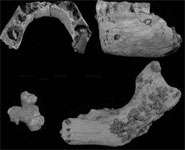
Parts of four mandibles (lower jaw bones) found in the Sima de las Palomas region of Murcia, Spain. Photo by Walker et al (PNAS)

(PhysOrg.com) -- It is widely accepted that Upper Paleolithic early modern humans spread westward across Europe about 42,000 years ago, displacing and absorbing Neanderthal populations in the process. However, Middle Paleolithic assemblages persisted for another 8,000 years in Iberia, presumably made by Neanderthals. It has been unclear whether these late Middle Paleolithic Iberian assemblages were made by Neanderthals, and what the nature of those humans might have been.

New research, published in the Proceedings of the National Academy of Sciences, is now shedding some light on what were probably the last Neanderthals.

The research is based on a study of human fossils found during the past decade at the Sima de la Palomas, Murcia, Spain by Michael Walker, professor at Universidad de Murcia, and colleagues, and published by Michael Walker, João Zilhão and Alistair Pike, from the University of Bristol, and colleagues.

The human fossils from the upper levels of the Sima de las Palomas are anatomically clearly Neanderthals, and they are now securely dated to 40,000 years ago. They therefore establish the late persistence of Neanderthals in this southwestern cul-de-sac of Europe. This reinforces the conclusion that the Neanderthals were not merely swept away by advancing modern humans. The behavioral differences between these human groups must have been more subtle than the Middle-to-Upper Paleolithic technological contrasts might imply.

In addition, the Palomas Neanderthals variably exhibit a series of modern human features rare or absent in earlier Neanderthals. Either they were evolving on their own towards the modern human pattern, or more likely, they had contact with early modern humans around the Pyrenees. If the latter, it implies that the persistence of the Middle Paleolithic in Iberia was a matter of choice, and not cultural retardation.

From the Sima de las Palomas, other late Neanderthal sites, and recent discoveries of the earliest modern humans across Europe, a complex picture is emerging of shifting contact between behaviorally similar, if culturally and biologically different, human populations. We are coming to see them all more as people, flexibly making a living through the changing human and natural landscapes of the Late Pleistocene.

Paper: Late Neanderthals in Southeastern Iberia: Sima de las Palomas del Cabezo Gordo, Murcia, Spain Michael J. Walker, Josep Gibert, Mariano V. López, A. Vincent Lombardi, Alejandro Pérez-Pérez, Josefina Zapata, Jon Ortega, Thomas Higham, Alistair Pike, Jean-Luc Schwenninger, João Zilhão, Erik Trinkaus PNAS (http://www.pnas.org/)

Provided by University of Bristol


print this article email this article download pdf blog this article bookmark this article     Stumble it Digg this share on Facebook retweet share on Reddit add to delicious
Rate this story - 4.4 /5 (26 votes)

Rank Filter

Move the slider to adjust rank threshold, so that you can hide some of the comments.


Display comments: newest first

  • agg - Dec 10, 2008
    • Rank: not rated yet
    Some speculate the only cultural artifact left from the Neanderthal in modern times is the two party system.

December 9, 2008 all stories

Comments: 1

4.4 /5 (26 votes)
  • Stumble this up

  • Digg this

  • share this

  • hide
  • Related Stories

  • Modern men are wimps, according to new book
    created Oct 21, 2009 | popularity not rated yet | comments 0
  • Researchers Probe Links Between Modern Humans and Neanderthals
    created Sep 19, 2009 | popularity not rated yet | comments 0
  • Humans spread out of Africa later
    created Sep 04, 2009 | popularity not rated yet | comments 0
  • Early modern humans use fire to engineer tools from stone
    created Aug 13, 2009 | popularity not rated yet | comments 0
  • Unlocking the key to human fertility
    created Aug 03, 2009 | popularity not rated yet | comments 0


  • hide
  • Relevant PhysicsForums posts

Other News

Racial segregation key factor in subprime lending

Other Sciences / Economics

created 9 hours ago | popularity 3 / 5 (2) | comments 2

(PhysOrg.com) -- New study examines impact of segregation on the prevalence of high-cost loans in U.S. metro areas. Subprime loans disproportionately located in segregated areas.


UWM study explores why women leave engineering careers

Other Sciences / Social Sciences

created 6 hours ago | popularity 2 / 5 (3) | comments 1

While only one in 10 male engineers leave their field by the time they reach their 30s, about one in four women are not working in engineering despite having completed the necessary education.


We spend more on products with detailed nutritional information

We spend more on products with detailed nutritional information

Other Sciences / Social Sciences

created 12 hours ago | popularity not rated yet | comments 0

People would be willing to pay more for products that carry detailed nutritional information than for the so-called light items. Thus it has been confirmed by researchers from the University of Santiago de ...


New research may help to reduce global supply chain disruptions

Other Sciences / Economics

created 10 hours ago | popularity not rated yet | comments 1

(PhysOrg.com) -- With consumer spending dwindling over the past couple months, retailers are hoping to see it increase with the holiday shopping season. In order to seize the opportunity and boost sales, retailers need to ...


Weather-sensitive architectural skins integrate form with function

Weather-sensitive architectural skins integrate form with function

Other Sciences / Other

created 11 hours ago | popularity 3 / 5 (2) | comments 0

Buildings typically provide shelter from the elements, but one Ryerson University researcher thinks structures ought to relate more to the environment instead. To this end, she has created architectural "skins," ...