Student Helps Bloggers Overcome Writer's Block
December 9, 2008
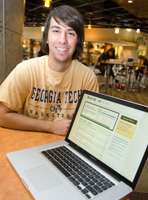
Georgia Tech student Paul Stamatiou created Skribit, a blog that helps bloggers overcome writer’s block. Skribit has more than 4,000 blogs using it and gets more than 4 million hits per month. (Photo: Rob Felt/Ga Tech)
(PhysOrg.com) -- If you write a blog and haven’t been to Skribit (skribit.com) perhaps it’s just a matter of time. Paul Stamatiou created the service as a tool to help cure blogger’s block (writer’s block for bloggers) a little over a year ago, and already it boasts more than 4,000 blogs using it and gets about 4 million hits per month.
Stamatiou created Skribit (rhymes with ribbet) out of necessity to help him as he worked on his own blog, PaulStamatiou.com. He had been running his blog since 2005, but was having a bit of trouble coming up with the next thing to write. So he pitched the idea at Startup Weekend Atlanta, a conference that brings together entrepreneurs, computer programmers and marketing types to create companies and products —they built it that weekend.
“After three days, people start to ask, ‘why haven’t you blogged in a while?’,” said Stamatiou. “With Skribit, readers can vote on topics and post ideas on what to write about and the widget will sort them out by how hot they are. If you suggest something, you will get notified when they use your suggestion.”
Skribit’s user base is vast, according to Stamatiou. Everyone from English-speaking bloggers to Japanese, Spanish and Korean bloggers are using it. He even has a police department in Maryland using it to get feedback from the community.
What makes Skribit successful, said Stamatiou, is that it provides a place for bloggers to get new ideas, rather than simply write about what everyone else is already talking about.
“Someone might use Skribit if they want their site to be up-to-date, but don’t want to go to the echo chamber to mimic everyone else,” said Stamatiou.
Skribit works in two ways. Users can post suggestions on topics to write about on the site either anonymously or with a user account. Bloggers can either read the site or post a widget on their blog. The benefit, said Stamatiou, of having the widget is that readers can post their suggestions directly to the blog they read. Readers can vote on their favorite topics, and the blog displays the suggestions based on factors such as how many votes they’ve received and how recently they were suggested.
Stamatiou created the site while he was a Computational Media student in both the College of Computing and the Ivan Allen College of Liberal Arts at Georgia Tech. And although it came out of his initial idea, Stamatiou continues to develop the site with co-founder Calvin Yu. When he graduates later this month, he plans to work full time on making Skribit profitable with help from the Georgia Tech Edison Fund.
The Georgia Tech Edison Fund helps provide initial funding for early-stage technology companies that have a close association with Georgia Tech. Chief Commercialization Officer Stephen Fleming said that keeping young talent from having to look outside of Atlanta for initial funding is one of his most important missions.
“At one time, I know that Paul was looking to move out to California to try to get funding for Skribit,” said Fleming. “I’m glad that we were able to provide him with the initial funding to keep young talent like him here in Atlanta.”
So, does Stamatiou ever use Skribit to help out when he gets blogger’s block? Of course he does.
“For me it is a backup plan when I really can’t think of something to write. If I notice something that has received a lot of votes in a very short amount of time, I'll take that as a note that my readers really want to read about it and I'll change my plans and blog about it,” he said. “Then there are the times that, for a few weeks, I won’t have any clue about what to write, so I'll just rely on it.”
Provided by Georgia Institute of Technology
-
Engineers build first sub-10-nm carbon nanotube transistor
Feb 01, 2012 |
4.9 / 5 (33) |
30
-
Something old, something new: Evolution and the structural divergence of duplicate genes
Jan 31, 2012 |
4.6 / 5 (7) |
1
-
The hidden nanoworld of ice crystals: Revealing the dynamic behavior of quasi-liquid layers
Jan 30, 2012 |
5 / 5 (4) |
1
-
Stock market network reveals investor clustering
Jan 27, 2012 |
3.9 / 5 (23) |
8
-
Of microchemistry and molecules: Electronic microfluidic device synthesizes biocompatible probes
Jan 26, 2012 |
5 / 5 (2) |
0
-
How to tilt a object
5 hours ago
-
How to calculate total compressibility in liquid porous solid system
10 hours ago
-
Need help reading 3-D
Feb 11, 2012
-
A way to send and receive wireless data
Feb 11, 2012
-
Calling function with no input argument
Feb 10, 2012
-
Force free body diagram problem on gym equipment
Feb 10, 2012
- More from Physics Forums - General Engineering
More news stories
Google might launch Drive for cloud storage soon
(PhysOrg.com) -- Google's next big move, according to the Wall Street Journal, is a cloud storage service called Drive. Hardly first to the plate, Google is simply catching up to introducing its cloud reposi ...
Iran blocks email, restricts net access: reports
Iran has further restricted access to the Internet and blocked popular email services for the past few days, in a move a top lawmaker said could "cost the regime dearly," media reports said on Sunday.
11 hours ago |
5 / 5 (2) |
5
Walney offshore wind farm is world's biggest (for now)
(PhysOrg.com) -- The Walney wind farm on the Irish Sea--characterized by high tides, waves and windy weather--officially opened this week. The farm is treated in the press as a very big deal as the Walney ...
Navy to begin tests on electromagnetic railgun prototype launcher
The Office of Naval Research (ONR)'s Electromagnetic (EM) Railgun program will take an important step forward in the coming weeks when the first industry railgun prototype launcher is tested at a facility ...
Feb 06, 2012 |
4.6 / 5 (20) |
95
|
New power source discovered
(PhysOrg.com) -- Researchers at the Massachusetts Institute of Technology (MIT) and RMIT University have made a breakthrough in energy storage and power generation.
Technology / Energy & Green Tech
Feb 10, 2012 |
4.6 / 5 (51) |
51
|
Scientists discover molecular secrets of 2,000-year-old Chinese herbal remedy
For roughly two thousand years, Chinese herbalists have treated Malaria using a root extract, commonly known as Chang Shan, from a type of hydrangea that grows in Tibet and Nepal. More recent studies suggest that halofuginone, ...
New method to examine batteries -- MRI from the inside
There is an ever-increasing need for advanced batteries for portable electronics, such as phones, cameras, and music players, but also to power electric vehicles and to facilitate the distribution and storage of energy derived ...
A mitosis mystery solved: How chromosomes align perfectly in a dividing cell
Although the process of mitotic cell division has been studied intensely for more than 50 years, Whitehead Institute researchers have only now solved the mystery of how cells correctly align their chromosomes during symmetric ...
Lab study raises questions over nano-particle impact
Tests involving chickens have raised questions about the impact on health from engineered nano-particles, the ultra-fine grains commonly used in drugs and processed foods, scientists said on Sunday.
Starve a virus, feed a cure? Findings show how some cells protect themselves against HIV
A protein that protects some of our immune cells from the most common and virulent form of HIV works by starving the virus of the molecular building blocks that it needs to replicate, according to research published online ...
Researchers find extensive RNA editing in human transcriptome
In a new study published online in Nature Biotechnology, researchers from BGI, the world's largest genomics organization, reported the evidence of extensive RNA editing in a human cell line by analysis of RNA-seq data, demons ...