HiRISE Camera Captures High-Resolution 3-D Images of Mars
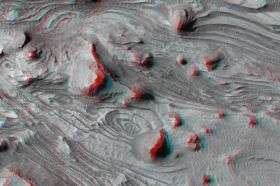
(PhysOrg.com) -- The High Resolution Imaging Science Experiment, or HiRISE, team based at The University of Arizona today released 362 three-dimensional images of Mars taken by the HiRISE camera on NASA's Mars Reconnaissance Orbiter.
Other Mars-orbiting cameras have taken 3-D views of Mars, but the HiRISE camera – the most powerful camera ever to orbit another planet – can resolve features as small as one meter, or 40 inches, across.
"It's really remarkable to see Martian rocks and features on the scale of a person in 3-D," said Alfred McEwen of UA's Lunar and Planetary Laboratory, HiRISE principal investigator. "The level of detail is just much, much greater than anything previously seen from orbit."
The 3-D images, or anaglyphs, can be viewed on the HiRISE Web site (hirise.lpl.arizona.edu/anaglyphs) with inexpensive color filter glasses commonly used for viewing 3-D images and movies. The HiRISE Web site links to information on where to purchase and how to make 3-D red-cyan filter glasses. Without 3-D glasses, the Mars images appear out of register.
Seen in HiRISE 3-D, Mars becomes a collection of deep panoramic views that leap out from the computer screen.
"You'd swear you could touch the terrain," HiRISE operations manager Eric Eliason said.
Striking stereo views include:
-- Sixty-meter tall, or 200-foot-tall fractured mounds, probably composed of solidified lava, on the southern edge of Elysium Planitia. The fractured surface suggests that lava pushed the surface into domes, uplifting some sides along the same fracture higher than others. See image here.
-- Spectacular layers exposed on the floor about 2-and-a-half miles, or 4 kilometers, below the rim of Candor Chasma, which is a large canyon in the Valles Marineris system. The canyon may once have been filled to its rim by sedimentary layers of sand and dust-sized particles, but these have since eroded, leaving patterns of elongated hills and layered terrain that has been turned and folded in many angles and directions. See image here.
-- Groups of gullies at different elevations along the wall of an unnamed crater in Terra Cimmeria. The anaglyph image provides three-dimensional perspective on the depth of the gullies and the amount of material deposited below the gullies. Geological evidence suggests that the gullies may have formed by subsurface water, rather than by snow or ice melting on the surface. See image here.
Other dramatic anaglyphs show a huge jumbled mass of rock that includes megabreccia at a central peak in Ritchey crater, ejecta-formed channels and mudflows at Hale crater, tightly folded rock layers lining the floor of Tithonium Chasm, "spiders" created by carbon dioxide venting through south polar layered deposits, and Martian glacier flows.
Eliason and the team at HiROC, the High Resolution Imaging Operations Center on the UA campus, began processing stereo images in October. They automated some of the software used in processing HiRISE images so two images of a stereo pair could be fed into the software "pipeline" and correlated automatically.
"The real advance here is making this process semi-automated so we can really crank through all these huge images," McEwen said. Producing anaglyphs from stereo pairs is otherwise a tedious, time-consuming effort.
The HiRISE camera has so far taken 950 stereo image pairs. The camera features a half-meter, or 20-inch, diameter primary mirror and a focal plane mechanism that can acquire up to a 3.6 megapixel image in about 11 seconds.
The anaglyphs are among 1,642 observations containing 3.6 terabytes of data and 148,000 image products that HiRISE released today to the Planetary Data System, or the PDS, the NASA mission data archive.
Since HiRISE began the science phase of its mission in November 2006, the HiRISE team has released a total 867,430 image products, or 30.2 terabytes of data. That is by far the greatest volume of data a space experiment has delivered to the PDS, and well more than twice the data volume some HiRISE team members expected to get during the primary science phase.
The HIRISE camera was designed to take images at high-convergence angles so researchers can calculate the thickness of surface features to within about 10 inches, or 25 centimeters. High-convergence angles used to get quantitative measurements aren't always best for making anaglyphs, McEwen said.
In addition, if the two stereo images on two different orbits were taken far enough apart in time, the illumination or air opacity may have changed, or frost or dust devils may have appeared in one of the images, so paired images don't always match that well, he added.
"Nevertheless, many of these stereo anaglyphs are very interesting and useful to us in understanding the topography," McEwen said.
"There's a lot of science to be done by just looking at these directly and understanding what's up and what's down," he added. "Anaglyphs can definitely change how we interpret things, and help us focus on how to proceed when it comes to prioritizing some science tasks."
Binocular vision gives humans wearing 3-D color glasses the ability to see anaglyphs in three dimensions the same way they see in three dimensions through a View-Master viewer or a Victorian-era stereoscope. The same scene is viewed in two pictures taken from slightly different angles. Each eye has its own slightly different view, which the brain fuses together into a single picture with depth.
With the colored glasses, the red filter for the left eye sees only red in the picture, the cyan filter for the right eye sees only blue-green in the picture, and the brain correlates the images. The glasses work for viewing stereo pictures in print or on TV, movie and computer screens.
Provided by University of Arizona


