Researchers focus on building telescope at South Pole
It's 40 degrees F below zero (with the wind chill) at the South Pole today. Yet a research team from the University of Delaware is taking it all in stride.
The physicists, engineers and technicians from the University of Delaware's Bartol Research Institute are part of an international team working to build the world's largest neutrino telescope in the Antarctic ice, far beneath the continent's snow-covered surface.
Dubbed "IceCube," the telescope will occupy a cubic kilometer of Antarctica when it is completed in 2011, opening super-sensitive new eyes into the heavens.
"IceCube will provide new information about some of the most violent and far-away astrophysical events in the cosmos," says Thomas Gaisser, the Martin A. Pomerantz Chaired Professor of Physics and Astronomy at the University of Delaware, and one of the project's lead scientists.
The University of Delaware is among 33 institutions worldwide that are contributing to the National Science Foundation project, which is coordinated by the University of Wisconsin.
Besides taking a turn as "on-ice lead" for this year's IceCube construction effort at the South Pole (or simply "Pole," as the locals call it), Gaisser is managing the University of Delaware's continued deployment of the telescope's surface array of detectors, known as "IceTop."
A huge telescope in the ice
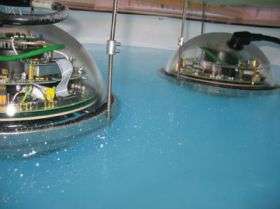
Rather than a giant lens aimed at the heavens, the IceCube telescope consists of kilometer-long strings of 60 optical detectors frozen more than a mile deep in the Antarctic ice like beads on a necklace. Atop each string of deep detectors sits a pair of 600-gallon IceTop tanks, each containing two optical detectors.
Ironically, it takes about seven weeks for the water in the IceTop tanks to freeze perfectly, without bubbles or cracks, which could obstruct the tiny flash that occurs when particles pass through the ice.
Neutrinos are among the most fundamental constituents of matter. Because they have no electrical charge and interact only weakly, these particles can travel millions of miles through space.
Neutrinos can pass right through planets, and they can emerge from deep inside regions of intense radiation such as the accretion disk around a massive black hole.
The surface IceTop detectors measure cascades of particles generated by high-energy cosmic rays showered down from above, while the detectors deep in the ice monitor neutrinos passing up through the planet from below.
When a flash of light is detected, the information is relayed to the nearby IceCube Lab, where the path of the particle can be reconstructed and scientists can trace where it came from, perhaps an exploding star or a black hole.
For Gaisser, this great quest to capture neutrinos is a cosmic journey in more ways than one.
"All of my career at Bartol Research Institute at the University of Delaware has been to study high-energy particles from space," Gaisser says. "This experiment we're building fulfills all of my dreams. Besides, it's fun to work here," he notes.
Working in the deep freeze
A drill camp supports each season of the IceCube project in the 24-hour daylight of the Antarctic summer. Drilling is a 24/7 operation with three shifts of drillers.
In the subfreezing temperatures and howling winds, fuel tanks supply generators that make electricity, which is used to heat the water that pulses through the high-pressure hoses that melt the mile-and-a-half-long deep holes into which strings of optical detectors are submerged.
The IceTop team works six days a week from 8 a.m. to 6 p.m., retreating to the warmth of the new Amundsen-Scott South Pole Station, to sleep, eat, and spend what little free time they have reading, watching movies, exercising, or chatting with fellow "Polies."
Among the new facility's amenities are constant e-mail communication, a recreation room with enough musical instruments for a band, and a greenhouse where lettuce, cucumbers and tomatoes are grown.
Gaisser and senior electronics instrument specialist James Roth, electronics engineer Leonard Shulman, and physicist Paul Evenson will all work on location at the South Pole over the next several weeks, assisted by Hermann Kolanoski, a colleague who is a professor of physics at the Humboldt University in Berlin.
Ten other scientists and graduate students from the University of Delaware Department of Physics and Astronomy also are involved in the effort, from deployment to data analysis. They include David Seckel, John Clem, Chris Elliott, Shahid Hussain, Takao Kuwabara, Bakhtiyar Ruzybayev, Todor Stanev, Serap Tilav and Chen Xu.
Source: University of Delaware


