Biggest Full Moon of the Year
December 10, 2008 Biggest Full Moon of the Year

Enlarge

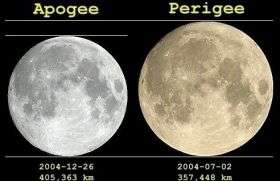
In 2004, Greek amateur astronomer Anthony Ayiomamitis photographed an apogee Moon and a perigee Moon, and set the images side by side to show the difference.

No, you can not see Neil Armstrong's footprint. But go ahead and look: The full Moon of Dec. 12th is the biggest and brightest full Moon of the year.

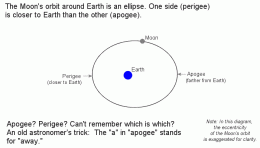
It's no illusion. Some full Moons are genuinely larger than others and this Friday's is a whopper. Why? The Moon's orbit is an ellipse with one side 50,000 km closer to Earth than the other: see diagram. In the language of astronomy, the two extremes are called "apogee" (far away) and "perigee" (nearby). On Dec. 12th, the Moon becomes full a scant 4 hours after reaching perigee, making it 14% bigger and 30% brighter than lesser full Moons we've seen earlier in 2008.
Biggest Full Moon of the Year
Enlarge


A perigee Moon brings with it extra-high "perigean tides," but this is nothing to worry about, according to NOAA. In most places, lunar gravity at perigee pulls tide waters only a few centimeters (an inch or so) higher than usual. Local geography can amplify the effect to about 15 centimeters (six inches)--not exactly a great flood.

Okay, the Moon is 14% bigger, but can you actually tell the difference? It's tricky. There are no rulers floating in the sky to measure lunar diameters. Hanging high overhead with no reference points to provide a sense of scale, one full Moon looks much like any other.

The best time to look is when the Moon is near the horizon. That is when illusion mixes with reality to produce a truly stunning view. For reasons not fully understood by astronomers or psychologists, low-hanging Moons look unnaturally large when they beam through trees, buildings and other foreground objects. On Friday, why not let the "Moon illusion" amplify a full Moon that's extra-big to begin with? The swollen orb rising in the east at sunset may seem so nearby, you can almost reach out and touch it.

But you still won't be able to see Armstrong's footprint. Not even Hubble can do that. The Moon is 384,400 km away (on average). At that distance, the smallest things Hubble can distinguish are about 60 meters wide. The biggest pieces of left-behind Apollo equipment are only about 9 meters across and smaller than a single pixel in a Hubble image.

What you will see is the world around you. This is both the brightest and (in the northern hemisphere) the highest-riding full Moon of the year. If you go outside around midnight it will be close to overhead and act like a cosmic floodlamp making the landscape absolutely brilliant, especially if there's snow. Full moons are always high during winter and, indeed, the solstice is right around the corner on Dec. 21st.

A fun experiment: Take a friend outside on Friday evening and ask if they notice anything unusual. Is the Moon big and bright enough to impress the unwary? Explain perigee later....

Source: Science@NASA, by Dr. Tony Phillips


print this article email this article download pdf blog this article bookmark this article     Stumble it Digg this share on Facebook retweet share on Reddit add to delicious
Rate this story - 4.5 /5 (22 votes)

Rank Filter

Move the slider to adjust rank threshold, so that you can hide some of the comments.


Display comments: newest first

  • Mercury_01 - Dec 10, 2008
    • Rank: not rated yet
    But what is it full of?
  • KBK - Dec 10, 2008
    • Rank: 1 / 5 (2)
    Smegma.
  • Eco_R1 - Dec 10, 2008
    • Rank: not rated yet
    hubble that weak?
  • Stavros - Dec 11, 2008
    • Rank: not rated yet
    hubble not weak...armstrong never made it to the moon remember -- they were abducted by aliens on the way up.
  • Andrux - Dec 12, 2008
    • Rank: not rated yet
    I certainly hope the last comment was sarcastic, unless you believe the the moon just grew a pimple made of mirrors to help us measure its accurate distance from us. :P

December 10, 2008 all stories

Comments: 5

4.5 /5 (22 votes)
  • Stumble this up

  • Digg this

  • share this

  • hide
  • Related Stories

  • Biggest Full Moon of the Year: Take 2
    created Jan 08, 2009 | popularity not rated yet | comments 0
  • The Stars My Destination
    created Nov 10, 2009 | popularity not rated yet | comments 0
  • Fantastic Voyage
    created Nov 02, 2009 | popularity not rated yet | comments 0
  • STAR TRAK for November: Mars is prominent again
    created Nov 02, 2009 | popularity not rated yet | comments 0
  • Icebreaker: Scientist brings out big gun to explore behavior of ice in planetary collisions
    created Oct 29, 2009 | popularity not rated yet | comments 0


  • hide
  • Relevant PhysicsForums posts

  • Sideral question
    created 20 hours ago
  • Doppler shifted blackbody spectrum
    created 22 hours ago
  • Earth v. Moon
    created Nov 21, 2009
  • help me with coordinates and orbits
    created Nov 21, 2009
  • More from Physics Forums - General Astronomy

Other News

Baby can wait as expectant dad finishes spacewalk (AP)

Baby can wait as expectant dad finishes spacewalk

Space & Earth / Space Exploration

created 11 hours ago | popularity 3 / 5 (2) | comments 0

(AP) -- A spacewalking astronaut put aside the impending birth of his daughter and blazed through his first-ever venture outside the International Space Station on Saturday.


Unseasonably hot and dry weather combined with strong winds to fan scores of blazes in the country's southeastern states

Australia issues 'catastrophic' alerts as fires rage

Space & Earth / Environment

created 17 hours ago | popularity 4 / 5 (3) | comments 0

Australia has issued "catastrophic" alerts after record-breaking temperatures and wild lightning storms sparked more than 100 fires across the country, officials said Saturday.


Commuters wait on the platform shrouded by fog in London

Climate change not man-made, say majority of Britons: poll

Space & Earth / Environment

created Nov 15, 2009 | popularity 3.3 / 5 (15) | comments 46

Less than half of Britons believes that human activity is to blame for global warming, according to a poll carried out for The Times newspaper and published on Saturday.


Mysteriously warm times in Antarctica

Mysteriously warm times in Antarctica

Space & Earth / Earth Sciences

created Nov 18, 2009 | popularity 4.2 / 5 (21) | comments 28

(PhysOrg.com) -- A new study of Antarctica's past climate reveals that temperatures during the warm periods between ice ages (interglacials) may have been higher than previously thought. The latest analysis ...


UN: Fight climate change with free condoms (AP)

UN: Fight climate change with free condoms

Space & Earth / Environment

created Nov 18, 2009 | popularity 3.1 / 5 (11) | comments 24

(AP) -- The battle against global warming could be helped if the world slowed population growth by making free condoms and family planning advice more widely available, the U.N. Population Fund said Wednesday.