Researchers Observe Magnus Effect in Light for First Time
December 10th, 2008 Researchers Observe Magnus Effect in Light for First Time

Enlarge

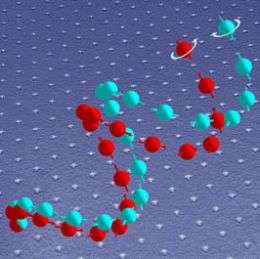
(PhysOrg.com) -- Researchers at the Technion-Israel Institute of Technology have become the first to observe the Magnus effect in light, potentially opening a new avenue for controlling light in nanometer-scale optical devices, which could lead to much faster computation data processing. The discovery also provides a more precise way to study important physical behavior that until now could only be observed in relatively complex, messy condensed matter systems. The findings are published in the December 2008 issue of Nature Photonics.

The research was carried out by Prof. Erez Hasman, Dr. Konstantin Y. Bliokh, Dr. Vladimir Kleiner and Avi Niv from the Micro and Nanooptics Laboratory, Faculty of Mechanical Engineering and Russell Berrie Nanotechnology Institute at the Technion.

The Magnus effect can be observed in a wide range of systems. It describes, for example, the sideways force a spinning ball feels as it travels through the air, which explains why a baseball pitcher's curveball curves, and why a badly hit golf ball slices. Light waves, which are made up of massless particles called photons, have their own version of spin. Light's spin depends on whether its polarization, or direction of wave vibration, rotates in one direction or in the opposite direction as it travels. The Magnus effect for light (also called the spin Hall effect) causes the light to deflect due to the interaction between the light's spin and shape of the light's trajectory.

Prof. Hasman and his collaborators detailed a unified theory of this effect, and also made the first experimental observation of it. The potential extensions of their work are wide ranging. "Utilizing this effect in photonic and nano-optic devices may lead to the development of a promising new area of research called Spinoptics," says Prof. Hasman. "The hope is that we will be able to control light in all-optical nanometer scale devices in ways that were impossible before. Such devices could one day be used in all-optical nanometer scale devices that compute and process data faster than anything available today."

The researchers also believe their ongoing work can provide results that are useful to other fields of physics. According to Prof. Hasman, "There are a number of systems where the spin of a particle couples with its trajectory in high-energy and condensed matter physics. The math is the same in all cases, but experimentally it's very hard to understand what's going on. Our experimental system offers a new way to get at some of these fundamental questions clearly and precisely."

Provided by Technion-Israel Institute of Technology


print this article email this article download pdf blog this article bookmark this article     Digg this Stumble it share on Facebook share on Reddit add to delicious save to Yahoo! bookmarks
4.6/5 after 14 votes

Rank Filter

Move the slider to adjust rank threshold, so that you can hide some of the comments.


Display comments: newest first

  • dirk_bruere - Dec 10, 2008
    • Rank: 5 / 5 (2)
    Not again... the "could one day" is always the BS warning for what is about to follow. They've done some solid work, so why not leave it at that without the hype about computing? Just about every optical technology for the past 30 years has felt the need to jump on the "could one day" optical computing bandwagon
  • theophys - Dec 10, 2008
    • Rank: not rated yet
    Could we use spinoptics to make a flashlight that curves photons? Point it at the ground and light up the back of your head. That could be a fun way to waste ten minutes.
  • Yes - Dec 10, 2008
    • Rank: 4 / 5 (1)
    Light waves, which are made up of mass less particles called photons, have their own version of spin.

    One photon is an electromagnetic wave. Has a wavelength/frequency, has a temperature, and energy it also has polarization.
    Don't know what property I forgot.
    The problem is I don't see where its spin might be. Did I miss something?
  • theophys - Dec 10, 2008
    • Rank: not rated yet
    Light waves, which are made up of mass less particles called photons, have their own version of spin.

    One photon is an electromagnetic wave. Has a wavelength/frequency, has a temperature, and energy it also has polarization.
    Don't know what property I forgot.
    The problem is I don't see where its spin might be. Did I miss something?

    Light has duality, meaning sometimes it acts as a particle and sometimes it acts as a wave. Photons represent light in its particle form and have spin, just like most other particles. Actualy, the same thing applies to everything. You actauly have a wavelength because all the particles that make you sometimes act as waves. Your wave length is equal to Planck's constant divided by your mass times your velocity or, h/mv. Ain't quantum mechanics a hoot?
  • Yes - Dec 10, 2008
    • Rank: not rated yet
    Hmm I think a medium is needed to have the polarization vector spin.
    Like what happens if the light passes through the Acid of Yogurt.
    Spin is no property of light like in spin up or down, but you can make the polarization vector of light "spin" I suppose that is what they do.
  • Alizee - Dec 13, 2008
    • Rank: 1 / 5 (1)
    By AWT the Hert/Lentz force is an analogy of the Newton-Magnus-Robbins force. We can met with many other hydrodynamic analogies there, because Maxwell equations are isomorphous to Navier-Stokes equations...

    http://superstrun...gnus.gif
    http://superstrun...art1.gif
    http://superstrun...okes.gif

December 10th, 2008 all stories
Physics / General Physics

Comments: 6
Rank: 4.6/5 after 14 votes

  • Stumble this up

  • Digg this

  • Share it:
  • share on Facebook
  • share on MySpace
  • share on Slashdot
  • rss-newsfeed
  • share on Google
  • share on Reddit
  • add to delicious
  • save to Yahoo! bookmarks
  • share on Windows Live
  • Add to Mixx!
Rating: 4.6/5 after 14 votes

  • Related Stories

  • New exotic material could revolutionize electronics
    created Jun 15, 2009 | popularity not rated yet | comments 0
  • Next generation nanofilms created
    created Apr 14, 2009 | popularity not rated yet | comments 0
  • Clockwork plants
    created Mar 25, 2009 | popularity not rated yet | comments 0
  • Physicist develops battery using new source of energy
    created Mar 11, 2009 | popularity not rated yet | comments 0
  • Spinning carbon nanotubes spawns new wireless applications
    created Mar 09, 2009 | popularity not rated yet | comments 0


  • Physicists Demonstrate Quantum Memory with Matter Qubits
    Physicists Demonstrate Quantum Memory with Matter Qubits
    Physics / General Physics
    created Jul 03, 2009 | popularity 4.4 / 5 (17) | comments 1
  • 'Holey' Nanosheets for Wastewater Dye Removal
    Nanotechnology / Nanomaterials
    created Jul 01, 2009 | popularity 5 / 5 (5) | comments 1
  • Jellyfish Robot Swims Like its Biological Counterpart
    Jellyfish Robot Swims Like its Biological Counterpart
    Electronics / Robotics
    created Jun 26, 2009 | popularity 4.4 / 5 (8) | comments 1
  • Could Maxwell's Demon Exist in Nanoscale Systems?
    Could Maxwell's Demon Exist in Nanoscale Systems?
    Physics / General Physics
    created Jun 24, 2009 | popularity 4.4 / 5 (18) | comments 29
  • Living Safely with Robots, Beyond Asimov's Laws
    Living Safely with Robots, Beyond Asimov's Laws
    Electronics / Robotics
    created Jun 22, 2009 | popularity 4.6 / 5 (53) | comments 40
  • Other News

    Physical reality of string theory demonstrated

    Physics / General Physics

    created 16 minutes ago | popularity 5 / 5 (1) | comments 0

    String theory has come under fire in recent years. Promises have been made that have not been lived up to. Leiden (The Netherlands) theoretical physicists have now for the first time used string theory to describe a physical ...


    UQ researchers break the law -- of physics

    Physics / General Physics

    created 5 hours ago | popularity 4.5 / 5 (10) | comments 4

    (PhysOrg.com) -- Two UQ Science researchers have proved two famous physical laws that have been widely used for the past 25 years do not always work.


    Scientists create first electronic quantum processor

    Scientists create first electronic quantum processor

    Physics / General Physics

    created Jun 28, 2009 | popularity 4.8 / 5 (54) | comments 44

    A team led by Yale University researchers has created the first rudimentary solid-state quantum processor, taking another step toward the ultimate dream of building a quantum computer.


    Science journals

    How to Spot an Influential Paper Based on its Citations

    Physics / General Physics

    created Jul 04, 2009 | popularity 3.9 / 5 (10) | comments 6

    (PhysOrg.com) -- At first it may seem that the number of citations received by a published scientific paper is directly related to that paper's quality of content. The higher the quality, the more people read ...


    Fermilab's CDF observes Omega-sub-b baryon

    Fermilab's CDF observes Omega-sub-b baryon

    Physics / General Physics

    created Jun 29, 2009 | popularity 4.7 / 5 (18) | comments 7

    (PhysOrg.com) -- At a recent physics seminar at the Department of Energy’s Fermi National Accelerator Laboratory, Fermilab physicist Pat Lukens of the CDF experiment announced the observation of a new particle, ...