Carbon Nanofibers Cut Flammability of Upholstered Furniture
December 10th, 2008 Carbon Nanofibers Cut Flammability of Upholstered Furniture

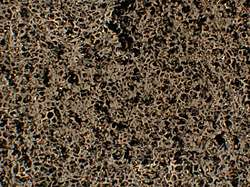
This microscope image of the remains of upholstery foam with carbon nanofiber additives after a burn test shows that the nanofibers in the foam retained their initial arrangement during the combustion process, forming an insulating structure with an extremely low density. Researchers believe that this “carbon foam” acts as a sponge to absorb the molten foam during burning and to prevent dripping. (Image shows a sample 24 millimeters across.)

(PhysOrg.com) -- Carbon, the active ingredient in charcoal, is normally not considered a fire retardant, but researchers at the National Institute of Standards and Technology have determined that adding a small amount of carbon nanofibers to the polyurethane foams used in some upholstered furniture can reduce flammability by about 35 percent when compared to foam infused with conventional fire retardants.

Laws require mattresses and upholstered furniture sold in California and used in public spaces such as hotels and offices be treated with fire retardants or barrier fabrics to minimize fire fatalities and injuries and to cut damage costs. According to the National Fire Protection Association, the total burden of fire in the United States was about $270 billion in 2005.

Ten years ago, NIST scientists found that nanoclays could be used as an effective fire retardant additive, but researchers have been seeking alternatives because nanoclay flame retardants do not prevent the melting and dripping of polyurethane foam when exposed to a fire. This molten foam accelerates the burning rate by as much as 300 percent. “It also creates so much smoke that it is a life-safety hazard,” said Jeff Gilman, leader of the Materials Flammability Group in the Building and Fire Research Laboratory.

Researchers added carbon nanofibers to the foam because they knew that adding nanoparticles to a polymer normally increases the viscosity, so it doesn’t flow as easily. “The carbon nanofibers help prevent the foam from dripping in a pool under the furniture and increasing the fire intensity,” Gilman said. Studies of the foam after the experiments showed that carbon nanofibers seemed to create a thermally stable, entangled network that kept the foam from dripping.

NIST fire researchers have traditionally used upholstered furniture to study its flammability, but in this study, they developed a small-scale technique for evaluating the effect of dripping and pooling on foam flammability. About the size of a slice of toast, the foam samples were treated with one of six combinations of carbon nanofibers or conventional clay flame retardants. The foam “toast” was suspended vertically over a pan, ignited, and the amount of drip was measured. The foam with carbon nanofibers did not drip.

“These small-scale experiments correlate well with the fire behavior of larger foam samples and are easier and less expensive to conduct,” said Gilman. “The small-scale tests will allow us to cost-effectively perform more experiments and help us find an optimal fire retardant faster.”

“Carbon nanofibers are still more expensive than conventional flame retardant materials, but because the price is decreasing and so little needs to be used, they could soon be an affordable and effective option,” Gilman explained.

NIST fire scientists will continue to study the mechanisms that reduce flammability and dripping and work with chemical companies, nano-additive suppliers, flame retardant suppliers and foam manufacturers to test new blends of foam and carbon nanofibers to improve flame retardant material. Additionally, new work is planned to develop sustainable, environmentally friendly fire retardants using cellulosic nanofibers and testing other innovative fire retardant approaches.

Provided by NIST


print this article email this article download pdf blog this article bookmark this article     Digg this Stumble it share on Facebook share on Reddit add to delicious save to Yahoo! bookmarks
4.3/5 after 8 votes

Rank Filter

Move the slider to adjust rank threshold, so that you can hide some of the comments.


Display comments: newest first

  • barakn - Dec 10, 2008
    • Rank: 2 / 5 (2)
    It's too bad carbon nanofibers are suspected of acting like asbestos. I certainly don't want them in my furniture.

December 10th, 2008 all stories
Nanotechnology / Nanomaterials

Comments: 1
Rank: 4.3/5 after 8 votes

  • Stumble this up

  • Digg this

  • Share it:
  • share on Facebook
  • share on MySpace
  • share on Slashdot
  • rss-newsfeed
  • share on Google
  • share on Reddit
  • add to delicious
  • save to Yahoo! bookmarks
  • share on Windows Live
  • Add to Mixx!
Rating: 4.3/5 after 8 votes


  • Physicists Demonstrate Quantum Memory with Matter Qubits
    Physicists Demonstrate Quantum Memory with Matter Qubits
    Physics / General Physics
    created Jul 03, 2009 | popularity 4.4 / 5 (17) | comments 1
  • 'Holey' Nanosheets for Wastewater Dye Removal
    Nanotechnology / Nanomaterials
    created Jul 01, 2009 | popularity 5 / 5 (5) | comments 1
  • Jellyfish Robot Swims Like its Biological Counterpart
    Jellyfish Robot Swims Like its Biological Counterpart
    Electronics / Robotics
    created Jun 26, 2009 | popularity 4.4 / 5 (8) | comments 1
  • Could Maxwell's Demon Exist in Nanoscale Systems?
    Could Maxwell's Demon Exist in Nanoscale Systems?
    Physics / General Physics
    created Jun 24, 2009 | popularity 4.4 / 5 (18) | comments 29
  • Living Safely with Robots, Beyond Asimov's Laws
    Living Safely with Robots, Beyond Asimov's Laws
    Electronics / Robotics
    created Jun 22, 2009 | popularity 4.6 / 5 (53) | comments 40
  • Other News

    Canadian researchers set to study impact of nanomaterials on aquatic ecosystems

    Nanotechnology / Bio & Medicine

    created 12 minutes ago | popularity not rated yet | comments 0

    A team of Canadian scientists and engineers, led by the University of Alberta and the National Research Council of Canada, will collaborate on a $3.39 million, three-year study to assess the potential effects of nanoparticles ...


    Nano Measurement in the 3rd Dimension

    Nano Measurement in the 3rd Dimension

    Nanotechnology / Nanophysics

    created 1hour ago | popularity 3 / 5 (1) | comments 0

    From the motion sensor to the computer chip - in many products of daily life components are used whose functioning is based on smallest structures of the size of thousandths - or even millionths - of millimetres. ...


    A 'quantum of sol' -- how nanotechnology could hold the key to a solar-powered future

    A 'quantum of sol' -- how nanotechnology could hold the key to a solar-powered future

    Nanotechnology / Nanomaterials

    created Jun 30, 2009 | popularity 3.9 / 5 (16) | comments 17

    (PhysOrg.com) -- A new generation of 'nano-structured' millimetre-sized solar cells that could convert the sun's energy to electricity more than twice as efficiently as current technology, is the subject of ...


    Australian researchers are set to begin human trials of a tiny nano-cell that acts as a "Trojan horse" against cancer

    Hi-tech 'Trojan horse' can kill cancer cells: researchers

    Nanotechnology / Bio & Medicine

    created Jun 29, 2009 | popularity 4.7 / 5 (12) | comments 7

    Australian researchers are set to begin human trials of a tiny nano-cell that acts as a "Trojan horse" against cancer cells, a breakthrough they say may curb the need for debilitating chemotherapy.


    'Holey' Nanosheets for Wastewater Dye Removal

    Nanotechnology / Nanomaterials

    created Jul 01, 2009 | popularity 5 / 5 (5) | comments 1

    (PhysOrg.com) -- Researchers have discovered that extremely thin sheets of nickel oxide with hexagonally shaped holes can absorb hazardous dyes from wastewater nearly as well as the best traditional methods, but are recyclable. ...