Oscillation Rules as the Pacific Cools
December 10, 2008 Oscillation Rules as the Pacific Cools

Enlarge

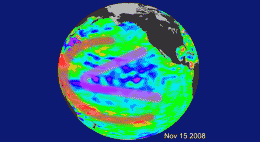
A cool wedge of lower-than-normal sea-surface heights continues to dominate the tropical Pacific, ringed by a horseshoe of warmer waters. The continuation of this long-term cool phase of the Pacific Decadal Oscillation stacks the odds against a wetter-than-average winter/spring in the southwestern United States. Image credit: NASA/JPL

(PhysOrg.com) -- The latest image of sea-surface height measurements from the U.S./French Jason-1 oceanography satellite shows the Pacific Ocean remains locked in a strong, cool phase of the Pacific Decadal Oscillation, a large, long-lived pattern of climate variability in the Pacific associated with a general cooling of Pacific waters. The image also confirms that El Niņo and La Niņa remain absent from the tropical Pacific.

The image is based on the average of 10 days of data centered on Nov. 15, 2008, compared to the long-term average of observations from 1993 through 2008. In the image, places where the Pacific sea-surface height is higher (warmer) than normal are yellow and red, and places where the sea surface is lower (cooler) than normal are blue and purple. Green shows where conditions are near normal. Sea-surface height is an indicator of the heat content of the upper ocean.

The Pacific Decadal Oscillation is a long-term fluctuation of the Pacific Ocean that waxes and wanes between cool and warm phases approximately every five to 20 years. In the present cool phase, higher-than-normal sea-surface heights caused by warm water form a horseshoe pattern that connects the north, west and southern Pacific. This is in contrast to a cool wedge of lower-than-normal sea-surface heights spreading from the Americas into the eastern equatorial Pacific. During most of the 1980s and 1990s, the Pacific was locked in the oscillation's warm phase, during which these warm and cool regions are reversed. For an explanation of the Pacific Decadal Oscillation and its present state, see: http://jisao.washington.edu/pdo/ and http://www.esr.org/pdo_index.html .

Sea-surface temperature satellite data from the National Oceanic and Atmospheric Administration mirror Jason sea-surface height measurements, clearly showing a cool Pacific Decadal Oscillation pattern, as seen at: http://www.cdc.noaa.gov/map/images/sst/sst.anom.gif .

"This multi-year Pacific Decadal Oscillation 'cool' trend can cause La Niņa-like impacts around the Pacific basin," said Bill Patzert, an oceanographer and climatologist at NASA's Jet Propulsion Laboratory, Pasadena, Calif. "The present cool phase of the Pacific Decadal Oscillation will have significant implications for shifts in marine ecosystems, and for land temperature and rainfall patterns around the Pacific basin."

According to Nathan Mantua of the Climate Impacts Group at the University of Washington, Seattle, whose research contributed to the early understanding of the Pacific Decadal Oscillation, "Even with the strong La Niņa event fading in the tropics last spring, the North Pacific's sea surface temperature anomaly pattern has remained strongly negative since last fall. This cool phase will likely persist this winter and, perhaps, beyond. Historically, this situation has been associated with favorable ocean conditions for the return of U.S. west coast Coho and Chinook salmon, but it translates to low odds for abundant winter/spring precipitation in the southwest (including Southern California)."

Jason's follow-on mission, the Ocean Surface Topography Mission/Jason-2, was successfully launched this past June and will extend to two decades the continuous data record of sea surface heights begun by Topex/Poseidon in 1992. The new mission has produced excellent data, which have recently been certified for operational use. Fully calibrated and validated data for science use will be released next spring.

Provided by NASA


print this article email this article download pdf blog this article bookmark this article     Stumble it Digg this share on Facebook retweet share on Reddit add to delicious
Rate this story - 4.8 /5 (16 votes)

Rank Filter

Move the slider to adjust rank threshold, so that you can hide some of the comments.


Display comments: newest first

  • MikeB - Dec 10, 2008
    • Rank: 2.7 / 5 (9)
    "During most of the 1980s and 1990s, the Pacific was locked in the oscillation's warm phase, during which these warm and cool regions are reversed."
    "The latest image of sea-surface height measurements from the U.S./French Jason-1 oceanography satellite shows the Pacific Ocean remains locked in a strong, cool phase of the Pacific Decadal Oscillation, a large, long-lived pattern of climate variability in the Pacific associated with a general cooling of Pacific waters."

    Hmmm, I guess this is why it's been getting cooler... and this is a long term trend?
    Interesting, very interesting.

    I wonder if this new, long-term cool phase we are entering is also caused by CO2.
  • GrayMouser - Dec 10, 2008
    • Rank: 2.7 / 5 (9)
    "I wonder if this new, long-term cool phase we are entering is also caused by CO2."

    Now your getting the hang of it.
  • deepsand - Dec 10, 2008
    • Rank: 3 / 5 (10)
    The lack of understanding of basic physics as above exhibited by both is appalling.

    'Tis interesting to note that those with the least understanding are those with the most to say.

    To quote Abraham Lincoln, "Better to remain silent, and be thought the fool, than to speak and remove all doubt."

  • mikiwud - Dec 11, 2008
    • Rank: 3.3 / 5 (7)
    deepsand,
    I think you will find it is sarcasm. Because the only "proof" put forward by warmists is based on the Sayings of Big Al,Little Jim and Co, we need a bit of it to keep our sanity and lighten the mood. Obviously you did not get it. This article shows that CO2 is not everything,but what the hell.
    CO2 can not warm water. The ocean mass is vastly greater than the atmosphere so energy transfer from the atmosphere is very limited.So, ocean heating must be from geothermal sources or...The Sun. But we know from the Goricle etc that the sun variations do not effect the earth.It's in the gospel of the Gori (pronounced GOR-HI as in Ori in Stargate SG1)
    Hallowed are the Gori,NOT
  • MikeB - Dec 11, 2008
    • Rank: 3.7 / 5 (6)
    "The lack of understanding of basic physics as above exhibited by both is appalling."

    Asking questions is bad?
  • Velanarris - Dec 11, 2008
    • Rank: 2.7 / 5 (7)
    The lack of understanding of basic physics as above exhibited by both is appalling.

    'Tis interesting to note that those with the least understanding are those with the most to say.

    To quote Abraham Lincoln, "Better to remain silent, and be thought the fool, than to speak and remove all doubt."

    Make sure you fire this comment over to the AGCC proponents that can't find ANY of the telltale markers of CO2 based AGCC.
  • agg - Dec 11, 2008
    • Rank: 3.3 / 5 (7)
    The "between the lines" message of this article is ocean currents are extremely complex, tied into the global weather system and understood by no one. Shouting about trends in a system that no one can fathom is ... politics, greed, corruption, misguided and naive - everything science wishes it wasn't.
  • GuruShabu - Dec 11, 2008
    • Rank: 3.9 / 5 (7)
    None of the climate models used presently predict "El Niņo". Not to mention "La Niņa". So, the bottom line is all those climate models are speculative but unfortunately, people and the media keep on presenting them as hard fact. Early in the 70s it was predicted that the global temperature average would increase by 1.4C and now we found out it merely went up about .3 to .4C. This is an error of 300%. When Phoenix landed on Mars Nasa's error was about 14s over a time span of about 22 months. NASA guys know what they are talking about. If climate alarmists were to invest your money would you trust someone making a 300% error?
    Agg is right. Those climatic trends in fact show only greed, corruption, misguided and naīve behaviour not real science.
  • Velanarris - Dec 12, 2008
    • Rank: 3.3 / 5 (7)
    Even more basic than that, they fail to accurately predict or account for clouds, which are a fundamental aspect of both weather and climate.
  • Noein - Dec 12, 2008
    • Rank: 2 / 5 (6)
    This article affirms my deep religious faith in global warming denialism. It so clearly proves that CO2 doesn't exist and that humans have no effect on the environment whatsoever. CO2 is just a conspiracy made up by scientists to steal money from me. Carbon taxes! Volcanoes!
  • GrayMouser - Dec 14, 2008
    • Rank: 4.6 / 5 (5)
    This article affirms my deep religious faith in global warming denialism. It so clearly proves that CO2 doesn't exist and that humans have no effect on the environment whatsoever. CO2 is just a conspiracy made up by scientists to steal money from me. Carbon taxes! Volcanoes!


    What it proves is that the oceans are the largest energy moderator on the planet.
  • barakn - Dec 14, 2008
    • Rank: 2.8 / 5 (4)
    GuruShabu said:
    None of the climate models used presently predict "El Niņo". Not to mention "La Niņa".

    http://meteora.uc...ino.html
    http://www.bom.go...ma.shtml
    http://ddb.kishou...#outlook
    http://gmao.gsfc....ndex.cgi
    http://www.cpc.nc...TMon.gif
    http://www.ecmwf....blic_s3/
    And here http://www.ucar.e.../elnino/ we read that "In 1986, a milestone was reached when the El Niņo beginning late that year was successfully predicted months in advance by a computer model at Lamont-Doherty Earth Observatory of Columbia University."
    Oh my. Not only do they predict ENSO oscillations, they've been doing so for over 2 decades. Please stop spreading falsehoods.
  • mikiwud - Dec 15, 2008
    • Rank: 3.7 / 5 (3)
    barakn,
    I think what GuruShabu should have said is that although El Nino and La Nina can be predicted,this knowledge is not incorporated into IPCC "models" as CO2 is the only driver taken into account or the whole premis of AGW falls down. This also applies to other variables such as Solar.
  • Nartoon - Jan 11, 2009
    • Rank: 1 / 5 (1)
    "the North Pacific's sea surface temperature anomaly pattern has remained strongly negative since last fall. This cool phase will likely persist this winter and, perhaps, beyond."

    Huh, the warm phase lasted through the 80's and 90's but the cool phase may persist past this winter? Give me a break!

December 10, 2008 all stories

Comments: 14

4.8 /5 (16 votes)
  • Stumble this up

  • Digg this

  • share this

  • hide
  • Related Stories

  • Past regional cold and warm periods linked to natural climate drivers
    created 4 hours ago | popularity not rated yet | comments 0
  • Global warming cycles threaten endangered primate species
    created Oct 27, 2009 | popularity not rated yet | comments 0
  • Study: Small fluctuations in solar activity, large influence on the climate
    created Aug 27, 2009 | popularity not rated yet | comments 0
  • 2008 Was Earth's Coolest Year Since 2000
    created Feb 23, 2009 | popularity not rated yet | comments 0
  • Brainy genes, not brawn, key to success on mussel beach
    created Oct 09, 2008 | popularity not rated yet | comments 0


  • hide
  • Relevant PhysicsForums posts

  • The IPCC and the term "most"
    created Nov 23, 2009
  • Is global warming a fact?
    created Nov 23, 2009
  • Random variability of wind patterns
    created Nov 23, 2009
  • Record precipitation in the UK
    created Nov 22, 2009
  • More from Physics Forums - Earth

Other News

Past regional cold and warm periods linked to natural climate drivers

Space & Earth / Earth Sciences

created 4 hours ago | popularity 5 / 5 (4) | comments 6

Intervals of regional warmth and cold in the past are linked to the El Niņo phenomenon and the so-called "North Atlantic Oscillation" in the Northern hemisphere's jet stream, according to a team of climate scientists. These ...


Russia: no space for space tourists (AP)

Russia: no space for space tourists

Space & Earth / Space Exploration

created 12 hours ago | popularity 2.7 / 5 (3) | comments 2

(AP) -- A top Russian space official says there is no space for tourists wishing to fly to the International Space Station.


Astronauts surprised by holiday turkey dinners (AP)

Astronauts surprised by holiday turkey dinners

Space & Earth / Space Exploration

created 7 hours ago | popularity not rated yet | comments 0

(AP) -- Space shuttle Atlantis' astronauts thought they were going to give thanks with pantry leftovers Thursday as their mission drew to a close, but found turkey dinners awaiting them.


Gullies and Flow Features on Crater Wall

Gullies and Flow Features on Crater Wall

Space & Earth / Space Exploration

created 8 hours ago | popularity not rated yet | comments 0

(PhysOrg.com) -- This image from the High Resolution Imaging Science Experiment (HiRISE) camera on NASA's Mars Reconnaissance Orbiter shows a sample of the variety and complexity of processes that may occur ...


Burning coal worse for climate than clearing rain forests

Space & Earth / Environment

created 6 hours ago | popularity 3 / 5 (4) | comments 0

Deforestation has had a big influence on the increase of carbon dioxide (CO2) emissions in the past three centuries, but its impact is tapering off relatively. Nowadays, the burning of fossil fuels is a more crucial factor. ...