Car key jams teen drivers' cell phones
December 11, 2008
A Key to Block Cell Phone Use by Teen Drivers

Enlarge

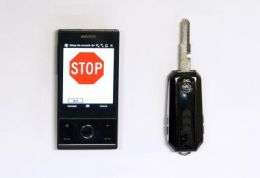
University of Utah engineers have invented a wireless car key device (sample shown at right) to stop teenage motorists from talking on their cell phone or sending text messages while driving. Each driver of a car would have a separate key device. When the key is extended from the device, it sends a signal to the teenage driver's phone, putting the phone in "driving mode" so it cannot be used to talk or send texts. The phone displays a stop sign while in driving mode. The University has licensed the Key2SafeDribving technology to a private company, which hopes to have the device on the market within six months, possibly through cell phone plan providers. Credit: University of Utah

University of Utah researchers have developed an automobile ignition key that prevents teenagers from talking on cell phones or sending text messages while driving.

The university has obtained provisional patents and licensed the invention – Key2SafeDriving – to a private company that hopes to see it on the market within six months at a cost of less than $50 per key plus a yet-undetermined monthly service fee.

"The key to safe driving is to avoid distraction," says Xuesong Zhou, an assistant professor of civil and environmental engineering who co-invented the system with Wally Curry, a University of Utah graduate now practicing medicine in Hays, Kan. "We want to provide a simple, cost-effective solution to improve driving safety."

Zhou notes that "at any given time, about 6 percent of travelers on the road are talking on a cell phone while driving. Also at any given time, 10 percent of teenagers who are driving are talking or texting." Studies have shown drivers using cell phones are about four times more likely to get in a crash than other drivers.

"As a parent, you want to improve driving safety for your teenagers," he says. "You also want to reduce your insurance costs for your teen drivers. Using our system you can prove that teen drivers are not talking while driving, which can significantly reduce the risk of getting into a car accident."

If things go as planned, the Key2SafeDriving system won't be sold directly to consumers by a manufacturer, but instead the technology may be licensed to cell phone service providers to include in their service plans, says Ronn Hartman, managing partner of Accendo LC. The Kaysville, Utah, company provides early stage business consulting and "seed funding." It has licensed the Key2SafeDriving technology from the University of Utah and is working to manufacture and commercialize it.

Hartman envisions gaining automobile and insurance industry backing so that Key2SafeDriving data on cell phone use (or non-use) while driving can be compiled into a "safety score" and sent monthly to insurance companies, which then would provide discounts to motorists with good scores. The score also could include data recorded via Global Positioning System (GPS) satellites on the driver's speeding, rapid braking or running of lights, which are calculated by comparing the driver's position with a database of maps, speed limits, stop lights and so on.

How Key2SafeDriving Works

The system includes a device that encloses a car key – one for each teen driver or family member. The device connects wirelessly with each key user's cell phone via either Bluetooth or RFID (radio-frequency identification) technologies.

To turn on the engine, the driver must either slide the key out or push a button to release it. Then the device sends a signal to the driver's cell phone, placing it in "driving mode" and displaying a "stop" sign on the phone's display screen.

While in driving mode, teen drivers cannot use their cell phones to talk or send text messages, except for calling 911 or other numbers pre-approved by the parents – most likely the parents' own cell numbers.

Incoming calls and texts are automatically answered with a message saying, "I am driving now. I will call you later when I arrive at the destination safely."

When the engine is turned off, the driver slides the key back into the device, which sends a "car stopped" signal to the cell phone, returning it to normal communication mode.

The device can't be "tricked" by turning the phone off and on again because the phone will receive the "driving mode" signal whenever the car key is extended.

Adult drivers cannot text or use a handheld cell phone, but the Key2SafeDriving system does allow them to talk using a hands-free cell phone – even though studies by University of Utah psychologists indicate hands-free phones are just as distracting as handheld phones.

Curry agrees that driving while talking on any cell phone "is not safe," but he says the inventors have to face the practical issue of whether adults would buy a product to completely block their cell phone use while driving.

Limiting some cell calls by adults "is a step in the right direction," he says.

Zhou says the goal for adults is to improve safety by encouraging them to reduce the time they spend talking while driving. The encouragement could come in the form of insurance discounts by insurers, who would receive monthly scores from Key2SafeDriving showing how well an adult driver avoided talking while driving.

The new invention began with Curry, a Salt Lake City native who graduated from the University of Utah with an accounting degree and premedical training in 1993. He returned from the Medical College of Wisconsin for his surgical residency in urology at University Hospital during 1998-2003. He now is a urologist in Hays, Kan.

His concern with driving-while-talking began because, as a doctor, "the hospital is calling me all the time on my cell phone when I'm driving."

One day while driving home, he saw a teenage girl texting while driving, making him worry about his 12- and 14-year-old daughters, who are approaching driving age.

"I thought, this is crazy, there has got to be something to stop this, because not only is she putting people at risk, but so was I," Curry says. "It struck me pretty hard that something should be done."

Curry's initial idea was a GPS system to detect a moving cell phone and disable it when it moved at driving speeds. Meanwhile, someone else developed a similar system based on the same idea. But it cannot distinguish if the cell phone user is driving a car or is a passenger in a moving car, bus or train – a problem overcome by Key2SafeDriving.

In early 2008, Curry called Larry Reaveley, a civil engineering professor at the University of Utah, who suggested Curry contact Zhou, a specialist in "intelligent" transportation systems. Zhou and Curry then came up with the idea of blocking cell phone usage via a vehicle ignition key.

Zhou, a native of Liuzhou, China, joined the University of Utah faculty in early 2007. He received his Ph.D. degree from the University of Maryland in 2004. He has worked for a California company that sold a product that provides traffic information to motorists using GPS satellites.

Additional information about Key2SafeDriving are available at:
http://www.Key2SafeDriving.net

Source: University of Utah

3.1 /5 (13 votes)  

Filter


Move the slider to adjust rank threshold, so that you can hide some of the comments.


Display comments: newest first

Stratford
Dec 11, 2008

Rank: 4 / 5 (5)
I rarely use a cell phone when my car is moving. However, on several occasions when I have done so, I had VERY close calls - these "almost accidents" would have been my fault. I also have had the experience of being rear-ended by a kid talking on a cell phone and also of broadsiding another motorist who ran a stoplight while she was yapping on a cell phone.

Keep in mind that it wasn't many years ago that cell phones did not exist except in the world of Star Trek science fiction. We got along just fine then without that type of distraction - need to use the phone, just stop at a telephone booth. There also are places where it is illegal to use a cell phone in a car because of the distraction and enhanced potential for having accidents. I can't say that I disagree, because I know first hand how distracted I am during those few moments when I succumb to the urge to make a call while driving.

Soooooo... What can I say? Definitely NOT "DUM DUM DUMMMMM"! Excellent idea, but probably not one that reaches far enough.
T3chWarrior
Dec 11, 2008

Rank: 2.5 / 5 (4)
whats the radius, will it affect other users or only teens :P seriously if it is against the law to use a cell jammer in a prison, then why should it be allowed on the road. it may save lives, but so would banning tabacco. you want accidents from cell phone users to stop. start crying about the police not doing anything about it. how many people do you know that have had a ticket because of cell phone use. NOT ENUOUGH

this is not the answer.
MGraser
Dec 11, 2008

Rank: 4 / 5 (3)
Once I read that 911 was allowed, I breathed easier. But, I have a nagging feeling it may lead to unexpected trouble.
LWM
Dec 11, 2008

Rank: 3 / 5 (1)
T3 - Not a jammer, you have to have their software. It works through blue-tooth or RF.
Nobody will buy this. You have to have their software and probably only certain phones...no kid will go for it.
PPihkala
Dec 11, 2008

Rank: 2 / 5 (1)
Kids will use it if their parents who pay the bills will make them to use it or be without a phone or a car. Adults could also get it if the lowered insurance is enough of a lure to do so. But there are pitfalls in this. First one may use other key. Or they may leave the keyholder device at home. Or they may have two phones. Maybe other ways to circumvent that too. Maybe by hacking the phone's software. Or to put the keyholder into radiation proof (metal) box, to prevent it signaling to phone.
jonnyboy
Dec 11, 2008

Rank: 3 / 5 (2)
R U F@#$@#$ kiding me? How long is it going to take for that teenager to have a key made at the local locksmith so that he (or she) doesnt have to use the one with this device.

Another example of sky in the pie engineering.
Excalibur
Dec 12, 2008

Rank: 5 / 5 (1)
R U F@#$@#$ kiding me? How long is it going to take for that teenager to have a key made at the local locksmith so that he (or she) doesnt have to use the one with this device.

Another example of sky in the pie engineering.

Today's electronic keys CANNOT be duplicated with a key cutter alone. Without a properly encoded key, the ignition system will not work.
barracudacx
Dec 13, 2008

Rank: not rated yet
California last year passed a law requiring most car manufacturers to provide their key codes to licensed locksmiths. The law took effect Jan. 1, 2008. It was sponsored by the American Automobile Association and opposed by many luxury car makers, who said it could compromise vehicle security. The law exempts a handful of manufacturers, including Mercedes-Benz, BMW, and Jaguar, until 2013. So how long is it going to take to find a locksmith willing to make a copy of daddy's key that is stuck in this "device"? This may be difficult, however, it proves this would only be 80% effective.
barracudacx
Dec 14, 2008

Rank: 5 / 5 (1)
Also if the family had AT&T or a GSM cell phone provider this would be pointless. The child could easily remove the sim card from their phone and place it in a cheap $9.99 AT&T GoPhone and bypass the restriction entirely.
cecilUU
Dec 26, 2008

Rank: not rated yet
All of you are missing the point, it's deterrence. Make it a little more difficult and chances are they won't be using their cell phones while driving. Yes, there are probably many ways around it but that takes a great deal of effort.
Rank 3.1 /5 (13 votes)
Related Stories
Relevant PhysicsForums posts
  • Does anyone make a small high temperature and high pressure pump?
    created6 hours ago
  • Strange indexing in Fortran Code
    created17 hours ago
  • Car Port post load calculation
    created18 hours ago
  • attempting to spin-cast parabola
    createdFeb 07, 2012
  • Flow around a reducing bend - effect on pumping work
    createdFeb 06, 2012
  • Formula for deflection of 6061 T6 hollow tube, please help.
    createdFeb 06, 2012
  • More from Physics Forums - General Engineering

More news stories

Scientists break satellite telephony security standards

Satellite telephony was thought to be secure against eavesdropping. German researchers at the Horst Gortz Institute for IT-Security (HGI) at the Ruhr University Bochum (RUB) have cracked the encryption algorithms of the European ...

Technology / Computer Sciences

created 5 hours ago | popularity 5 / 5 (2) | comments 0 | with audio podcast

Solar start-ups set new efficiency records

(PhysOrg.com) -- Although Alta Devices and Semprius make different types of solar panels, both start-ups have been breaking records in the past few days. Santa Clara, Calif.-based Alta Devices announced that ...

Technology / Energy & Green Tech

created 10 hours ago | popularity 4.9 / 5 (10) | comments 8 | with audio podcast report

Amazon strikes video deal with Viacom

Amazon announced a deal with entertainment giant Viacom on Wednesday, building up its arsenal of television shows as it takes on video streaming market leader Netflix.

Technology / Business

created 3 hours ago | popularity not rated yet | comments 0

Rambus, Nvidia sign patent licensing deal

Technology licensing company Rambus Inc. said Wednesday it has signed a licensing agreement with chip maker Nvidia Corp. to settle a long-running patent dispute.

Technology / Business

created 3 hours ago | popularity 3 / 5 (1) | comments 0

Darpa's Legged Squad Support System (LS3) to lighten troops' load

Today’s dismounted warfighter can be saddled with more than 100 pounds of gear, resulting in physical strain, fatigue and degraded performance. Reducing the load on dismounted warfighters has become a ...

Technology / Engineering

created 6 hours ago | popularity 4.8 / 5 (5) | comments 9


Short fasting cycles work as well as chemotherapy in mice

Man may not live by bread alone, but cancer in animals appears less resilient, judging by a study that found chemotherapy drugs work better when combined with cycles of short, severe fasting.

Physicists build highly efficient 'no-waste' laser

A team of University of California, San Diego researchers has built the smallest room-temperature nanolaser to date, as well as an even more startling device: a highly efficient, "thresholdless" laser that ...

Study shows how DNA finds its match

It's been more than 50 years since James Watson and Francis Crick showed that DNA is a double helix of two strands that complement each other. But how does a short piece of DNA find its match, out of the millions ...

Transparent iron? For the first time, an experiment shows that atomic nuclei can become transparent

At the high-brilliance synchrotron light source PETRA III, a team of DESY scientists headed by Dr. Ralf Röhlsberger has succeeded in making atomic nuclei transparent with the help of X-ray light. At the ...

'Explorers,' who embrace the uncertainty of choices, use specific part of cortex

Life shrouds most choices in mystery. Some people inch toward a comfortable enough spot and stick close to that rewarding status quo. Out to dinner, they order the usual. Others consider their options systematically ...

Scientists delve into the brain roots of hunger and eating

Synaptic plasticity – the ability of the synaptic connections between the brain's neurons to change and modify over time -- has been shown to be a key to memory formation and the acquisition of new learning behaviors. ...