Astronomers use ultra-sensitive camera to measure size of planet orbiting star
December 11, 2008
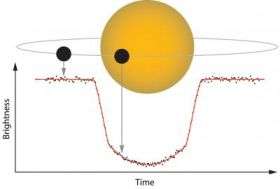
When the planet WASP-10b crosses the disk of its star, WASP-10, the brightness of the star decreases, allowing scientists to measure the precise size of the planet. Credit: Institute for Astronomy, University of Hawaii at Manoa
A team of astronomers led by John Johnson of the University of Hawaii's Institute for Astronomy has used a new technique to measure the precise size of a planet around a distant star. They used a camera so sensitive that it could detect the passage of a moth in front of a lit window from a distance of 1,000 miles.
The camera, mounted on the UH 2.2-meter telescope on Mauna Kea, measures the small decrease in brightness that occurs when a planet passes in front of its star along the line-of-sight from Earth. These "planet transits" allow researchers to measure the diameters of worlds outside our solar system.
"While we know of more than 330 planets orbiting other stars in our Milky Way galaxy, we can measure the physical sizes of only the few that line up just right to transit," explains Johnson. The team studied a planet called WASP-10b, which was thought to have an unusually large diameter. They were able to measure its diameter with much higher precision than before, leading to the finding that it is one of the densest planets known, rather than one of the most bloated. The planet orbits the star WASP-10, which is about 300 light-years from Earth.
IfA astronomer John Tonry designed the camera, known as OPTIC (Orthogonal Parallel Transfer Imaging Camera), and it was built at the IfA. It uses a new type of detector, an orthogonal transfer array, the same type used in the Pan-STARRS 1.4 Gigapixel Camera, the largest digital camera in the world. These detectors are similar to the CCDs (charge-coupled devices) commonly used in scientific and consumer digital cameras, but they are more stable and can collect more light, which leads to higher precision.
"This new detector design is really going to change the way we study planets. It's the killer app for planet transits," said team member Joshua Winn of MIT. The precision of the camera is high enough to detect transits of much smaller planets than previously possible. It measures light to a precision of one part in 2,000. For the first time, scientists are approaching the precision needed to measure transits of Earth-size planets.
Bigger planets block more of the star's surface and cause a deeper brightness dip. The diameter of WASP-10b is only 6 percent larger than that of Jupiter, even though WASP-10b is three times more massive. Correspondingly, its density is about three times higher than Jupiter's. Because their interiors become partially degenerate, Jovian planets have a nearly constant radius across a wide range of masses.
The photometric precision is three to four times higher than that of typical CCDs and two to three times higher than the best CCDs, and comparable to the most recent results from the Hubble Space Telescope for stars of the same brightness.
The scientific paper presenting this discovery will be published in the Astrophysical Journal Letters. A preprint is available on the Web at http://arxiv.org/abs/0812.0029 .
Source: University of Hawaii at Manoa
-
NRL's SoloHI instrument selected for flight on solar orbiter mission
Jan 24, 2012 |
not rated yet |
0
-
UA makes mirrors for world's largest telescope
Jan 18, 2012 |
4.8 / 5 (5) |
1
-
Subaru's sharp eye confirms signs of unseen planets in the dust ring of HR 4796 A
Dec 30, 2011 |
5 / 5 (11) |
1
-
Secrets of the 'Levitating' Slinky: Viral web videos trigger physicists to explore a striking phenomenon
Dec 22, 2011 |
4.4 / 5 (18) |
44
-
New NASA dawn visuals show Vesta's 'color palette'
Dec 06, 2011 |
5 / 5 (9) |
0
-
Engineers build first sub-10-nm carbon nanotube transistor
Feb 01, 2012 |
4.9 / 5 (33) |
30
-
Something old, something new: Evolution and the structural divergence of duplicate genes
Jan 31, 2012 |
4.6 / 5 (7) |
1
-
The hidden nanoworld of ice crystals: Revealing the dynamic behavior of quasi-liquid layers
Jan 30, 2012 |
5 / 5 (5) |
1
-
Stock market network reveals investor clustering
Jan 27, 2012 |
3.9 / 5 (23) |
8
-
Of microchemistry and molecules: Electronic microfluidic device synthesizes biocompatible probes
Jan 26, 2012 |
5 / 5 (2) |
0
-
Never ending outer space.....
Feb 11, 2012
-
Neutron Star fragments?
Feb 11, 2012
-
stationary or not?
Feb 11, 2012
-
Scale of the Universe
Feb 10, 2012
-
Titan's lack of impact craters
Feb 09, 2012
-
Real pictures of black hole eating a star?
Feb 08, 2012
- More from Physics Forums - General Astronomy
More news stories
With climate change, today's '100-year floods' may happen every three to 20 years: research
Last August, Hurricane Irene spun through the Caribbean and parts of the eastern United States, leaving widespread wreckage in its wake. The Category 3 storm whipped up water levels, generating storm surges ...
34 minutes ago |
2.3 / 5 (3) |
0
|
China's pollution puts a dent in its economy
Although China has made substantial progress in cleaning up its air pollution,a new MIT study shows that the economic impact from ozone and particulates in its air has increased dramatically. ...
11 minutes ago |
not rated yet |
0
New European rocket lifts off on maiden flight
A lightweight rocket aimed at securing Europe a stake in the market to launch small satellites lifted off from Kourou space base on its maiden flight on Monday.
Space & Earth / Space Exploration
1 hour ago |
5 / 5 (4) |
1
Climate change causes harmful algal blooms in North Atlantic: study
Warming oceans and increases in windiness could be causing of an abundance of harmful algal blooms in the North Atlantic Ocean and North Sea, according to new research.
3 hours ago |
not rated yet |
0
NASA budget will axe Mars deal with Europe: scientists
US President Barack Obama's budget proposal to be submitted next week for 2013 will cut NASA's budget by 20 percent and eliminate a major partnership with Europe on Mars exploration, scientists said Thursday.
Space & Earth / Space Exploration
Feb 10, 2012 |
5 / 5 (4) |
59
Researchers make better heat sensor based on butterfly wings
(PhysOrg.com) -- Scientists have long known that butterfly wings produce their iridescent colors by bouncing light around and between tiny ridges in structures made of chitin. More recently they’ve discovered ...
Manipulating genes with hidden TALENs
(PhysOrg.com) -- A better understanding of gene function in model plant and animal systems could be used to develop useful traits in livestock and crop plants, and might someday lead to developments in stem ...
The joy of cheques
An electronic cheque which eliminates the need for costly processing by banks but preserves the simplicity and ease of a traditional cheque book has been designed by a team of academics in the UK.
Research shows promise in converting camelina oil into jet fuel
(PhysOrg.com) -- Researchers at Montana State University-Northern have developed a process to convert camelina oil to jet fuel and other high-value chemicals. MSU has applied for a U.S. patent and research is ongoing.
Couples in the same place emotionally stay together, study says
(Medical Xpress) -- Despite lifes ups and downs, couples whose feelings are in sync consistently over time are more likely to stay together, says a University of California, Davis, study.
Researchers make breakthrough in stem cell research
(Medical Xpress) -- University of Queensland scientists have developed a world-first method for producing adult stem cells that will substantially impact patients who have a range of serious diseases.
Dec 11, 2008
Rank: 1.3 / 5 (3)
Event 2 (later that same year): US and ESA and Chinese and Japanese and Russian space program funding is increased by an order of magnitude.
Dec 12, 2008
Rank: 2.3 / 5 (3)
Yay for funding!
Dec 12, 2008
Rank: 1 / 5 (1)
Yet, it might be some time before that. The planets found until now are about the size of Jupiter! the diameter of earth is roughly 11 times smaller. The way we would see such a planet is 11^2 = 121 times smaller!
It would take a much more senstive camera to be able to see that one.
Not to mention the following situation: what happens if a earth like planet AND a jupiter like planet would go in front of a star? How would we know the measurement would be influenced by a planet that is 120 times smaller. At this moment the fluctuation would be considered as noise and not taken into account.
Like I stated earlier. It will be possible but with a much more sensitive camera. After that, it might be possible to detect water etc. with spectroscopic techniques that will be improved also at that time.
When that has happened I also hope that space programs will be funded more than they are now. And I hope they will work together as well...
Dec 15, 2008
Rank: 2.5 / 5 (2)