Drama in the heart of the Tarantula
December 11, 2008 Drama in the heart of the Tarantula

Enlarge

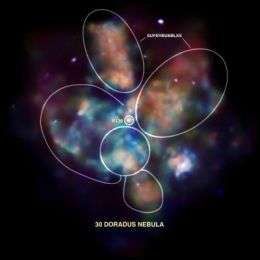
This version of the Chandra image of 30 Doradus outlines where the superbubbles have been carved into cooler surrounding dust and gas by intense radiation and searing winds from massive stars. Credit: NASA/CXC/Penn State/L. Townsley

Found in the nearby Large Magellanic Cloud, 30 Doradus is one of the largest massive star forming regions close to the Milky Way. Enormous stars in 30 Doradus, also known as the Tarantula Nebula, are producing intense radiation and searing winds of multimillion-degree gas that carve out gigantic bubbles in the surrounding cooler gas and dust.

Other massive stars have raced through their evolution and exploded catastrophically as supernovae, expanding these bubbles into X-ray-brightened superbubbles. They leave behind pulsars as beacons of their former lives and expanding supernova remnants that trigger the collapse of giant clouds of dust and gas to form new generations of stars.

At the center of 30 Doradus lies the star cluster R136 at the intersection of three of these superbubbles. However, with ages only between one and two million years old, the stars in R136 are too young to be source of the supernovae that brighten the superbubbles in X-rays. Instead, R136 is most likely just the latest cluster to form in 30 Doradus. It may be as massive as it is because these superbubbles have combined to concentrate their gas in this region and thus triggered intense star formation there.

30 Doradus is about 160,000 light years from Earth in the southern constellation of Dorado. It spans 800 light years across and is incredibly bright in many wavelengths. If it were at the distance of the Orion Nebula (1,300 light years), 30 Doradus would span the area of 60 full Moons and its optical light would be bright enough to cast shadows at night on the Earth. This latest X-ray image of 30 Doradus represents almost 114,000 seconds, or 31 hours, of Chandra observing time – three times longer than previously recorded. In this image, red represents the lower range of X-rays that Chandra detects, the medium range is green, while the highest-energy X-rays are blue.

Source: Chandra X-ray Center


print this article email this article download pdf blog this article bookmark this article     Stumble it Digg this share on Facebook retweet share on Reddit add to delicious
Rate this story - 3.7 /5 (7 votes)


December 11, 2008 all stories

Comments: 0

3.7 /5 (7 votes)
  • Stumble this up

  • Digg this

  • share this

  • hide
  • Related Stories

  • Fermi Telescope Detects Gamma-Ray From 'Star Factories' in Other Galaxies
    created Nov 02, 2009 | popularity not rated yet | comments 0
  • A trio of super-Earths
    created Jun 16, 2008 | popularity not rated yet | comments 0
  • Back on track: New technique for observing faint companions
    created Jun 19, 2007 | popularity not rated yet | comments 0
  • Portrait of a dramatic stellar crib
    created Dec 21, 2006 | popularity not rated yet | comments 0
  • Revealing the mysteries of galaxy formation
    created Nov 01, 2006 | popularity not rated yet | comments 0


  • hide
  • Relevant PhysicsForums posts

  • The shape of our solar system's orbits.
    created Nov 07, 2009
  • Above or Below the Line of Nodes
    created Nov 07, 2009
  • Supernova vs. Nova?
    created Nov 07, 2009
  • Supernova's Gamma Rays and Comets
    created Nov 06, 2009
  • More from Physics Forums - General Astronomy

Other News

Planetary Society plans new 'solar sail'

Space & Earth / Space Exploration

created 1hour ago | popularity not rated yet | comments 0

(AP) -- Four years after its first solar sail ended up in the ocean instead of orbit, The Planetary Society announced Monday that by the end of 2010 it will try again to launch a spacecraft that will be propelled by the ...


L-R: Chiwetel Ejiofor, Amanda Peet and John Cusack at the premiere of "2012"

NASA on crusade to debunk 2012 apocalypse myths

Space & Earth / Space Exploration

created 7 hours ago | popularity 4 / 5 (1) | comments 1

The world is not coming to an end on December 21, 2012, the US space agency insisted Monday in a rare campaign to dispel widespread rumors fueled by the Internet and a new Hollywood movie.


Antarctica glacier retreat creates new carbon dioxide store

Antarctica glacier retreat creates new carbon dioxide store

Space & Earth / Earth Sciences

created 12 hours ago | popularity 3.5 / 5 (4) | comments 0

Large blooms of tiny marine plants called phytoplankton are flourishing in areas of open water left exposed by the recent and rapid melting of ice shelves and glaciers around the Antarctic Peninsula. This ...


NASA satellites make a movie and get rainfall, wind info on Ida

NASA satellites make a movie and get rainfall, wind info on Ida (w/ Video)

Space & Earth / Earth Sciences

created 7 hours ago | popularity not rated yet | comments 0

NASA satellites are amazing examples of technology. The TRMM satellite peers into tropical cyclones and can tell how much rain is falling per hour and where. QuikScat uses microwave technology to measure Ida's ...


The GOES-12 satellite sees Large Hurricane Ida nearing landfall

The GOES-12 satellite sees Large Hurricane Ida nearing landfall

Space & Earth / Earth Sciences

created 8 hours ago | popularity 5 / 5 (1) | comments 0

Residents of the U.S. Gulf coast thought they were getting a break this hurricane season until Ida showed up. Today, November 9, Ida is a hurricane and is headed for a landfall in the western Florida Panhandle ...