Researchers explain mystery of gravity fingers
December 11, 2008 'Gravity fingers'

Enlarge

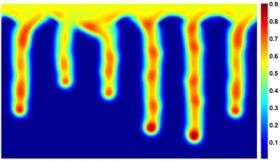
Saturation maps from a numerical simulation of the proposed model show that the flow dynamics and the distinctive saturation overshoot at the tip of the fingers agree with experimental observations. Graphic / Luis Cueto Felgueroso

(PhysOrg.com) -- Researchers at MIT recently found an elegant solution to a sticky scientific problem in basic fluid mechanics: why water doesn't soak into soil at an even rate, but instead forms what look like fingers of fluid flowing downward.

Scientists call these rivulets "gravity fingers," and the explanation for their formation has to do with the surface tension where the water—or any liquid—meets the soil (or other medium). Knowing how to account for this phenomenon mathematically will have wide-ranging impact on science problems and engineering applications, including the recovery of oil from reservoirs and the sequestration of carbon underground.

The solution reported in the Dec. 12 issue of Physical Review Letters involves borrowing a mathematical phrase, if you will, from the mathematical description of a similar problem, a solution both simple and elegant that had escaped the notice of many researchers in earlier attempts to describe the phenomenon.

Co-authors Luis Cueto-Felgueroso and Ruben Juanes of the MIT Department of Civil and Environmental Engineering discovered the solution while studying the larger question of how water displaces oil in underground reservoirs. (Petroleum engineers commonly flush oil reservoirs with water to enhance oil recovery.)

"Our paper addresses a long-standing issue in soil physics," said Cueto-Felgueroso. "Lab experiments of water infiltration into homogeneous, dry soil, repeatedly show the presence of preferential flow in the form of fingers. Yet, after several decades, the scientific community has been unable to capture this phenomenon using mathematical models."

"This was the type of problem that required someone from a different research discipline to take a look at it and come up with the solution," said Juanes, the ARCO Assistant Professor in Energy Studies. "Luis applied his expertise to a fluid mechanics problem in another medium—porous media flows—and quickly figured out the solution."

Cueto-Felgueroso, a post-doctoral associate who has previously worked primarily on airflow fluid mechanics problems, had a Eureka! moment when he realized that gravity fingers in soil (or clay or sand) look very similar to water flowing down a window pane, a fairly well-understood phenomenon. He and Juanes then pulled the mathematical explanation (think of it as a phrase of words or music) from the equation describing water on a window, and included that mathematical phrase in the equation describing liquid moving downward through soil.

After rigorous comparison of data produced by the new mathematical model with observed phenomena, the two realized they'd found the solution, a solution described by one scientist reviewing the paper in Physical Review Letters as "simple and elegant" and a "major breakthrough" in the field.

The Cueto-Felgueroso and Juanes solution also describes one aspect of the water-flowing-down-a-windowpane phenomenon that previously was not understood by scientists, who actually refer to this as "the flow of thin films": why water builds up at the tips of the fingers. Again, the answer has to with the surface tension. Before the water can flow down the film, it must build up enough energy to overcome the tension holding it in place.

So what was missing from earlier models of water moving downward through soil that made it appear to move as a steady, horizontal front, rather than in finger-like paths—even when the soil was homogenous in particle size and shape?

The missing mathematical phrase describes the surface tension of the entire finger of water, which may be several centimeters in width, as opposed to the tension existing at the micron-scale of pores between soil particles.

And that phrase will sound like music to the ears of physicists and engineers.

Source: MIT


print this article email this article download pdf blog this article bookmark this article     Stumble it Digg this share on Facebook retweet share on Reddit add to delicious
Rate this story - 4.3 /5 (23 votes)

Rank Filter

Move the slider to adjust rank threshold, so that you can hide some of the comments.


Display comments: newest first

  • Alizee - Dec 15, 2008
    • Rank: not rated yet
    gravity fingers in soil look very similar to water flowing down a window pane
    This is good insight, indeed - but the correlation isn't always causation, many analogies can become just a homologies under more thorough investigation. While the surface tension forces can affect the water drips on the glass (Marangoni instability, tears of wine phenomena), in soil the propagation of long distance interactions isn't so straightforward for me and it can be explained by another bulk effects. For example, the soil in contact with watter can undergo swelling, which affects the further spreading of fluid through it in simmilar manner, but by completelly different mechanism. Instead of it, water spreading in real multiparticle system analogous to soil should be modelled.
    that phrase will sound like music to the ears of physicists
    The blind tendency of mainstream science to replace the understanding of physical phenomena by postulating of formal models at any price can lead into development of new "epicycles models" of medieval era. In analogy to geocentric model of solar system, suc formal models can work well in certain extent, but true nature of phenomena can still remain quite different. The positivistic approach in science should by always balanced by nonformal one. By AWT the information is spreading through civilization like energy through multiparticle system: the causual (transversal wave based) approach should be always balanced by nonformal and holistic approach (longitudinal waves based) and they cannot be separated each other.
  • Alizee - Dec 15, 2008
    • Rank: not rated yet
    The development of formal models by scientists for engineers is well substantiated due the practical reasons - but in fact it corresponds the production of bronze tools of medieval era without true knowledge about atoms and bronze composition.

    For example, the fact, we can replace description of relativity or quantum mechanics by math still doesn't mean, we understand the nature of QM phenomena, such models still remain sort of complex numeric regression of reality. We can live a long time with such empiric/positivistic approach, but at the certain level of society evolution we're always forced to understand nature of reality at deeper level.

December 11, 2008 all stories

Comments: 2

4.3 /5 (23 votes)
  • Stumble this up

  • Digg this

  • share this

  • hide
  • Related Stories

  • Colorado county copes with methane mystery
    created Nov 02, 2009 | popularity not rated yet | comments 0
  • In search of wildlife-friendly biofuels
    created Oct 01, 2009 | popularity not rated yet | comments 0
  • Gov't stands by as mercury taints water
    created Sep 18, 2009 | popularity not rated yet | comments 0
  • Roadsides, contaminated fields could be unlikely solutions to fuel shortages, water pollution
    created Aug 12, 2009 | popularity not rated yet | comments 0
  • Moon potential goldmine of natural resources
    created Jul 16, 2009 | popularity not rated yet | comments 0


  • hide
  • Relevant PhysicsForums posts

  • How do you separate things from centrifugal force?
    created 2 hours ago
  • Physical Science...need help
    created 2 hours ago
  • Calculating a Damping Constant
    created 3 hours ago
  • Bodies in motionÂ…..
    created 6 hours ago
  • More from Physics Forums - General Physics

Other News

The LHC tunnel

Peckish bird briefly downs big atom smasher

Physics / General Physics

created 16 hours ago | popularity 3.8 / 5 (9) | comments 11

A peckish bird briefly knocked out part of the world's biggest atom smasher by causing a chain reaction with a piece of bread, the European Organisation for Nuclear Research (CERN) said Monday.


First Bose-Einstein condensation of strontium

First Bose-Einstein condensation of strontium

Physics / Quantum Physics

created 9 hours ago | popularity 5 / 5 (4) | comments 1

In an international first, scientists from the Institute of Quantum Optics and Quantum Information (IQOQI, Austria) produced a Bose-Einstein condensate of the alkaline-earth element strontium, thus narrowly ...


Solving big problems

Solving big problems with new quantum algorithm

Physics / Quantum Physics

created 4 hours ago | popularity 4.3 / 5 (10) | comments 0

(PhysOrg.com) -- In a recently published paper, Aram Harrow at the University of Bristol and colleagues from MIT in the United States have discovered a quantum algorithm that solves large problems much faster ...


Contracts Awarded for Production of NSLS-II Storage Ring Magnets

Physics / General Physics

created 2 hours ago | popularity not rated yet | comments 0

(PhysOrg.com) -- All seven contracts for the production of the NSLS-II storage ring magnets have now been awarded -- a significant milestone for the project. The magnets -- 750 in total -- will be made by vendors in the United ...


Ginzburg helped develop the Soviet Union's hydrogen bomb in the late 1940s and early 1950s

Russian bomb physicist Ginzburg dead at 93

Physics / General Physics

created 17 hours ago | popularity 5 / 5 (4) | comments 0

Nobel Physics prize winner Vitaly Ginzburg, who helped develop the Soviet hydrogen bomb, has died at age 93, the Russian Academy of Sciences said Monday.